

Hackaday Links Column Banner

Hackaday Links: May 3, 2026

Software that collects public data from the Internet and uses it to provide half-assed answers to your questions might seem like a modern craze, but today we bid farewell to a website that helped pioneer pretend conversations all the way back in 1997 — as of May 1st, Ask Jeeves is no more.

Well, technically they dropped the “Jeeves” part back in 2006. Since then it’s just been Ask.com, but as the name implies the idea was more or less the same. Rather than the relatively rigid parameters and keywords required by traditional search engines, you could ask Jeeves questions about the world using natural language. Early advertisements showed the virtual valet answering arbitrary questions like “How many calories in a banana?,” which of course today seems commonplace and utterly unimpressive, but was a pretty wild for the 1990s.

It might seem surprising that a site designed from day one to offer a human-like Q&A experience should fold right as such technology is becoming commonplace. But of course, that commonality is the problem. When Google can answer your questions just as well (or poorly…) as Jeeves or anyone else, what’s the benefit for the average Internet user to seek out another service? But it’s still somewhat ironic, which is probably why the farewell message on Ask.com ends with the line “Jeeves’ spirit endures.”

Continue reading “Hackaday Links: May 3, 2026”

Giving WiFi To An Apple Newton

The Apple Newton gets a bad rap, partly because of the bad handwriting recognition of the first version of the firmware, and mostly because Steve Jobs hated it. Those who know of the Newton love the Newton; it has an exceptionally well-designed interface, the handwriting recognition is great with updated firmware.

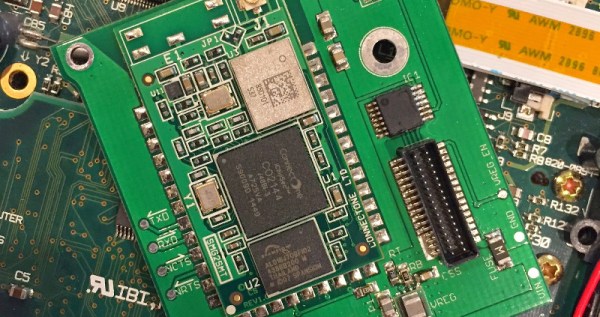
[Jake] has the king of the Newtons – a MessagePad 2100. There’s a hidden port in this machine for a modem card, but Apple never made one. While other Newton aficionados trudge along with old PCMCIA WiFi cards that only support 802.11a without WPA2, [Jake] thought it would be possible to build a modern WiFi card for the Newton. He succeeded, opening the door to modern networking apps on the finest tablet Apple will ever make.

Oddly, this isn’t [Jake]’s first attempt at expanding the capabilities of his Newton. There’s an internal serial port inside the MessagePad 2×00, and a few years ago [Jake] tried to build an internal Bluetooth card. The RF design didn’t work, but with a few more years of experience, [Jake] figured he had the skills for the job.

The critical piece of hardware for this build isn’t an ESP8266 or other common WiFi module. Instead, a WiReach module from ConnectOne was used for the built-in PPP server. This allows legacy hardware to use standard AT modem commands to access a WiFi network. It’s a very interesting module; there is a lot of hardware out there that speaks PPP natively, and a module like this could be a drop-in replacement for a modem.

That said, thanks to unintelligible and ‘Apple Classified’ documentation, getting this card working wasn’t easy. The APIs to access the internal serial slot were never documented, and it took a bit of time with a disassembler to figure out how to address the port correctly.

[Jake] has pushed all the files for his project up to Github. This includes the design files for the PCB, the Newton software that enables WiFi, and a nifty 3D printed port cover that shows off the new wireless capabilities of Apple’s greatest tablet.








