
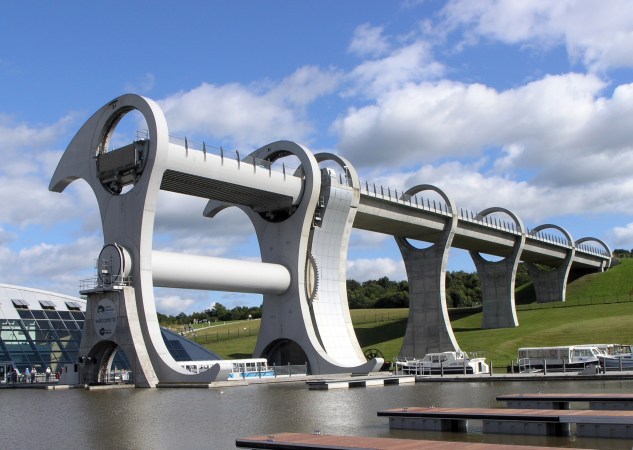
The Engineering Of The Falkirk Wheel

We live in an age where engineering marvels are commonplace: airplanes crisscross the sky, skyscrapers grow like weeds, and spacecraft reach for the stars. But every so often, we see something unusual that makes us take a second look. The Falkirk Wheel is a great example, and, even better, it is functional art, as well.

The Wheel links two canals in Scotland. Before you click away, here’s the kicker: One canal is 35 meters higher than the other. Before 1933, the canals were connected with 11 locks. It took nearly a day to operate the locks to get a boat from one canal to the other. In the 1930s, there wasn’t enough traffic to maintain the locks, and they tore them out.

Fast Forward

In the 1990s, a team of architects led by [Tony Kettle] proposed building a wheel to transfer boats between the two canals. The original model was made from [Tony’s] daughter’s Lego bricks.

The idea is simple. Build a 35-meter wheel with two caissons, 180 degrees apart. Each caisson can hold 250,000 liters of water. To move a boat, you fill the caissons with 500 tonnes of water. Then you let a boat into one of them with its weight displacing an equal amount of water, so the caissons stay at the same weight.

Once you have a balanced system, you just spin the wheel to make a half turn. There are 10 motors that require 22.5 kilowatts, and each half-turn consumes about 1.5 kilowatt-hours.
Continue reading “The Engineering Of The Falkirk Wheel”

Traffic Jam In The Suez Canal; Container Ship Run Aground

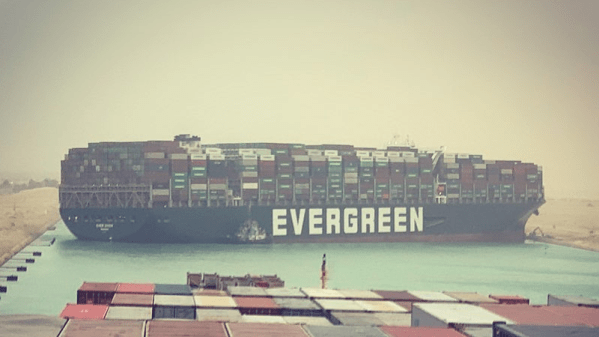
A vital shipping lane has been blocked in Egypt, as a 220,000 ton container ship, the MV Ever Given, became lodged sideways in the channel Tuesday morning local time. The Suez Canal, long a region of trading and strategic importance, has been blocked to travel in both directions as authorities make frantic efforts to free the ship.

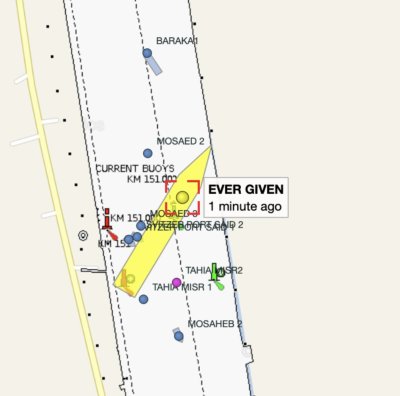
Live tracking shows a flurry of activity around the stricken vessel. If you find yourself transiting the Suez Canal next week, don’t do this. Everyone’s patience is going to be pretty thin.

The Ever Given is carrying goods from China to Rotterdam, making a northward journey through the canal. The exact reason for grounding remains unclear, though such incidents are often due to mechanical malfunction or navigational errors in the tight confines of the channel. Like many important waterways, the Suez Canal requires transiting vessels to take on a pilot. This is to ensure that ships passing through the canal have someone onboard with experience of navigating the 673-foot wide passage. However, incidents still happen, as with huge container ships, there is minimal room for error.

A flotilla of tugboats dispatched to the area have begun working to free the ship, working in concert with excavators on the banks of the canal. This photo taken by [Julianne Cona] at the incident shows the sheer scale of the problem — with the excavator digging at the bow a tiny speck in the shadow of the gigantic ship.

We’re sure shipping firms and residents of the Netherlands are eager for a quick resolution, whether its to avoid costly delays or simply to get those online purchases sooner. If you live near the canal and want to keep an eye on what’s happening, you could always grab a software-defined radio and track things in real time. Alternatively, watch the progress on Vessel Finder. And, if you’ve got strong opinions on the proper procedure for navigating the Suez Canal, sound off in the comments!









