Custom Hybrid Drivetrain Powers Boat

Offloading acceleration and braking to an electric motor in a hybrid configuration allows the less efficient combustion engine run in a more narrow set of RPM and torque ranges. In some cases the motor is decoupled from the mechanical drivetrain entirely and used simply as a generator, where it can run at a single speed all the time. And this concept isn’t limited to passenger vehicles, either. [rctestflight] put this premise to the test using a small knockoff Honda motor as a generator for an electric boat.

This project builds on a previous version where he used a much smaller hobby motor to see if it could generate usable power, and that system powered a small autonomous boat as a proof-of-concept. Those motors aren’t really designed to be used in this sort of application though, so this build upgrades the internal combustion engine and pairs it with an electric skateboard motor that’s configured to run as a generator. The setup is capable of producing almost 800 watts for as long as the gasoline lasts, provided that the 3D printed parts all hold together and the other parts don’t vibrate off of the assembly.

Out on the lake at full throttle, the small generator can get the boat up to seven knots (13 kph) but at this speed [rctestflight] reports that the generator is “quite unpleasant” due to the noise and vibration. Instead, he ran it on a test bench at several RPM and torque points and documented the efficiency of the motor at each one, and then operated the boat mostly at the point he found it to be most efficient. For a hybrid drivetrain, that not only decreases noise and vibration, but also maintenance and fuel efficiency.

Although the energy density of fossil fuels is much better than batteries, a fuel-free long-distance option is still available if you’d rather equip your boat with solar panels instead.

Continue reading “Custom Hybrid Drivetrain Powers Boat”

Camping On Unconventional Watercraft

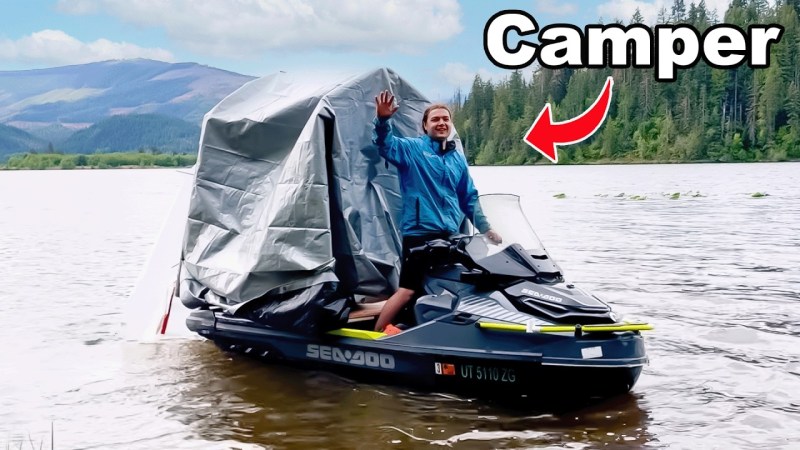
The fjords of Norway are world famous for their beauty, but even though the word itself is Norwegian, there are fjords all over the world in areas that used to be covered in glaciers. One of these areas is the Pacific Northwest of North America, we herit’s actually possible to travel by boat from the Seattle area all the way into Alaska without going to the Pacific Ocean, and although plenty of people make this journey by boat, [Matt] is planning on doing this journey on a jet ski with a custom camper on the back.

Normally a jet ski wouldn’t be the ideal platform for a multi-day on-boat adventure because of their size, but [Matt] found perhaps the largest jet ski ever made and he got a deal on it since it had previously been wrecked. Once he repaired the hull damage, he cut a sheet of plywood in half and put a hinge in the middle so it can unfold over the top of the jet ski but fold it away when he’s traveling. With the basic concept in place he took it right out on the water to a campsite before finalizing the construction of the rest of the tent, including the installation of a door, a window, and some interior lighting.

During that first night, a storm cropped up and pushed the craft out to shore while [Matt] was sleeping, so after realizing, waking up, and motoring back to shore, he made sure to tie the craft to a rock to avoid similar situations before going back to sleep. But besides some motion sickness which prevented him from cooking inside his camper, the rest of the adventure went off without a hitch. Before taking it on the Inside Passage he has been thinking of a few improvements like outriggers to keep it from rocking while he sleeps. [Matt] is no stranger to unusual camper builds, though, we recently featured his other camper which is an electric car converted to explore abandoned railroads.

Continue reading “Camping On Unconventional Watercraft”

A Sail And Oar Skiff Built From Common Lumber

For those first venturing into sailing, it can be overwhelming since the experience is thick with jargon and skills that don’t often show up in life ashore. With endless choices, including monohulls versus catamarans, fiberglass versus wood, fractional versus masthead rigs, and sloops versus ketches, a new sailor risks doing something like single-handing a staysail schooner when they should have started on a Bermuda-rigged dinghy without a spinnaker. Luckily, there are some shortcuts to picking up the hobby, like the venerable Sunfish or Hobie ships. It’s also possible to build a simple sailing vessel completely out of materials from a local hardware store, as [Cumberland Rover] has been demonstrating.

Continue reading “A Sail And Oar Skiff Built From Common Lumber”

What Has 5,000 Batteries And Floats?

While it sounds like the start of a joke, Australian shipmaker Incat Tasmania isn’t kidding around about electric ships. Hull 096 has started charging, although it has only 85% of the over 5,000 lithium-ion batteries it will have when complete. The ship has a 40 megawatt-hour storage system with 12 banks of batteries, each consisting of 418 modules for a total of 5,016 cells. [Vannessa Bates Ramierz] breaks it down in a recent post over on IEEE Spectrum. You can get an eyeful of the beast in the official launch video, below. The Incat Tasmania channel also has other videos about the ship.

The batteries use no racks to save weight. Good thing since they already weigh in at 250 tonnes. Of course, cooling is a problem, too. Each module has a fan, and special techniques prevent one hot cell from spreading. Charging in Australia comes from a grid running 100% renewable energy. When the ship enters service as a ferry between Argentina and Uruguay, a 40-minute charge will be different. Currently, Uruguay has about 92% of its power from renewable sources. Argentina still uses mostly natural gas, but 42% of its electricity is sourced from renewable generation.

The ship is 130 meters (426 feet) long, mostly aluminum, and has a reported capacity of 2,100 people and 225 vehicles per trip. Ferry service is perfect for electric ships — the distance is short, and it’s easy to schedule time to charge. Like all electric vehicles, though, the batteries won’t stay at full capacity for long. Typical ship design calls for a 20-year service life, and it’s not uncommon for a vessel to remain in service for 30 or even 40 years. But experts expect the batteries on the ferry will need to be replaced every 5 to 10 years.

While electric ferries may become common, we don’t expect to see electric cargo ships plying the ocean soon. Diesel is hard to beat for compact storage and high energy density. There are a few examples of cargo ships using electric, though. Of course, that doesn’t mean you can’t build your own electric watercraft.

Continue reading “What Has 5,000 Batteries And Floats?”

Solar-Powered RC Boat Has Unlimited Range

For RC aircraft there are generally legal restrictions that require the craft to stay within line of sight of the operator, but an RC boat or car can in theory go as far as the signal will allow — provided there is ample telemetry to let the operator navigate. [Thingify] took this idea to the extreme with a remote-controlled boat that connects to a satellite internet service and adds solar panels for theoretically unlimited range, in more ways than one.

The platform for this boat is a small catamaran, originally outfitted with an electric powertrain running on a battery. Using a satellite internet connection not only allows [Thingify] to receive telemetry and pilot the craft with effectively unlimited range, but it’s a good enough signal to receive live video from one of a pair of cameras as well. At that point, the main limiting factor of the boat was the battery, so he added a pair of flexible panels on a custom aluminum frame paired with a maximum power point tracking charge controller to make sure the battery is topped off. He also configured it to use as much power as the panels bring in, keeping the battery fully charged and ready for nightfall where the boat will only maintain its position and wait for the sun to rise the next morning.

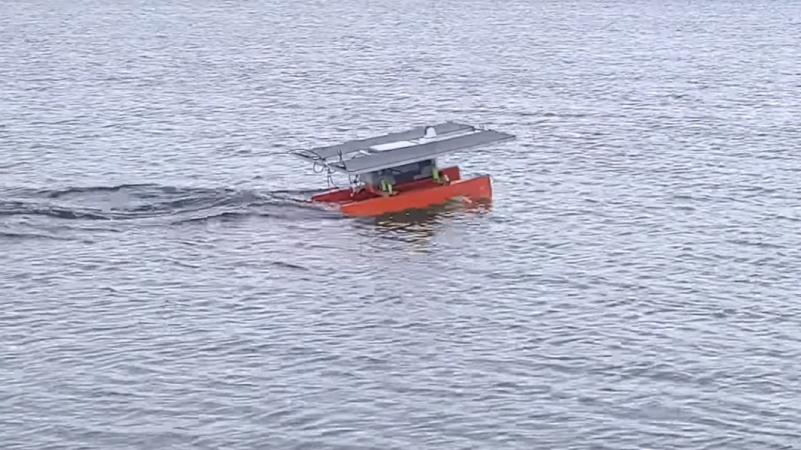
With this setup [Thingify] hopes to eventually circumnavigate Lake Alexandrina in Australia. Although he has a few boat design issues to work out first; on its maiden voyage the boat capsized due to its high center of gravity and sail-like solar panels. Still, it’s an improvement from the earlier version of the craft we saw at the beginning of the year, and we look forward to his next iteration and the successful voyage around this lake.

Continue reading “Solar-Powered RC Boat Has Unlimited Range”

navdesk

DIY Navigation System Floats This Boat

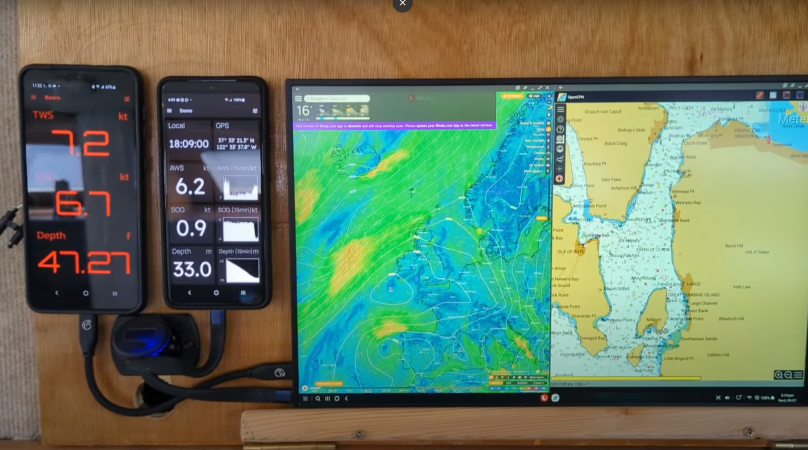
[Tom] has taken a DIY approach to smart sailing with a Raspberry Pi as the back end to the navigation desk on his catamaran, the SeaHorse. Tucked away neatly in a waterproof box with a silicone gasket, he keeps the single board computer safe from circuit-destroying salt water. Keeping a board sealed up so tightly also means that it can get a little too warm. Because of this he under-clocks the CPU so that it generates less heat. This also has the added benefit of saving on power which is always good when you aren’t connected to the grid for long stretches of time.

A pair of obsolescent phones and a repurposed laptop screen provide display surfaces for his navdesk. With these screens he has weather forecasts, maps, GPS, depth, speed over ground — all the data from all the onboard instruments a sailor could want to stream through a boat’s WiFi network — at his fingertips.

There’s much to be done still. Among other things, he’s added a software defined radio to the Pi to integrate radio monitoring into the system, and he’s started experimenting with reprogramming a buoy transmitter, originally designed for tracking fishing nets, so that it can transmit his boat’s location, speed and heading instead.

The software that ties much of this system together is the open source navigational platform OpenCPN which, with its support for third-party plugins, looks like a great choice for experimenting with new gadgets like fishing net buoy transmitters.

For more nautical computing fun check out this open source shipboard computer, and this data-harvesting, Arduino-driven buoy.

Continue reading “DIY Navigation System Floats This Boat”

Jettison Sails For Electric Propulsion

Although there are some ferries and commercial boats that use a multi-hull design, the most recognizable catamarans by far are those used for sailing. They have a number of advantages over monohull boats including higher stability, shallower draft, more deck space, and often less drag. Of course, these advantages aren’t exclusive to sailboats, and plenty of motorized recreational craft are starting to take advantage of this style as well. It’s also fairly straightforward to remove the sails and add powered locomotion as well, as this electric catamaran demonstrates.

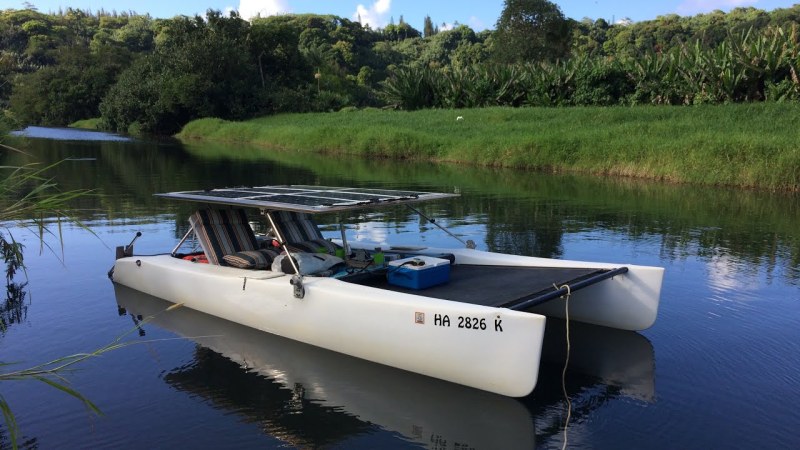
Not only is this catamaran electric, but it’s solar powered as well. With the mast removed, the solar panels can be fitted to a canopy which provides 600 watts of power as well as shade to both passengers. The solar panels charge two 12V 100ah LifePo4 batteries and run a pair of motors. That’s another benefit of using a sailing cat as an electric boat platform: the rudders can be removed and a pair of motors installed without any additional drilling in the hulls, and the boat can be steered with differential thrust, although this boat also makes allowances for pointing the motors in different directions as well. 

In addition to a highly polished electric drivetrain, the former sailboat adds some creature comforts as well, replacing the trampoline with a pair of seats and adding an electric hoist to raise and lower the canopy. As energy density goes up and costs come down for solar panels, more and more watercraft are taking advantage of this style of propulsion as well. In the past we’ve seen solar kayaks, solar houseboats, and custom-built catamarans (instead of conversions) as well.

Continue reading “Jettison Sails For Electric Propulsion”