Scanning Table For The Professional Maker

Sometimes the simplest objects need some overthinking. This is exactly what [Chris Borge] realized when using his 3D scanner and finding that the included rotation table left quite a bit to be desired — providing him the perfect excuse to build a new one.

One of the main features of a rotation stage is the, well, rotation. This was done in [Chris]’s case with a NEMA 17 stepper motor, perfect for precise rotation of scanning. Hooking up the motor to a basic perf board with an Arduino Nano allows for on the fly adjustments to rotation speed. To really solidify the over-engineering, [Chris] applies his obligatory concrete mix to add some heft to the stage.

While the previous features could be removed/downgraded without much loss, the adjustable grid built into the top adds significant functionality. The grid is based on [Chris]’s past projects, which allows cross compatibility.

We love over-engineering here at Hackaday, especially when adding something new. For more prime overthought design, check out this over engineered egg cracker!

Continue reading “Scanning Table For The Professional Maker”
Concrete Lathe Turns Metal

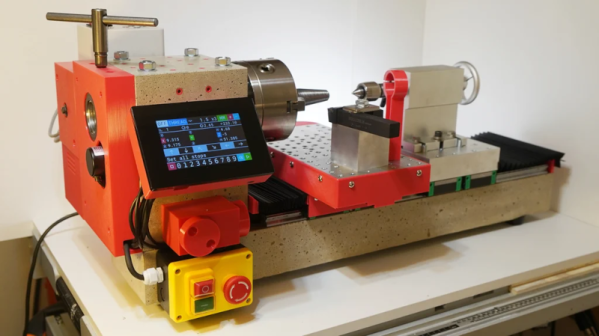
Full disclosure. If you want a lathe capable of turning metal stock, you probably should just buy one. But what fun is that? You can do like [kachurovskiy] and build one with your 3D printer. If you are chuckling, thinking you can’t make 3D printed parts sturdy enough, you aren’t exactly wrong. [Kachurovskiy’s] trick is to 3D print forms and then cast the solid parts in concrete. The result looks great, and we don’t doubt his claim that it “can surpass many comparable lathes in rigidity and features.”

Even he admits that this is a “… hard, long, and expensive project…” But all good projects are. There’s a GitHub page with more details and informative videos below. The action shots are in the last video just before the six-minute mark. Around the seven-minute mark, you can see the machine cut a conical thread. Color us impressed!

Continue reading “Concrete Lathe Turns Metal”

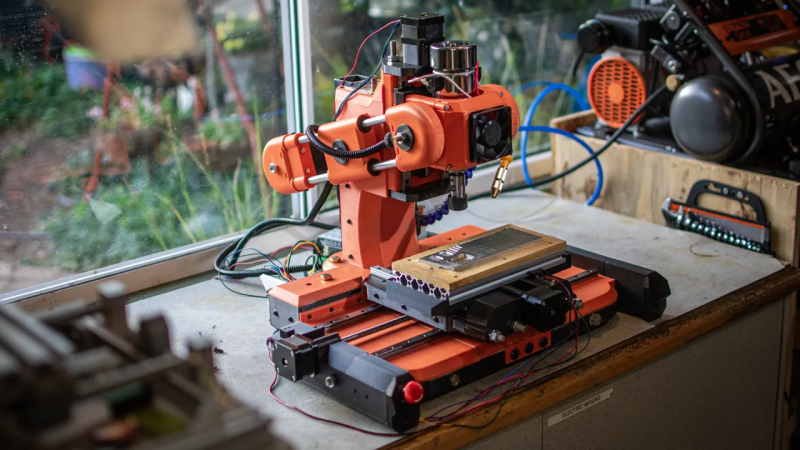
An attractive orange CNC mill sitting ona bench.

3D Printed Milling Machine Is Solid As A Rock

There are no shortage of CNC machines in the DIY space these days, but sometimes you just need to do things your own way. That’s what [Chris Borges] decided when he put together this rock-solid, concrete-filled CNC milling machine.

The concrete body of this machine is housed inside a 3D printed shell, which makes for an attractive skin as well as a handy mold. Within the concrete is a steel skeleton, with the ‘rebar’ being made of threaded rods and a length of square tubing to hold the main column. You can see the concrete being poured in around the rebar in the image, or watch it happen in the build video embedded below.

An image of the main column of [Chris]'s CNC mill as the concrete is added. The steel reinforcement is clearly visible.
In goes the concrete, up goes the rigidity.
All three axes slide on linear rails, and are attached to lead screws driven by the omnipresent NEMA 17 steppers. The air-cooled spindle, apparently the weak-point of the design, is attached to a pivoting counterweight, but make no mistake: it is on rails. All-in-all, it looks like a very rigid, and very capable design — [Chris] shows it cutting through aluminum quite nicely.

Given that [Chris] has apparently never used a true mill before, this design came out remarkably well. Between the Bill of Materials and 45 page step-by-step assembly instructions, he’s also done a fantastic job documenting the build for anyone who wants to put one together for themselves.

This isn’t the first concrete-filled project we’ve highlighted from [Chris], you may remember seeing his lathe on these pages. It certainly isn’t the first CNC mill we’ve covered, either.

Continue reading “3D Printed Milling Machine Is Solid As A Rock”

Casting Concrete With A 3D-Printed Mould

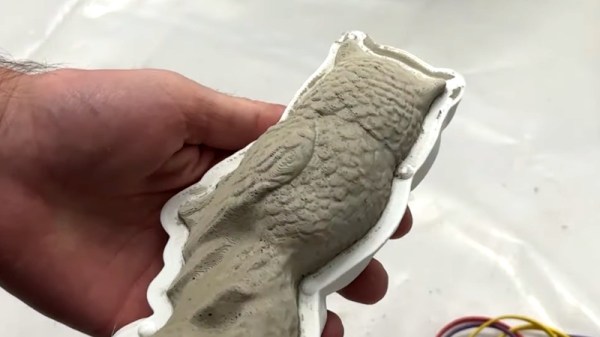
We’re accustomed to covering the use of 3D printing in casting, usually as a lost-PLA former in metal casting. That’s not the only use of the technique though, and perhaps one of the simplest is to use a 3D-printed mould for casting concrete. It’s what [ArtByAdrock] is doing in their latest video, casting an ornamental owl model.

The first part of the video below the break deals with the CAD steps necessary to produce the mould, and depending on your CAD proficiency may not be the most interesting part. The process creates a mould with two halves, a pouring hole, and registration points. Then a 3D printer produces it using flexible TPU. The pour is then simplicity itself, using a casting cement mix at a consistency similar to pancake batter. The video shows how a release spray provides easy separation, and the result is a fresh concrete owl and a mould ready for the next pour.

We can see that maybe readers have only so much space in their lives for concrete owls, but this process could be a valuable part of the armoury when it comes to making some less decorative items. It’s not the first time we’ve looked at this type of work.

Continue reading “Casting Concrete With A 3D-Printed Mould”