
Virtual Pet Responds To WiFi

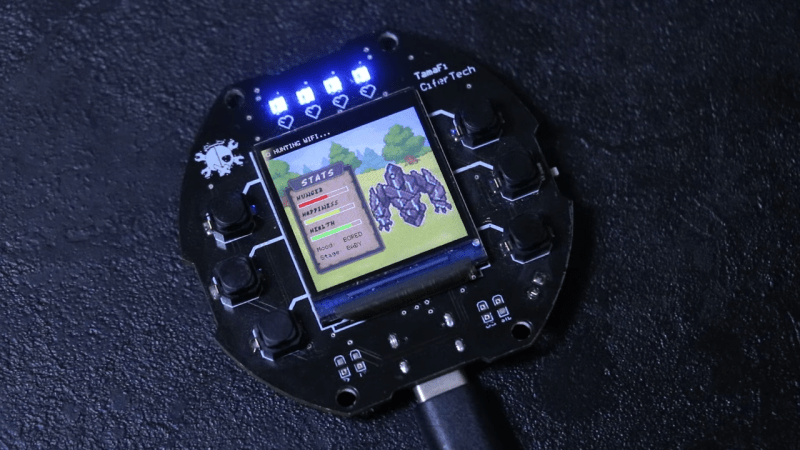
When the Tamagotchi first launched all those decades ago, it took the world by storm. It was just a bunch of simple animations on a monochrome LCD, but it had heart, and people responded to that. Modern technology is capable of so much more, so [CiferTech] set out to build a virtual pet that can sniff out WiFi networks.

The build employs an ESP32-S3, perhaps the world’s favorite microcontroller that has WiFi baked right in from the factory. It’s paired with a 240×240 TFT LCD that delivers bright, vivid colors to show the digital pet living inside. Addressable WS2812B LEDs and a simple sound engine provide further feedback on the pet’s status.

The pet has various behaviors coded in, like hunting, exploring, and resting, and moods such as “happy,” “curious,” and “bored.” For a bit of environmental reactivity, [CiferTech] also made the local WiFi environment play a role. Nearby networks can influence the “hunger, happiness, and health” of the pet.

Incidentally, if you’ve ever wondered what made the Tamagotchi tick, we’ve explored that before, too.

Continue reading “Virtual Pet Responds To WiFi”

Digital Squid’s Behavior Shaped By Neural Network

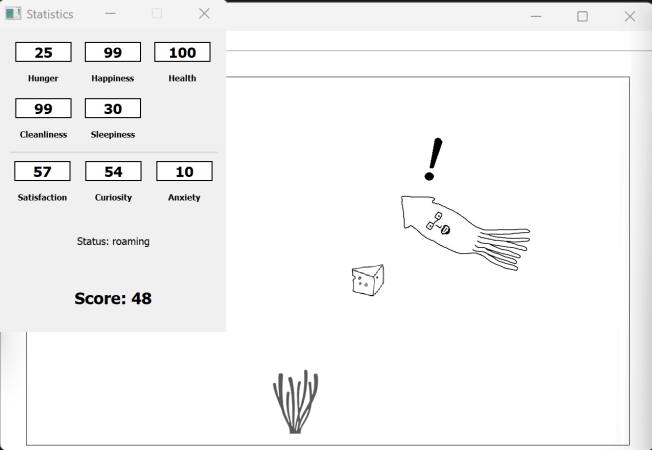
In the 90s, a video game craze took over the youth of the world — but unlike today’s games that rely on powerful PCs or consoles, these were simple, standalone devices with monochrome screens, each home to a digital pet. Often clipped to a keychain, they could travel everywhere with their owner, which was ideal from the pet’s perspective since, like real animals, they needed attention around the clock. [ViciousSquid] is updating this 90s idea for the 20s with a digital pet squid that uses a neural network to shape its behavior.

The neural network that controls the squid’s behavior takes a large number of variables into account, including whether or not it’s hungry or sleepy, or if it sees food. The neural network adapts as different conditions are encountered, allowing the squid to make decisions and strengthen its algorithms. [ViciousSquid] is using a Hebbian learning algorithm which strengthens connections between neurons which activate often together. Additionally, the squid’s can form both short- and long-term memories, and the neural network can even form new neurons on its own as needed.

[ViciousSquid] is still working on this project, and hopes to eventually implement a management system in the future, allowing the various behavior variables to be tracked over time and overall allow it to act in a way more familiar to the 90s digital pets it’s modeled after. It’s an interesting and fun take on those games, though, and much of the code is available on GitHub for others to experiment with as well. For those looking for the original 90s games, head over to this project where an emulator for Tamagotchis was created using modern microcontroller platforms.








