
The Current State Of ESP8266 Development

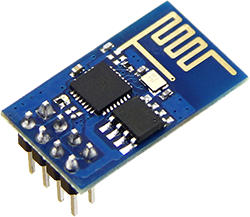
A few weeks ago we caught wind of a very cool new chip. It’s called the ESP8266, and it’s a WiFi module that allows you to connect just about any project to an 802.11 b/g/n network. It also costs $5. Yes, there was much rejoicing when this chip was announced.

Since we learned of the ESP8266, there has been a lot of work done to translate the datasheets from Chinese, figure out how the SOC can be programmed, and a few preliminary attempts at getting this module working with an Arduino. Keep in mind, very few people have one of these modules in hand right now, so all this information is completely untested. Here’s what we have so far:

Over on Hackaday Projects, [bafeigum] has been working to research the capabilities of this module. Most of the comments deal with the AT Command set for the module and figuring out what is actually returned when certain commands are called.

The ESP8266 community forum is about a week old, but already there’s a wealth of information. Most of the efforts seem to be centered on getting GCC to program this chip, something that would make the ESP8266 a single-solution chip for anything that needs WiFi and a bit of processing power. Everyone (including the great [Sprite_TM]) has currently hit a roadblock, so if you have a ton of experience with GCC and the Xtensa microcontroller, check out that thread. Failing that, we’ll have to wait until someone from Tensilica, the company behind the guts of this chip, to chime in and help everyone figure out how this thing actually works.

The Arduino-heads out there will have a much easier time. There’s already a tutorial for using the ESP8266 as a serial WiFi module. Note the ESP operates on 3.3 Volts, so connecting this module to the 5V pin means you’ll be out $5 and several weeks of shipping time.

This is an incredible amount of development in a very short amount of time, made even more remarkable by the fact that no one has one of these WiFi modules yet. When these modules do arrive to workbenches around the world, we’ll expect the Hackaday tip line to be flooded with very small and somewhat battery friendly WiFi builds.

New Chip Alert: The ESP8266 WiFi Module (It’s $5)

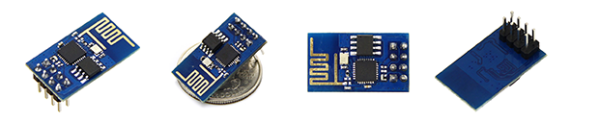
Every so often we run across something in the Hackaday tip line that sends us scurrying to Google, trying to source a component, part, or assembly. The ESP8266 WiFi module is the latest, made interesting because it pretty much doesn’t exist outside China.

Why is it cool? It’s a WiFi module with an SOC, making it somewhat similar to TI’s CC300 in conception (A.K.A. the thing that makes the Spark Core so appealing), in that a microcontroller on the module takes care of all the WiFi, TCP/IP stack, and the overhead found in an 802.11 network. It’s addressable over SPI and UART, making this an exceptionally easy choice for anyone wanting to build an Internet of Things thing; you can simply connect any microcontroller to this module and start pushing data up to the Internet. Oh, it’s also being sold for $5 in quantity one. Yes, for five dollars you can blink a LED from the Internet. That’s about half the price as the CC3000 itself, and a quarter of the price if you were to build a CC3000 breakout board.

There’s a catch, right, there’s always a catch. Yep. About two hours after this post is published it will be the number one English language Google result for “ESP8266.” As far as the English-speaking world is concerned, there is absolutely nothing to be found anywhere on the Internet on this module.

Seeed Studio recently sold a few of these modules for $7 and has some documentation, including a full datasheet and an AT command set. All the documentation is in Chinese. There’s also an “ESP8266 IoT SDK”, but from a quick glance at the code, this appears to be an SDK for the SOC on the module, not a simple way to connect the module to a microcontroller.

Anyone wanting to grab one of these modules can do so on Ali Express. Anyone wanting to do something with one of these modules will have a much more difficult time, most likely poking and prodding bits randomly with the help of Google translate. Should someone, or even a group of people, want to take up the task of creating a translation of the datasheet and possibly a library, we have a pretty collaborative project hosting site where you can do that. You may organize in the comments below; we’ll also be taking bets as to when a product using the ESP8266 will be found on Kickstarter. My guess is under a month.

EDIT: Here’s a translation of the datasheet and AT command set.

Edit two: [bafeigum] is writing a library go help him out.

Thanks [Liam] for the tip.








