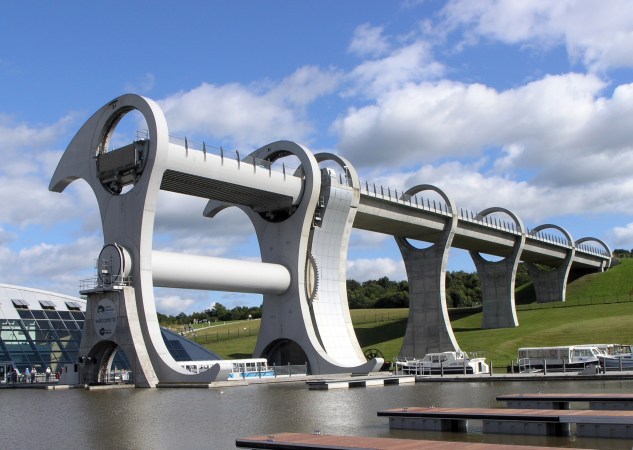
We live in an age where engineering marvels are commonplace: airplanes crisscross the sky, skyscrapers grow like weeds, and spacecraft reach for the stars. But every so often, we see something unusual that makes us take a second look. The Falkirk Wheel is a great example, and, even better, it is functional art, as well.
The Wheel links two canals in Scotland. Before you click away, here’s the kicker: One canal is 35 meters higher than the other. Before 1933, the canals were connected with 11 locks. It took nearly a day to operate the locks to get a boat from one canal to the other. In the 1930s, there wasn’t enough traffic to maintain the locks, and they tore them out.
Fast Forward
In the 1990s, a team of architects led by [Tony Kettle] proposed building a wheel to transfer boats between the two canals. The original model was made from [Tony’s] daughter’s Lego bricks.
The idea is simple. Build a 35-meter wheel with two caissons, 180 degrees apart. Each caisson can hold 250,000 liters of water. To move a boat, you fill the caissons with 500 tonnes of water. Then you let a boat into one of them with its weight displacing an equal amount of water, so the caissons stay at the same weight.
Once you have a balanced system, you just spin the wheel to make a half turn. There are 10 motors that require 22.5 kilowatts, and each half-turn consumes about 1.5 kilowatt-hours.