
Detecting Helium Leaks With Sound In A Physics-Based Sensor

Helium is inert, which makes it useful in a lot of different industries. But helium’s colorless and odorless non-reactivity also means traditional gas sensing methods don’t work. Specialized detectors exist, but are expensive and fussy. Thankfully, researcher [Li Fan] and colleagues found a physics-based method of detecting helium that seems as elegant as it is simple.

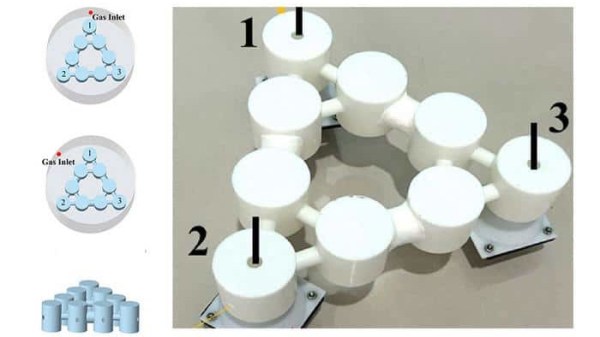
The new sensor relies on a topological kagome structure, and doesn’t depend on any chemical reaction or process whatsoever. The cylinders in the structure are interconnected; air can flow in and speakers at the three corners inject sound.

Sound waves propagate through the air within the structure at a fixed rate, and as helium enters the sensor it changes how fast the sound waves travel. This measurable shift in vibration frequency indicates the concentration of helium. It’s stable, calibration-free, doesn’t care much about temperature, and resets quickly. Even better, the three corners act as separate sensors, making it directional. It’s even quite rugged. Just as a basket weaved in a kagome pattern is stable and resistant to damage or imperfections in the individual strips that make up the pattern, so too is this sensor only marginally affected by physical defects.

The sensor design has been tested and shown to work with helium, but could possibly be applied to other gases. More detail is available at ResearchGate, with some information about the math behind it all in a supplemental paper.
Scratch And Sniff Stickers And The Gas Panic Of ’87

Ever wonder how those scratch and sniff stickers manage to pack a punch of aroma into what looks like ordinary paper? The technology behind it is deceptively clever, and has been used everywhere from children’s books to compact discs.

Most Scratch and Sniff stickers are simple nose-based novelties, though they’ve seen other uses as diagnostic tools, too. As Baltimore Gas and Electric discovered in 1987, though, these stickers can also cause a whole lot of hullabaloo. Let’s explore how this nifty technology works, and how it can go—somewhat amusingly—wrong.

The Science

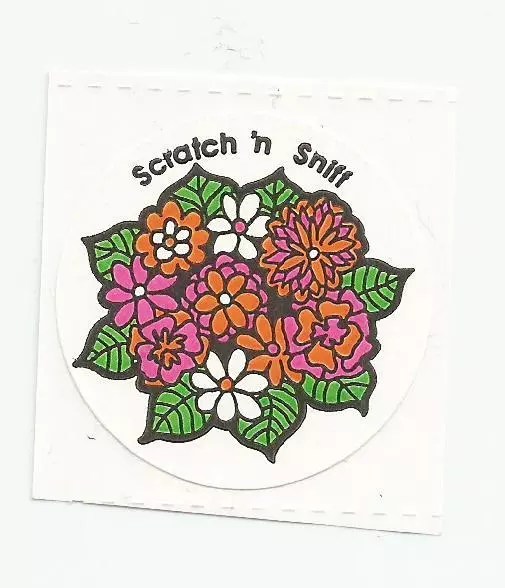
3M developed the scratch and sniff technology in the 1960s. It quickly gained iconic status in the decades that followed. via eBay

At its heart, scratch and sniff technology involves the microencapsulation of tiny smellable particles, which are then impregnated into stickers or other paper products. Microscopic amounts of aromatic materiale are trapped inside gelatin or plastic capsules, and then stuck to paper. When you scratch the surface, these capsules rupture, releasing their aromatic cargo into the air. It’s an elegant feat of materials engineering, originally developed by Gale W. Matson. Working at 3M in the 1960s, he’d been intending to create a new kind of carbonless copy paper.

Scratch and Sniff stickers soon became a popular novelty in the 1970s. The catchy name was perfect—it told you everything you need to know. A children’s book named Little Bunny Follows His Nose was one of the first widespread applications. Released in 1971, it  was entirely based around the whole scratch and sniff concept. Children could read along and scratch various illustrations of peaches, roses and pine needles to see what they smelled like. The book was reprinted multiple times, remaining in publication for over three decades.

Other popular media soon followed. Pop rock band The Raspberries put a scratch and sniff sticker on their album cover in 1972. Director John Waters would go on to release his 1981 film Polyester with an accompanying “Odorama” card, which featured multiple smells for viewers to sniff during the movie. The concept still resurfaces occasionally, though the gimmick is now well-worn. In 2010, Katy Perry’s Teenage Dream album smelled like cotton candy thanks to a scratch-and-sniff treatment on the Deluxe Edition, and King Gizzard & The Lizard Wizard put a similar touch on 2017’s Flying Microtonal Banana. Continue reading “Scratch And Sniff Stickers And The Gas Panic Of ’87”









