FM Transmitter Remotely Controlled Via ESP32

Imagine you’ve got an FM transmitter located some place. Wouldn’t it be mighty convenient if you could control that transmitter remotely? That way, you wouldn’t have to physically attend to it every time you had to change some minor parameters! To that end, [Ricardo Lima Caratti] built a rig to do just that.

The build is based around the QN8066—a digital FM transceiver built into a single chip. It’s capable of transmitting and receiving anywhere from 60 MHz to 108 MHz, covering pretty much all global FM stereo radio bands. [Ricardo] paired this chip with an ESP32 for command and control. The ESP32 hosts an HTTP server, allowing the administration of the FM transmitter via a web browser. Parameters like the frequency, audio transmission mode, and Radio Data Service (RDS) information can be controlled in this manner.

It’s a pretty neat little build, and [Ricardo] demonstrates it on video with the radio transmitting some field day content. We’ve seen some other nifty FM transmitters over the years, too. Video after the break.

Continue reading “FM Transmitter Remotely Controlled Via ESP32”

A Phone? A Ham Radio? Relax! It’s Both!

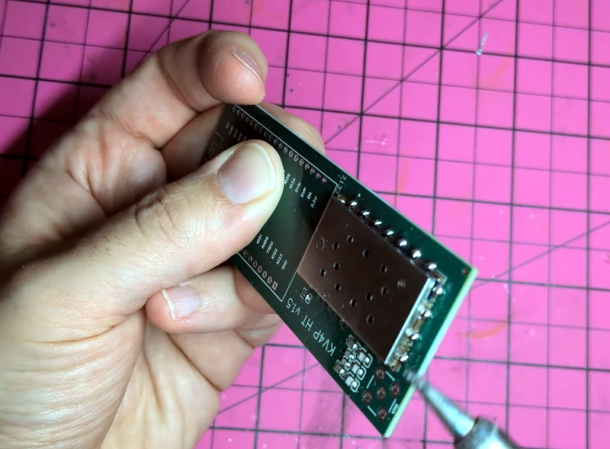
A lot of hams like to carry a VHF radio. Of course, nearly everyone wants to carry a phone. Now, thanks to the kv4p HT, you don’t have to carry both. The open-source device connects to your Android smartphone and turns it into a radio transceiver. You can build it yourself for about $35. Check out the video below.

The device uses an ESP32 and only transmits one watt, but it has lots of features like APRS and scanning.

Continue reading “A Phone? A Ham Radio? Relax! It’s Both!”

What’s Your SWR? Are You Sure?

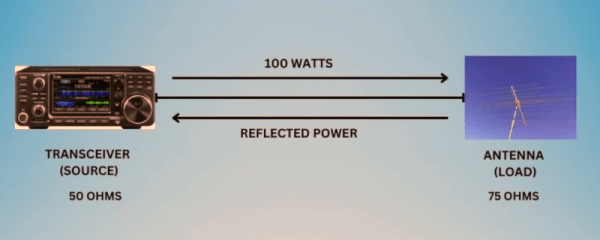
If you are involved in any sort of radio transmission, you probably have at least heard of SWR or standing wave ratio. Most transmitters can measure it these days and most ham radio operators have tuners that measure it, also. But what are you measuring? [KI8R] points out that if your coax has loss — and what coax doesn’t? — you are probably getting an artificially low reading by measuring at the transmitter.

The reason is that most common SWR-measuring instruments pick up voltage. If you measure, for example, 10V going out and 1V going back, you’d assume some SWR from that. But suppose your coax loses half the voltage (just to make an obvious example; if your coax loses half the voltage, you need new coax).

Now, you really have 5V getting to your antenna, and it returns 2V. The loss will affect the return voltage just like the forward voltage. Reflecting 2V from 5 is a very different proposition from reflecting 1V out of 10!

Continue reading “What’s Your SWR? Are You Sure?”

Ferrites Versus Ethernet In The Ham Shack

For as useful as computers are in the modern ham shack, they also tend to be a strong source of unwanted radio frequency interference. Common wisdom says applying a few ferrite beads to things like Ethernet cables will help, but does that really work?

It surely appears to, for the most part at least, according to experiments done by [Ham Radio DX]. With a particular interest in lowering the noise floor for operations in the 2-meter band, his test setup consisted of a NanoVNA and a simple chunk of wire standing in for the twisted-pair conductors inside an Ethernet cable. The NanoVNA was set to sweep across the entire HF band and up into the VHF; various styles of ferrite were then added to the conductor and the frequency response observed. Simply clamping a single ferrite on the wire helped a little, with marginal improvement seen by adding one or two more ferrites. A much more dramatic improvement was seen by looping the conductor back through the ferrite for an additional turn, with diminishing returns at higher frequencies as more turns were added. The best performance seemed to come from two ferrites with two turns each, which gave 17 dB of suppression across the tested bandwidth.

The question then becomes: How do the ferrites affect Ethernet performance? [Ham Radio DX] tested that too, and it looks like good news there. Using a 30-meter-long Cat 5 cable and testing file transfer speed with iPerf, he found no measurable effect on throughput no matter what ferrites he added to the cable. In fact, some ferrites actually seemed to boost the file transfer speed slightly.

Ferrite beads for RFI suppression are nothing new, of course, but it’s nice to see a real-world test that tells you both how and where to apply them. The fact that you won’t be borking your connection is nice to know, too. Then again, maybe it’s not your Ethernet that’s causing the problem, in which case maybe you’ll need a little help from a thunderstorm to track down the issue. Continue reading “Ferrites Versus Ethernet In The Ham Shack”

A 1930s Ham Station

[Mikrowave1] wanted to build an authentic 1930s-style ham radio station that was portable. He’s already done a regenerative receiver, but now he’s starting on a tube transmitter that runs on batteries. He’s settled on a popular design for the time, a Jones push-pull transmitter. Despite the tubes, it will only put out a few watts, which is probably good for the batteries which, at the time, wouldn’t have been like modern batteries. You can see the kickoff video below.

According to the video, these kinds of radios were popular with expeditions to exotic parts of the world. He takes a nostalgic look back at some of the radios and antennas used in some of those expeditions.

Continue reading “A 1930s Ham Station”

Hidden Gutter Antenna Keeps HOA Happy

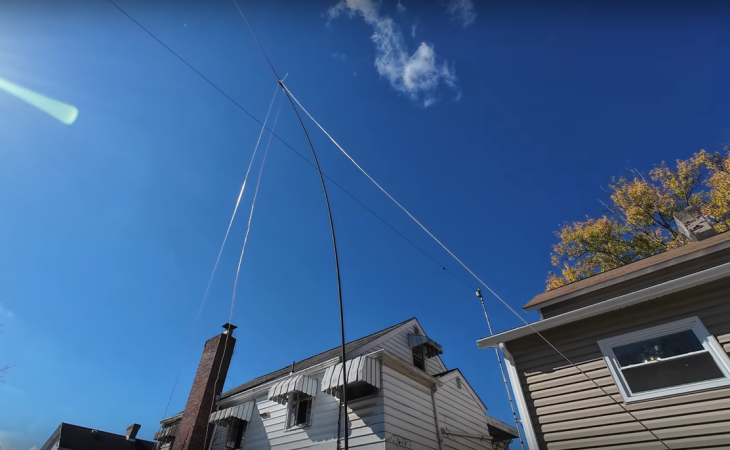
The United States and a few other countries have an astounding array of homeowners’ associations (HOAs), local organizations that exert an inordinate influence on what homeowners can and can’t do with their properties, with enforcement mechanisms up to foreclosure. In the worst cases they can get fussy about things like the shade of brown a homeowner can paint their mailbox post, so you can imagine the problems they’d have with things like ham radio antennas. [Bob] aka [KD4BMG] has been working on tuning up his rain gutters to use as “stealth” antennas to avoid any conflicts with his HOA.

With the right antenna tuner, essentially any piece of metal can be connected to a radio and used as an antenna. There are a few things that improve that antenna’s performance, though. [Bob] already has an inconspicuous coax connector mounted on the outside of his house with an antenna tuner that normally runs his end-fed sloper antenna, which also looks like it includes a fairly robust ground wire running around his home. All of this is coincidentally located right beside a metal downspout, so all this took to start making contacts was to run a short wire from the tuner to the gutter system.

With the tuner doing a bit of work, [Bob] was able to make plenty of contacts from 10 to 80 meters, with most of the contacts in the 20 – 30 meter bands. Although the FCC in the US technically forbids HOAs from restricting reasonable antennas, if you’d rather not get on the bad side of your least favorite neighbors there are a few other projects from [Bob] to hide your gear.

Continue reading “Hidden Gutter Antenna Keeps HOA Happy”

Moonbounce Music

There’s something inspiring about echos. Who among us hasn’t called out or clapped hands in a large space just to hear the sound reflected back? Radio takes this to a whole new level. You can bounce signals from buildings, aircraft, the ionisphere, or even the Moon itself. Humans have been bouncing radio waves from the moon for decades. It’s been used at war, and in peacetime. But [Hainbach] might be the first to use it for music.

Earth Moon Earth or EME communication is quite popular with amateur radio operators. With the right equipment, you can bounce a signal off the moon and hear the echo around 2.5 seconds later. The echo isn’t quite normal though. The moon and the earth are both rotating and moving in relation to each other. This causes Doppler shifts. At higher frequencies, even the craters and surface features of the moon can be heard in the echo.

[Hainbach] spent some time learning about moonbounce at a large radio telescope, and wanted to share this strange audio effect with the world. Unfortunately, most of us don’t have the large microwave dish required for this. The next best thing was to create an application which emulates the sound of a moon bounce. To this end, [Hainbach] created a Moon Echo, an audio plugin that emulates a moonbounce.

Moon Echo was created using sounds from a soprano signer and a double bass. [Hainbach] had to be careful not to be too musical, as ham operators are not allowed to broadcast music. This meant all the tests had to be broken into short non-musical clips. Rolling all this empirical data into a model took quite a bit of work, but the end result is worth it.

If you’d like to learn how to moonbounce yourself, check this article out.
Continue reading “Moonbounce Music”