
Build The CPU, Then Build The Calculator

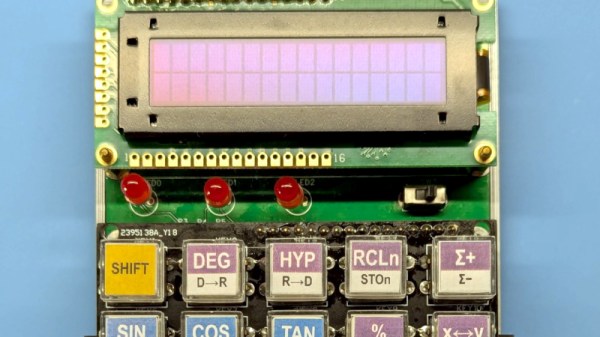
It’s possible that among Hackaday readers are the largest community of people who have designed their own CPU in the world. We have featured many here, but it’s possible that not so many of them have gone on to power an everyday project. Step forward [Baltazar Studios] then, with a scientific calculator sporting a self-designed CPU on an FPGA.

The calculator itself is nice enough, with a smart 3D printed case, an OLED display which almost evokes a VFD, and very well made buttons. But it’s the CPU which is of most interest, because while it follows a conventional Harvard architecture with a 12-bit instruction set, it works with 4-bit nibbles. This choice follows one used by HP in their calculator designs, seemingly because it can be optimised for the binary coded decimal which the calculator uses.

With calculators being yet another app on our spartphones or comnputers, there seems to be less use of calculators outside of education in 2026. But if you are a calculator user there’s nothing like a calculator you made yourself, and with a CPU of your own design it has few equals. We like this project almost as much as we like the Flapulator!

A RISC-V That The Rest Of Us Can Understand

There is great excitement in the world of microprocessors, surrounding the RISC-V architecture. This is an open source modular instruction set specification that has seen implementations on FPGAs, and is starting to emerge in dedicated silicon.

If you are not yet up to speed on what is probably going to be the most important microprocessor development of a generation, you should watch this video. As [Robert Baruch] sets out to demonstrate, the combination of RISC technology and a modular instruction set means that the simplest processor compliant with the RISC-V specification can be surprisingly accessible. And to demonstrate this he’s building one from LSI and MSI TTL CMOS chips, something we’d more usually expect to see in a recreation of a much older architecture.

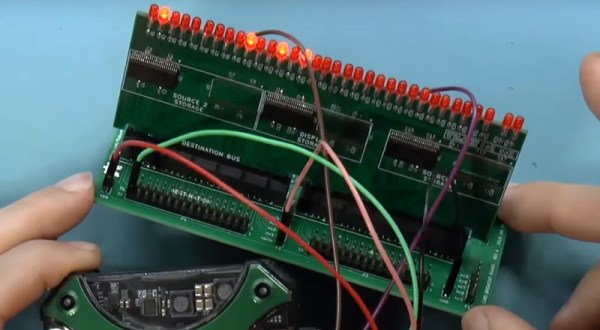
The video below the break is the first of a forthcoming series, and in it he introduces the project and gives us an easily-understandable overview of RISC-V before explaining the mechanics of a register for his RISC-V implementation. This will be his first module, and he’s created a PCB for it. He runs through its design, his choice of indicator LEDs, and then his choice of PCB house. There is also a breakout board, with two of the PCI sockets he’ll be using for his backplane. Finally we see the board being tested, with LEDs lighting up in response to values being stored in a completed register.

[Robert] has appeared on these pages many times before, among the most recent with his TMS9900-based breadboard computer. This build moves away from his retro fare though, and should be well worth watching for future installments.

Continue reading “A RISC-V That The Rest Of Us Can Understand”








