
Building A Monitor Light Bar For Better Productivity

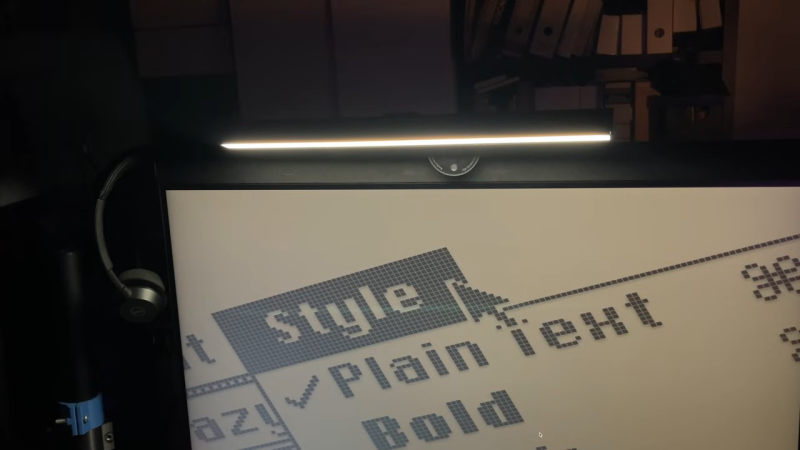
If you’re intending to work at your desk for long periods of time, good lighting is a must, as it can help stave off eye strain and mental fatigue. It was a desire for more comfortable productivity that drove [Jade] to whip up a monitor-mounted lighting system for her workstation.

The build uses an ESP32 to run the show, with a rotary encoder for manual control and firmware that allows the monitor light to be neatly integrated with Home Assistant. The light itself comes from light strips that feature both warm white and cold white LEDs. Simple MOSFETs are used to control the brightness of the LEDs and which of the warm and cold LEDs are activated at any time. Everything is wrapped up in a 3D printed housing that neatly sits on top of the monitor with the aid of a simple printed clamp. The LED strips also have a nice soft glow thanks to a strip of diffuser material that [Jade] snatched from an old television.

We love a good lighting build, from the work-focused to the creative and beautiful.

Continue reading “Building A Monitor Light Bar For Better Productivity”
LED Fun And Light Painting With The PyMCU

pymcu-led-pov-writing

Recently [Richard] at [pyMCU] was nice enough to send me one of their units to try out. As featured here before, this little board allows you to control physical things using your computer and the Python programming language. After evaluating it and making a LED blink, there were a couple other LED projects I wanted to try.

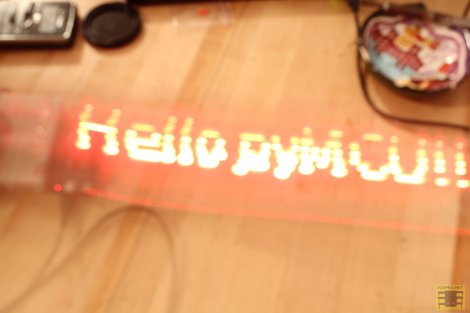
The first idea was to make a LED chaser. This was quite simple, using a little code and plugging in a few LEDs. From this, since you can make the LEDs chase each other, then in the right sequence it should be able to be used to display images using long-exposure photography. Be sure to check out the video after the break of this 10 LED chaser/light bar being assembled.

The results of this LED light bar experiment were really cool, writing some simple text and image with 10 LEDs. Considering the low component count, this is one of the simplest light bar builds that we’ve seen. Programming was simple as well, since the computer using Python does all the processing of the drawing as well as physically turning the LEDs on and off. Of course this setup isn’t without its limitations, having to be connected to a computer being the most obvious. Continue reading “LED Fun And Light Painting With The PyMCU”









