[nanofix] and his assortment of tweezers

Reviewing Tweezers For Microsoldering And SMD Work

Attributed to Picasso was the notion that when art critics get together they talk about content, style, trend, and meaning; but that when painters get together they talk about where to get the best turpentine. We can extend that sentiment into the digital age by saying that when philosophers get together they talk about ideas, theory, and meaning; but when hackers get together they talk about where to get the best tweezers.

In this video [nanofix] runs us through his collection of tweezers talking about what he likes and doesn’t like for each. If you’re just getting into microsoldering this video will have some tips about where you should start, and if you’ve been soldering tiny stuff for a while you might find some ideas for a helpful new bit of kit, or two.

If you’re interested in tweezers and novel applications you might want to check out “smart” tweezers, which can read capacitance and resistance values on the fly. Or read about a suction based SMD tool, which can securely hold SMD components with less risk of them flying across the bench and disappearing forever into the carpet on the floor.

Continue reading “Reviewing Tweezers For Microsoldering And SMD Work”
World’s Smallest Blinky, Now Even Smaller

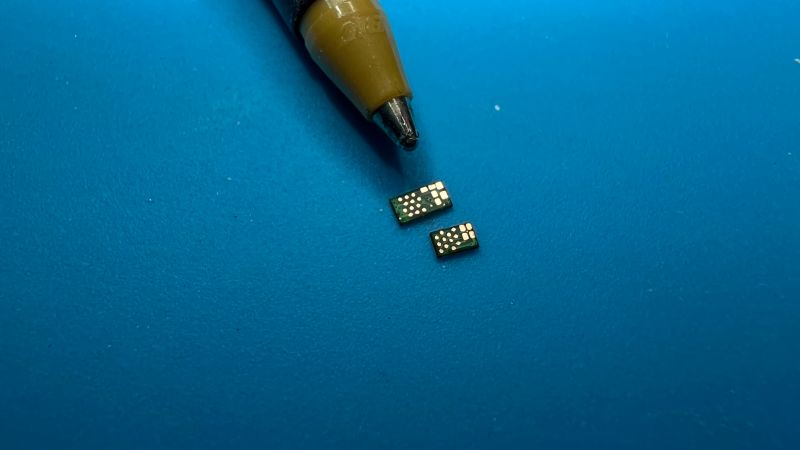
Here at Hackaday, it’s a pretty safe bet that putting “World’s smallest” in the title of an article will instantly attract comments claiming that someone else built a far smaller version of the same thing. But that’s OK, because if there’s something smaller than this nearly microscopic LED blinky build, we definitely want to know about it.

The reason behind [Mike Roller]’s build is simple: he wanted to build something smaller than the previous smallest blinky. The 3.2-mm x 2.5-mm footprint of that effort is a tough act to follow, but technology has advanced somewhat in the last seven years, and [Mike] took advantage of that by basing his design on an ATtiny20 microcontroller in a WLCSP package and an 0201 LED, along with a current-limiting resistor and a decoupling capacitor. Powering the project is a 220-μF tantalum capacitor, which at a relatively whopping 3.2 mm x 1.6 mm determines the size of the PCB, which [Mike] insisted on using.

Assembling the project was challenging, to say the least. [Mike] originally tried a laboratory hot plate to reflow the board, but when the magnetic stirrer played havoc with the parts, he switched to a hot-air rework station with a very low airflow. Programming the microcontroller almost seemed like it was more of a challenge; when the pogo pins he was planning to use proved too large for the job he tacked leads made from 38-gauge magnet wire to the board with the aid of a micro hot air tool.

After building version one, [Mike] realized that even smaller components were available, so there’s now a 2.4 mm x 1.5 mm version using an 01005 LED. We suspect there’ll be a version 3.0 soon, though — he mentions that the new TI ultra-small microcontrollers weren’t available yet when he pulled this off, and no doubt he’ll want to take a stab at this again.