[Steven K. Roberts] is the original digital nomad, having designed and built mobile computing for his own use since the 80s. His latest project is Bionode, a portable computing lab built into a hand truck that can accommodate a wide spectrum of needs for a person on the go.
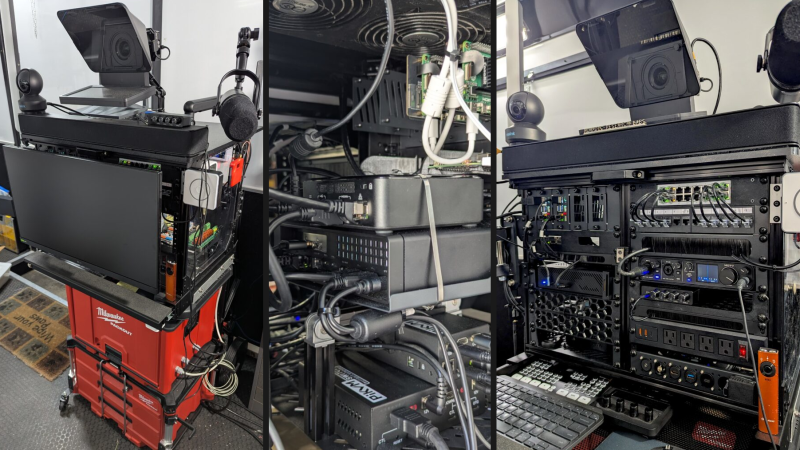
Far more than just a portable computer with wheels and a handle, Bionode is an integrated collection of systems with power management, a sensor suite, multiple computers, NAS for storage, networking, video production tools, and even the ability to be solar charged. [Steven] also uses a laptop, and Bionode complements it by being everything else.
If one truly wishes to be mobile and modular as well as effective, then size and weight begins to be just as important as usability. Everything in Bionode has a purpose, and it currently contains a PC with GPU for local AI and machine learning work, a NAS with 14 TB of storage, an Ubuntu machine, a Raspberry Pi 5 running Home Assistant, another Raspberry Pi 5 for development work, a Raspberry Pi 3 for running his 3D printer, and a Raspberry Pi 4 for SDR (software-defined radio) work. A smart KVM means a single keyboard, mouse, and display can be shared among machines as needed and additional hardware in a thoughtful layout makes audio and video projects workable. Everything is integrated with sensors and Home Assistant with local AI monitoring, which [Steven] likes to think of as the unit’s nervous system.
Bionode is therefore more than just a collection of computers crammed into a hand truck; it’s a carefully-selected array of hardware that provides whatever [Steven] needs.
Give it a look if you want to see what such a system looks like when it’s been designed and assembled by someone who’s “been there, done that” when it comes to mobile computing. Bionode would complement something like a mobile workshop quite nicely; something [Steven] has also done before.
Thanks [Paul] for the tip!