The Engineering That Makes A Road Cat’s Eye Self-Cleaning

Although most people manage to navigate roads without major issues during the day, at night we become very reliant on the remaining navigational clues. The painted marks on the asphalt may not be as obvious in the glare of headlights, not to mention scuffed up and/or covered by snow and hidden by fog. This is where cat’s eyes are a great example of British ingenuity. A common sight in the UK and elsewhere in Europe, they use retroreflectors embedded in the road. Best of all, they are highly durable and self-cleaning, as [Mike Fernie] details in a recent video on these amazing devices.

Invented in the 1930s by [Percy Shaw], cat’s eyes feature a sturdy body that can take the abuse of being driven over by heavy trucks, along with a rubber dome that deforms to both protect the reflectors and wipe them clean using any water that’s pooled in the area below them. They also provide an auditory clue to the driver when they pass the center line, which can be very useful for night-time driving when attention may be slipping.

In the video the cat-squishing cleaning process is demonstrated using an old cat’s eyes unit that seems to have seen at least a few decades to road life, but still works and cleans up like a charm. Different color cat’s eyes are used to indicate different sections of the road, and modern designs include solar-powered LEDs as well as various sensors to monitor road conditions. Despite these innovations, it’s hard to beat the simplicity of [Percy]’s original design.

Continue reading “The Engineering That Makes A Road Cat’s Eye Self-Cleaning”
Using Smartphone Cameras To Make Sure Drivers Are Looking At The Road

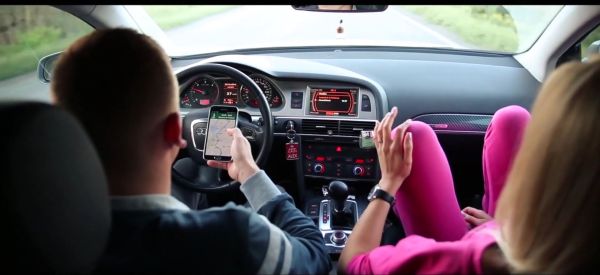
Most of us are probably quite aware of the damage that a car can inflict when driven by a distracted driver. In an ideal world, people who are driving a car would not allow something like their phone to distract them from their primary task of being the primary navigation system for the 1+ metric ton vehicle which they are controlling.

Many smartphone apps as well as in-car infotainment systems have added features over the years that try to prevent a driver from using them, but they run into the issue that it’s hard to distinguish between passenger and driver. As it turns out, asking the human driver whether they are the driver doesn’t always get the expected result. This is where [Rushil Khurana] and his team at Carnegie Mellon University (CMU) have come up with a more fool-proof approach.

In their paper (PDF), they cover the algorithm and software implementation that uses the smartphone’s own front (selfie) and back cameras to determine from the car’s interior which side of the car the user is sitting in, and deducing from that whether the user is sitting in the driver’s seat or not.  From there it is a fairly safe assumption to make that if the user is sitting in the driver’s seat, and the car is moving, that this user should not be looking at the phone’s screen.

In a test involving 16 different cars and 33 users, they achieved an overall accuracy of 94% with the phone held in the hand, and 92.2% while docked. This is more reliable than the other approaches covered in the paper, and as a benefit does not require any extra hardware. Who knows, upcoming smartphones may include a feature like this, so that apps can easily determine what feature set should be made available to a driver, if any.

Continue reading “Using Smartphone Cameras To Make Sure Drivers Are Looking At The Road”