Hand Of Man Mechanical Claw

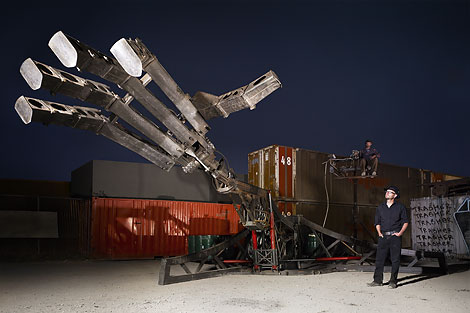
[Christian Ristow], a former Muppet creator, has created a much larger puppet that has caught the attention of Popular Mechanics. His Hand of Man is a 27 foot long remote control mechanical claw. Powered by a 90 hp diesel engine, the hydraulic system can be controlled by a glove worn by the operator. This started as a demonstration for a robotics fair, but has recently made appearances at Burning Man, Maker Faire, and had the Grand Champions seat of Popular Mechanic’s Backyard Geniuses Award. While not as practical as some robotic human augmentations, it can crush a car. [Christian] is even allowing anyone who is interested at these events to pick things up and crush them at their own whim.

Various promo videos after the jump.

Continue reading “Hand Of Man Mechanical Claw”

Little Dog

[youtube=http://www.youtube.com/watch?v=YBSK7LYpg9w]

Dating back to September of 2007, this certainly isn’t new news, but its new to us. This is Little dog, the miniature version of the ever so creepy Big Dog. We aren’t sure if the lack of Big dogs signature jogging in place makes this little guy seem more lifelike or less.  Little dog was designed to be a research platform into study automated navigation of natural terrain. We wouldn’t mind having one of these around the office, though we would have to add some kind of a head or face to give it some character.

[via Bot Junkie]

Bots 4 Tots Charity Launched

Bots 4 Tots

If you feel the same way that we do about robotics, you probably wish that you had more experience with them when you were a kid. [Don] felt that way too, and he decided to do something about it. So [Don] and his partner started the Chicago based organization Bots 4 Tots, with the mission of introducing inner city kids to robotics. [Don] told us that his organization plans on starting the kids with snap together projects like OWI’s Jungle Robot. After a few snap together projects, they plan to introduce the kids to soldering and hope to eventually move on to a larger collaborative project that all the kids can work on. Of course, doing all of these things requires money. Thats where we, as the DIY community, come in. So feel free to hit up the Bots 4 Tots site and make a donation to support their worthwhile cause, we know we will.

Creepy Robot Eye Follows You And Winks In Response


Opto-Isolator is an interesting art installation that was on display at the Bitforms Gallery in NYC. This single movement-tracking eye creates a statement about how we view art and is a response to the question “what if art could view us?”. The somewhat creepy display not only follows the person viewing it, but mimics blinks a second later and averts its gaze if eye contact is kept up for too long. Its creators [Golan Levin] and [Greg Baltus] have done a great job mimicking human behavior with such a simple element and the social implications of it are truly fascinating.

If they wanted to, [Levin] and [Baltus] could possibly crank up the spook factor by adding facial recognition and programming it to remember how certain people interact with it, then tailor its behavior to wink at different rates or become more shy or bold, depending on the personality of the person watching it. Of course, that would require that someone goes back to it more than once…

[via Glass Tumbler]

Time Magazine’s Favorite Robots


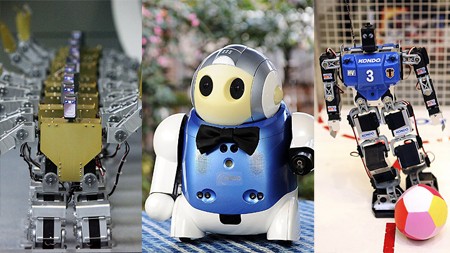
Time Magazine recently posted a photo essay of some of their favorite robots. The article was composed in response to the recent release of the Pixar film Wall-E, and features some of the cutest, most cuddly automatons in the world. We were more interested in the most functional ones, huggability notwithstanding. See some of these Hack a Day veterans after the break.

Continue reading “Time Magazine’s Favorite Robots”

Robofish > Real Fish


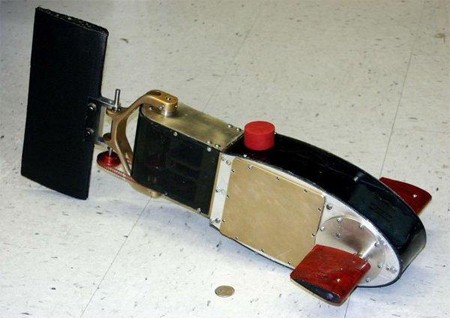
This is the kind of engineering that gets us excited, and not just because we like machines modeled on living things. Science Daily reports that Associate professor [Kristi Morgansen] from The University of Washington has developed these robofish for underwater data collection. Her technology is notable for two major reasons: the small robots use fins for locomotion instead of propellers, which reduces drag and creates greater maneuverability. The second and more important reason is that the robofish can communicate with each other via sonar, largely obviating the need for the robofish to surface for more instructions. Both design concepts were inspired by the shape and behavior of real fish. Currently the robots are only programmed to swim with or away from each other, but these are still prototypes and the technology looks promising. For more tech specs on these “Fin Actuated Autonomous Underwater Vehicles” (see why Robofish is better?), you can have a look at Morgansen’s notes.

DIY X-Men: Flame Throwing Wrist Guard


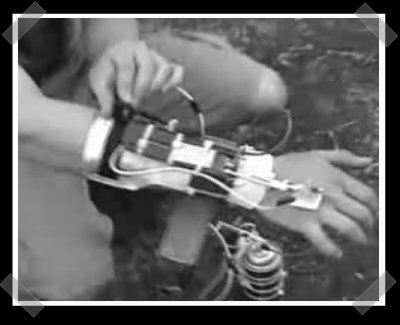
[everett] sent in his final project for his mechanisms class. In an attempt to create his own bolt on X gene, he built a wrist mounted hand activated flame thrower: The Pyro System. The wrist mount has an igniter and a nozzle for dispersing fuel. When he flexes his hand back, a switch actuates a servo on the fuel and fires the igniter. Quick disclaimer: Don’t try replicating this one! If you want to skip the movie clip, skip 33 seconds into the video.