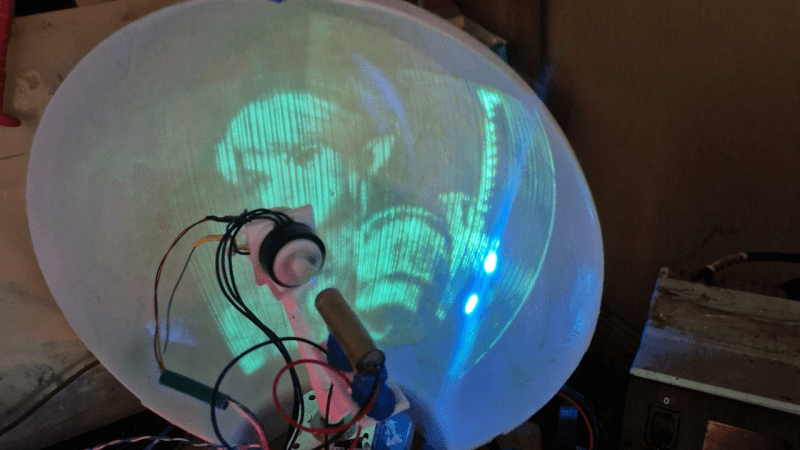
Image of an elf projected by the laser scanner

2026 Frikkin Lasers Contest: Glow Engine Is Like An Open Air Slow Scan CRT

Slow-scan CRTs were never exactly common compared to their faster cousins, but given the popularity of Slow Scan TV (SSTV) amongst hams and NASA broadcasts, many of you are probably familiar with them. The slow scan rate of SSTV meant it required much less bandwidth, but in the early days you needed a CRT with a long-persistence phosphor to hold onto the image. [AJRussell]’s Glow Engine works much the same, with one key difference — instead of cathode rays, he’s using a frikkin laser beam.

In this case, the phosphor is Strontium Aluminate, the same stuff that gives most glow-in-the-dark toys and filament its kick. Energized by a 405 nm laser of questionable wattage, the phosphor will glow for several seconds, allowing the creation of an image. So while this is a laser projector, it works more like a CRT than most galvo projectors, which rely on Persistence of Vision to create an image. Here it’s persistence of fluorescence.

Continue reading “2026 Frikkin Lasers Contest: Glow Engine Is Like An Open Air Slow Scan CRT”

Hackaday Links Column Banner

Hackaday Links: February 8, 2015

[CNLohr] is famous for his extremely strange projects, including something that does something with Minecraft that even he can’t describe. Over the years, he’s built up a vast collection of projects that have been both incredible fails and successes. Here’s a video tour of all those projects.

For this week’s edition “Kickstarter is going insane”, you only need to look at the title of the campaign: Tesla Coils for North Korea.

Last week, a few slow scan TV signals were received from the International Space Station. Here’s the reddit thread.

The worst thing about using an Arduino in a semi-professional environment is the IDE. Here’s cuwire, a better IDE.

Wanna see something insane? How about an SSH library written in x64 assembly?

Radio Shack is in its death throes, and since you haven’t gone in the last few years, you might as well head out one last time and pick up some items on clearance. Here’s the list of store closings (PDF) and all 1,784 stores slated to be closed plotted on Google Maps.

Digital Camera Becomes Video Transmitter

canon

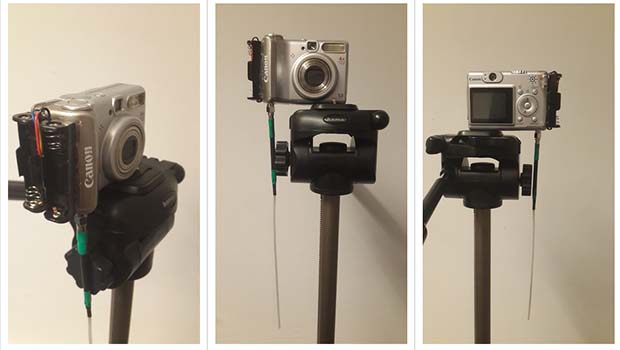
In the arena of high altitude balloons, Canon’s PowerShot series of digicams are the camera du jour for sending high into the stratosphere. There’s a particular reason for this: these cameras can run the very capable CHDK firmware that turns a $100 digicam into a camera with a built-in intervalometer along with a whole bunch of really cool features. It appears this CHDK firmware is much more powerful than we imagined, because [Chris] is now transmitting pictures taken from a Canon a530 to the ground, using only the CHDK firmware and a cheap radio module.

These PowerShot cameras have an ARM processor inside that runs VxWorks, a minimal but very capable OS for embedded devices and Mars rovers. By tying in to the Tx and Rx lines of the camera, [Chris] can issue commands to the OS, change settings, and even install his own code.

With the help of [Phil Heron]’s SSDV encoder written in C, [Chris] was able to get the camera to transmit images  with a small radio transmitter that fits in the battery compartment. Right now, [Chris] has only built the CHDK + SSDV for the Canon a530, but with how useful this build is, we expect to see an improved version very shortly.