
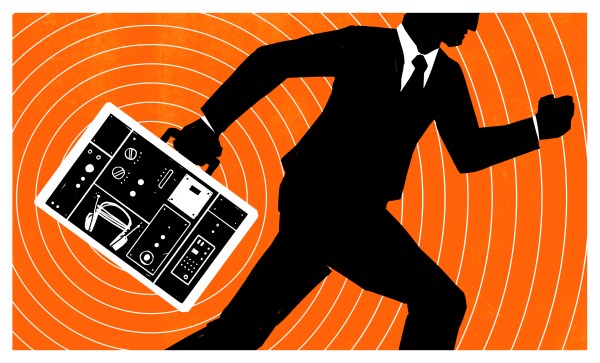
Spy Tech: A Quiet Radio For Spies

Normally, when you think of a radio transmitter, you want the strongest signal and range. But if your radio operator is secretly operating as a spy, broadcasting their position isn’t a feature; it is a liability. This fact didn’t escape World War II radio designers.

In late 1942, the British realized they needed a way for Special Operation Executive agents, resistance members, and other friendly forces to communicate with an aircraft without attracting undue attention. Two engineers from the Royal Corps of Signals developed a pair of transceivers — the S-Phone — operating around 380 MHz just for this purpose. Frequencies this high were unusual at the time, which further deterred enemy detection.

The output power was below 200 mW, and the ground equipment consisted of a dipole strapped to the operator. No transistors, so with rechargable batteries, the rig weighed about fifteen pounds and reused some parts of a paratrooper radio, Wireless Set Number 37. The other side of the connection was installed in an airplane.

Continue reading “Spy Tech: A Quiet Radio For Spies”

Check Out These Amazing Self-Soldering Sleeves From World War II

Imagine you’re a commando, doing some big secret mission on the continent in the midst of World War II. You need to hook up some wires to your explosive charges, and time is of the essence. Do you bust out the trusty Weller and see if those petulant Axis chaps will let you plug it in somewhere? No! You use a pyrotechnic self-soldering sleeve, as [Our Own Devices] explains.

Like so many British inventions during the war, the sleeves really are ingenious. They were developed by the Special Operation Executive, an organization charged with sabotage and subversion operations in then-occupied Europe.

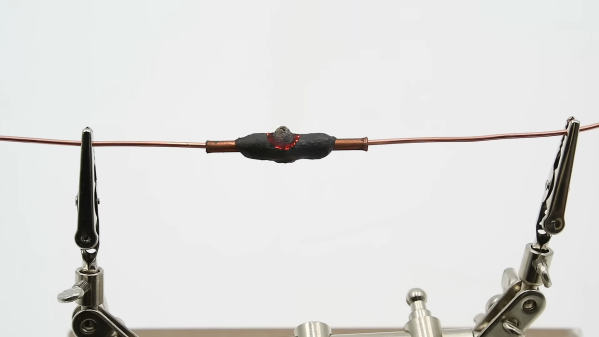
The soldering sleeves were designed to make electrical connections between detonators and firing wires for explosives.  The sleeves consist of a copper tube through which wires to be joined are fed, with a lump of solder in the middle. The assembly is covered in pyrotechnic material with a safety match-style starter chemical dosed on top. Using the sleeves is simple. First, two stripped wires are fed into either end of the copper tube. The starter the sleeve is then ignited using the box, just like striking a match. The pyrotechnic material then gets red hot, melting the solder and making the connection.

It’s well worth watching the video to see how these field-expedient devices actually work. We’ve explored the use of more-typical solder sleeves before, too. Video after the break.

Continue reading “Check Out These Amazing Self-Soldering Sleeves From World War II”

Fictional Hacking: Michael Westen

I don’t know if it is true or not today, but in fiction, spies depend on lots of high-tech gadgets. I do know that during World War II, the various secret services like the OSS and the SOE did have gadgets like secret transmitters and concealed weapons. But, like [James Bond’s] grenade-launching ink pen, to [Maxwell Smart’s] shoe phone, those gadgets came from some organized lab. (When you watch the video below, remember that at that time, a personal phone going off in a theater was unknown as cell phones were years in the future.)

Continue reading “Fictional Hacking: Michael Westen”







