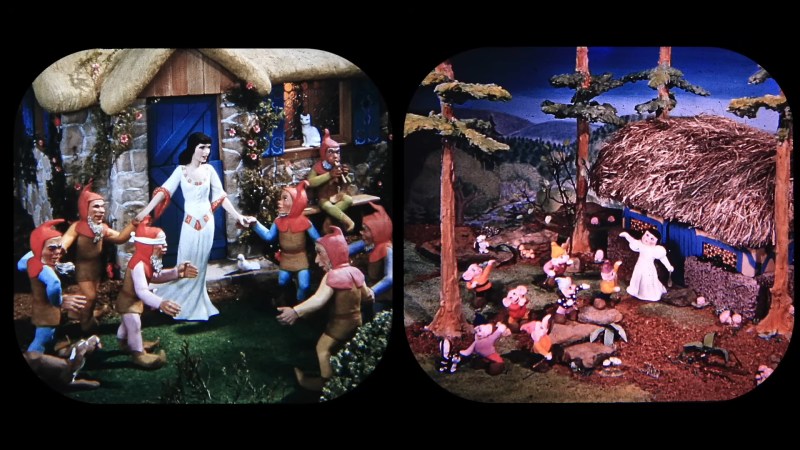
An image of a miniature diorama of Snow White and the Seven Dwarves. On the left is a more detailed 1/6 scale model with a tall, dark haired Snow White and dwarves with red caps and tan tunics. The image on the right is of a much smaller and less detailed set of miniatures. The figures's proportions are a little more uncanny and feel like a low budget Disney rip-off.

How Did They Make View-Master Slides?

The basics of producing a stereophotograph of real life places were well-established by the time the View-Master arrived, but producing images of imaginary scenes was a bit more involved. [View Master Travels and Peter Dibble] took a look at how the fairy tale and media tie-in reels may have been made.

Starting with simple dioramas, View-Master eventually developed an entire team to work on fairy tales. One of the most influential members was sculptor [Florence Thomas]. She was instrumental in updating many of the original fairy tale reels from small scale miniatures to 1/6 scale dioramas for the scenes. Unfortunately, the department was eventually cut and all the original miniatures thrown away.

Before VCRs, View-Master was the primary way people could interact with their favorite TV shows and movies when they weren’t being broadcast. TV shows could be photographed while in production in Hollywood with a stereo camera giving great visual detail. Some cartoon and movie reels were less engaging, having been made from promotional images, giving more of a paper cutout appearance rather than “real” 3D. In either case, many of these visual techniques have been lost with little documentation on how they were achieved.

We previously covered [View Master Travels and Peter Dibble]’s History of the View-Master and how you can digitize the disks for posterity.
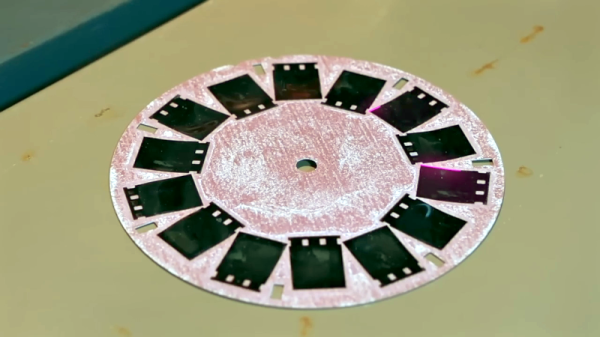
Continue reading “How Did They Make View-Master Slides?”

The History Of The View-Master

We are going to bet that as a kid, you had a View-Master. This toy has been around for decades and is, more or less, a handheld stereoscope. We never thought much about the device’s invention until we saw a recent video from [View Master Travels and Peter Dibble]. It turns out that the principle of the whole thing was created by the well-known [Charles Wheatstone]. However, it was piano repairman [William Gruber] who invented what we think of as the View-Master.

[Gruber] didn’t just work on normal pianos, but complex player pianos and, in particular, the pianos used to record player piano rolls. He was also, as you might expect, a stereo photography enthusiast. Many of the ideas used in automating pianos would show up in the View-Master and the machines that made the reels, too. In the 1930s, stereoscopes were not particularly popular and were cumbersome to use. Color film was also a new technology.

Continue reading “The History Of The View-Master”

Old Time Stereographs Get New Photos

In the late 1800s, the stereograph — sometimes incorrectly called a stereopticon — was a big craze. You’d view two side-by-side images through some lenses and see a three-dimensional image. This, of course, later would morph into View-Masters and, eventually, virtual reality headsets. But if you have an old stereograph, where do you get new images for it? If you are [Engineers Need Art], you write a program to convert MPO files (a common 3D image format) to printable stereograms. Interestingly, he used AI to assist in the project and has observations about where it helped and where it didn’t.

The post goes into a lot of detail about how the author experimented with 3D imaging for many years. However, it eventually discusses a MacOS application built with the help of an AI chatbot.

Continue reading “Old Time Stereographs Get New Photos”

Inexpensive Reading Glasses Become Stereoscope

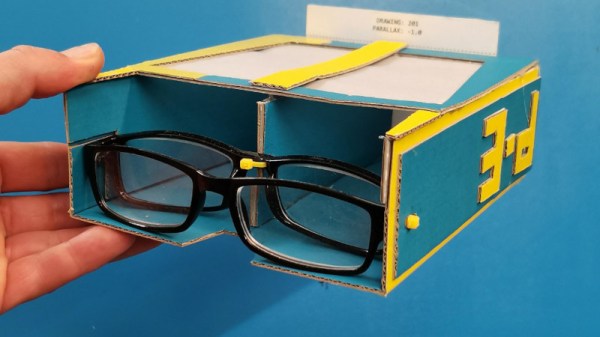
It’s an unfortunate consequence of growing older, that no longer are you able to read the print on a SOT-23 package or solder a QFN without magnification. Your eyes inexorably start to fail, and to have any hope of continuing a set of reading glasses is required. We have this in common with [Niklas Roy], who noticed while shopping for cheap reading glasses that their lenses were of surprisingly good quality. The result of this observation was a stereoscope made from card and a few euros worth of eyewear.

In the tradition of [Niklas]’ work it has a high level of attention to detail, which manifests itself here in a parametric web-based template generator to produce a result tailored to your glasses. It’s a fairly straightforward trapezoid shape, with a compound lens made from two sets of glasses drilled and held back-to-back with zip ties.

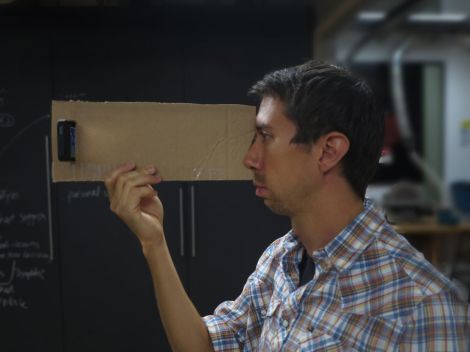
It served as a project for a group of children, and of course because stereo cameras are a relative rarity he also investigated taking his own pictures by moving a smartphone for left and right eye perspectives. It seems the youngsters had a lot of fun.

These lenses hadn’t come up on our radar until now, but like many goodies in a dollar store they’re certainly something to take a look at. Maybe not as a stereoscope for everyone though, some of us can’t see what the fuss is about.

Turn Your IPhone Into A View-Master

This super quick hack will be fun to do with the kids. Remember the days of View-Masters? You’d put a disk of small slides into a little plastic viewer and a stereoscopic image would jump out at you in 3D! Now you can not only view stereoscopic images on your smartphone, but make your own too!

To shoot the images just hold your phone in portrait orientation and take a snapshot of your subject, then move the camera six inches to the right and take a second image. The two pics need to be displayed on the screen at the same time and for this [Plarky] uses a free iPhone app called Pic Stitch. We’re sure you can find an Android equivalent in no time if you do a bit of searching.

To view the stereoscope it helps to make a divider out of cardboard like the one seen above. You’ll need to cross your eyes and focus on a point to bring the two images together. We don’t remember having to do this with the View-Master so we’re hoping someone will take the idea and improve upon it. We’ve already seen a digital View-Master. Now we want to see those dual screens replaced with an iPhone cradle.

Blinkenlights’ Stereoscope Goes Live In Toronto

We’re happy to present this guest post from History Hacker’s [Bre Pettis]. Today [Bre] catches up with the Blinkenlights team, who turn entire buildings into displays. Their current project is Stereoscope which goes live in Toronto, Canada today.

Earlier this week, I posted about the beginnings of the blinkenlights project. It started in 2001 in Berlin, but now Seven years later, in May 2008, blinkenlights is back. The City of Toronto asked the blinkenlights team if they would be interested in joining another Nuit Blanche (as they did in Paris in 2002). Short on time and with a lot of ambition, they decided to redesign and push the envelope on the project to make it wireless for The Toronto City Hall since there would be 960 windows split up in two towers. In the above photo, you can see Stereoscope in all its glory. Continue reading “Blinkenlights’ Stereoscope Goes Live In Toronto”