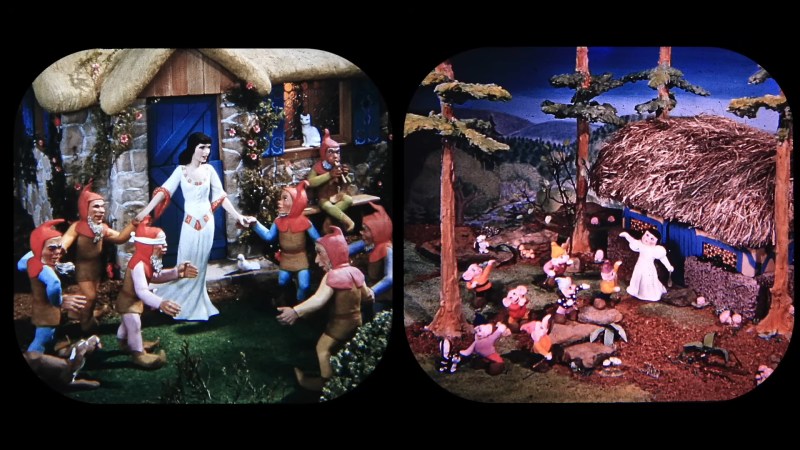
An image of a miniature diorama of Snow White and the Seven Dwarves. On the left is a more detailed 1/6 scale model with a tall, dark haired Snow White and dwarves with red caps and tan tunics. The image on the right is of a much smaller and less detailed set of miniatures. The figures's proportions are a little more uncanny and feel like a low budget Disney rip-off.

How Did They Make View-Master Slides?

The basics of producing a stereophotograph of real life places were well-established by the time the View-Master arrived, but producing images of imaginary scenes was a bit more involved. [View Master Travels and Peter Dibble] took a look at how the fairy tale and media tie-in reels may have been made.

Starting with simple dioramas, View-Master eventually developed an entire team to work on fairy tales. One of the most influential members was sculptor [Florence Thomas]. She was instrumental in updating many of the original fairy tale reels from small scale miniatures to 1/6 scale dioramas for the scenes. Unfortunately, the department was eventually cut and all the original miniatures thrown away.

Before VCRs, View-Master was the primary way people could interact with their favorite TV shows and movies when they weren’t being broadcast. TV shows could be photographed while in production in Hollywood with a stereo camera giving great visual detail. Some cartoon and movie reels were less engaging, having been made from promotional images, giving more of a paper cutout appearance rather than “real” 3D. In either case, many of these visual techniques have been lost with little documentation on how they were achieved.

We previously covered [View Master Travels and Peter Dibble]’s History of the View-Master and how you can digitize the disks for posterity.
Continue reading “How Did They Make View-Master Slides?”

The History Of The View-Master

We are going to bet that as a kid, you had a View-Master. This toy has been around for decades and is, more or less, a handheld stereoscope. We never thought much about the device’s invention until we saw a recent video from [View Master Travels and Peter Dibble]. It turns out that the principle of the whole thing was created by the well-known [Charles Wheatstone]. However, it was piano repairman [William Gruber] who invented what we think of as the View-Master.

[Gruber] didn’t just work on normal pianos, but complex player pianos and, in particular, the pianos used to record player piano rolls. He was also, as you might expect, a stereo photography enthusiast. Many of the ideas used in automating pianos would show up in the View-Master and the machines that made the reels, too. In the 1930s, stereoscopes were not particularly popular and were cumbersome to use. Color film was also a new technology.

Continue reading “The History Of The View-Master”

Scanner Captures View-Master Discs As Glorious 3D Videos

The toys of the past may have been cheesy, but you can’t deny the creativity needed to build something engaging without any electronics. One stalwart toy from this category is View-Master, the little stereoscopic slide viewer that brought the world to life in seven vibrant scenes. And digitizing these miniature works of art is the purpose of this neat View-Master reel scanner project.

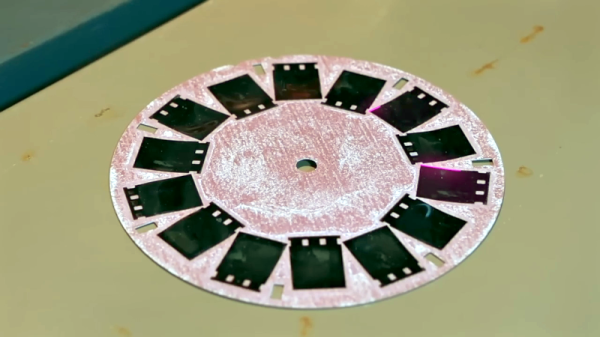
If you haven’t had the pleasure of using a View-Master, the gist is that a flat cardboard disc ringed with 14 color transparencies was inserted into a plastic viewer. Binocular eyepieces showed scenes from opposing pairs of slides, which were illuminated by a frosted screen and room lighting. The scenes were photographed from slightly different angles, leading to a stereoscopic image that was actually pretty good quality.

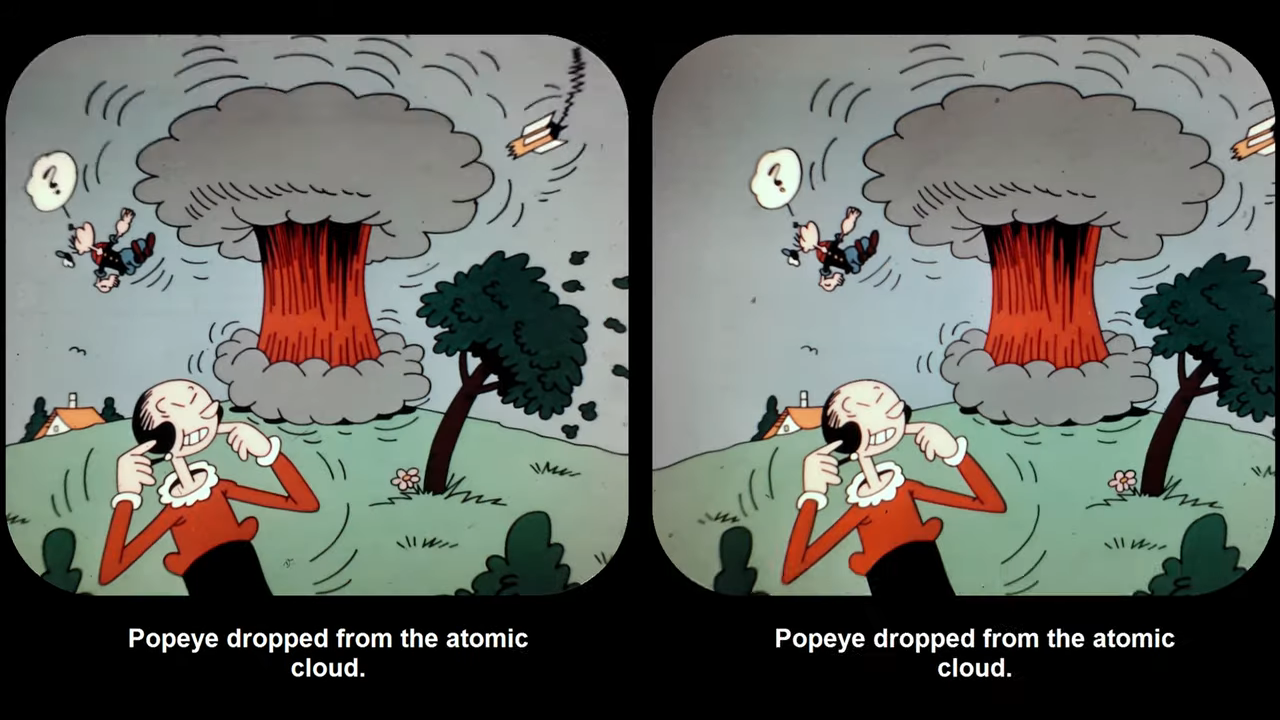
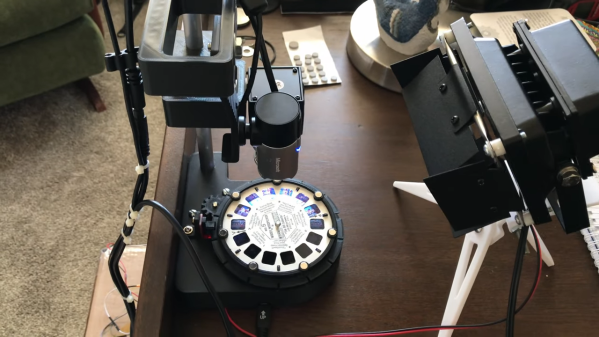
In the video below, project creator [W. Jason Altice] describes View-Master as “the YouTube of the 1950s.” We partially agree; with only seven frames to tell a story, we’d say it’s more like TikTok than YouTube. Regardless, capturing these mini-movies requires quite a bit of complexity. All the parts for the reel carousel are 3D-printed, with a small stepper to advance the reel and an optical sensor to register its position. A ring of RGB LEDs beneath the reel illuminates the slides; being able to control the color of the light helps with color balancing for slides with faded colors. An 8-megapixel camera captures each slide, and some pretty slick software helps with organizing the image pairs, tweaking their alignment, capturing the captions from the disc, and stitching everything into a video.

There’s a whole YouTube channel devoted to View-Master captures, which are best viewed with a Google Cardboard or something similar. Even without the 3D effect, it’s still pretty cool to watch [Popeye] beat up a nuke again.

Continue reading “Scanner Captures View-Master Discs As Glorious 3D Videos”

View-Master Video Player!

view master 3d video player

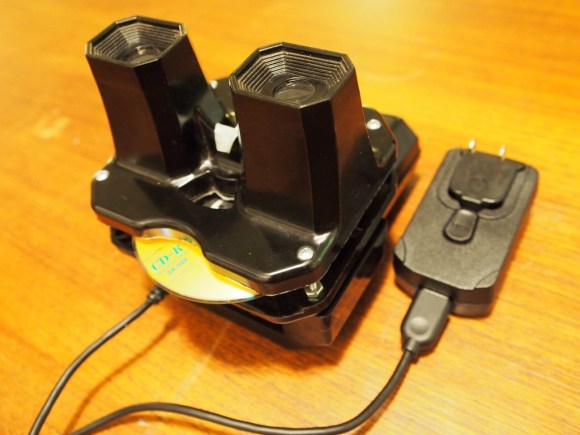
[Alec] just sent us this great project he’s been working on. Converting an antique View-Master from the early 50’s into a modern 3D video player, capable of reading Mini-CDs.

Most View-Masters don’t have much space for tinkering, let alone adding a Raspberry Pi, two displays and a CD drive, so [Alec] really lucked out when he found this model — complete with light and D-cell battery pack. Tons of space! He originally looked into getting some cheap digital photo frame LCDs from China, but soon realized the effort involved with making those work just wouldn’t be worth it, so instead he picked up some 0.9″ OLED displays from Adafruit. He still forgot to check if they had drivers for the Raspberry Pi though, and ended up on another detour of modifying FBTFT drivers to make it all work.

After that headache he got to the fun part — cramming all the hardware inside. He picked up a cheap laptop CD drive off of eBay, and discovered that using the 80MM Mini-CD standard, the discs would just fit inside of the View-Master, sticking out just a little bit, kind of like the original photo wheels!

Quite a bit of fiddling later, he managed to assemble the entire thing in layers, without damaging the external shell of the View-Master. Since it is an antique, it was important for him that his hack be reversible — and for the most part, it is! Stick around after the break to see a short video explanation!

Continue reading “View-Master Video Player!”

Turn Your IPhone Into A View-Master

This super quick hack will be fun to do with the kids. Remember the days of View-Masters? You’d put a disk of small slides into a little plastic viewer and a stereoscopic image would jump out at you in 3D! Now you can not only view stereoscopic images on your smartphone, but make your own too!

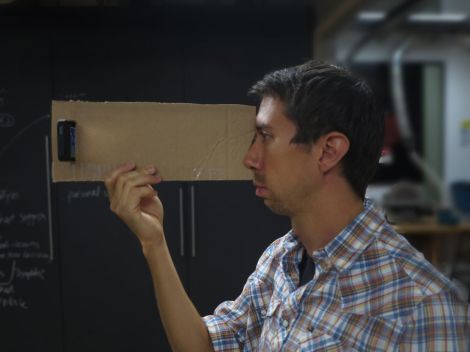
To shoot the images just hold your phone in portrait orientation and take a snapshot of your subject, then move the camera six inches to the right and take a second image. The two pics need to be displayed on the screen at the same time and for this [Plarky] uses a free iPhone app called Pic Stitch. We’re sure you can find an Android equivalent in no time if you do a bit of searching.

To view the stereoscope it helps to make a divider out of cardboard like the one seen above. You’ll need to cross your eyes and focus on a point to bring the two images together. We don’t remember having to do this with the View-Master so we’re hoping someone will take the idea and improve upon it. We’ve already seen a digital View-Master. Now we want to see those dual screens replaced with an iPhone cradle.

Digital View-Master

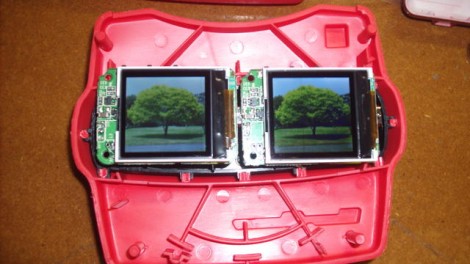
Who could forget the stereoscopic goodness of a View-Master? [Tuttle] put a modern flair on the classic optical device by adding two 1.5″ LCD screens. The screens replace the film disk of the original, showing slightly different images to produce a 3D effect. No word on a camera rig used to take the original images, but for our money this a great way to make something out of those useless key chain picture frames.