
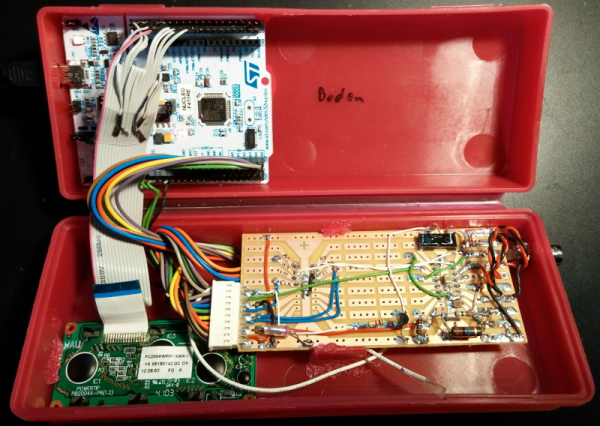
Poor Man’s Time Domain Reflectometer

A time domain reflectometer, or TDR, is an essential piece of test gear when working on long cables. The idea is simple: send a pulse down the cable and listen for the reflection from the far end. The catch is that pesky universal constant, the speed of light.

The reason the speed of light is an issue is that, in a traditional system, the pulse needs to be complete before the reflection. Also, time is resolution, so a 1 GHz sampling rate provides a resolution of about 10 centimeters. [Krampmeier] has a different design. He sends variable length pulses and measures the overlap between the outgoing and reflected pulses. The approach allows a much simpler design compared to the traditional method.

Continue reading “Poor Man’s Time Domain Reflectometer”

Hackers Measure Cable Lengths With Time Domain Reflectometers

[android] has built up a fast edge pulse generator for time domain reflectometry (TDR). TDR is a neat technique which lets you measure cable lengths using electrical signals and can also be used to locate faults within the cable.

TDR works by sending a pulse down the cable. When the pulse reaches the end of the unterminated cable it is reflected back to the source. By monitoring the delay between the original pulse and its reflection you can determine the length of the cable. We’ve seen projects that use TDR before, and it’s often used in telecoms industry to locate faults in long cable runs.

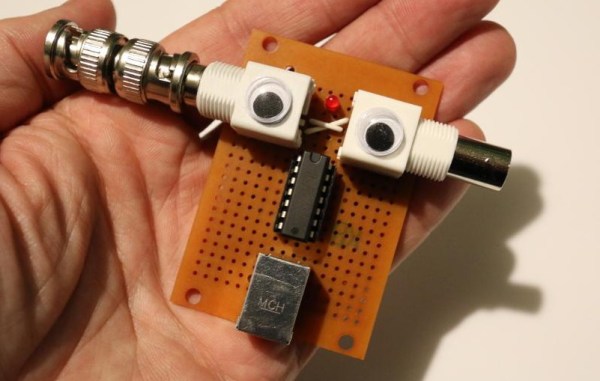
You can try TDR in your lab using only a scope to observe the delay and a function generator to create the pulse. However, the technique works a lot better with pulses that have very fast rise times. So [android] built a fast edge pulse generator based on [w2aew]s design. Then added googly eyes for good measure. His build works great and is a nice demonstration of the technique.







