If You Like The Sound Of A Thermoacoustic Stirling Engine, Check Out These Plans

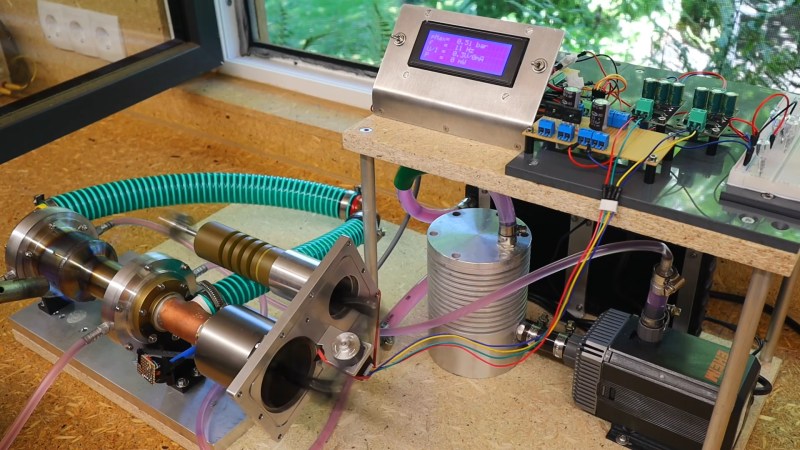
[My Engines] has been doing some sterling work on Stirling engines for some years now. Their thermoacoustic engine is now finally far enough along to open-source, so the magic of collaboration can speed technological advancement.

You’ve probably heard of Stirling Engines, but what’s this “thermoacoustic” business? Hot sound? Well, that’s the translation, and it’s not a bad starting point for understanding what’s going on: the engine converts heat into high-amplitude sound waves — that is, waves of pressure — which means the engine itself has no moving parts. Well, almost. Obviously moving parts are required to get power out. In [My Engines] case he’s using a piston and linear generator, but otherwise it makes for a very simple, very reliable engine that can be fueled by any available source of heat. Say like burning methane from [My Engines]’s home biogas plant.

[My Engines] promises more videos to help you understand the construction in a way his previous videos might not detail, and has put 3D models and drawings at a public Google Drive. There’s also a Discord you can join, because apparently that’s the only way to communicate about projects these days.

The whole build is very much within range of a home maker, though there’s a lot more to it than the toy Stirling engines you may have made out of tin cans back in the day. If you want to play with thermoacoustics but [My Engines]’s design seems like a little much to get started with, you can make a demonstrator with some steel wool and a test tube. Be careful, though: model engines can be an addictive hobby.

Continue reading “If You Like The Sound Of A Thermoacoustic Stirling Engine, Check Out These Plans”

Demonstrating ThermoAcoustics With The Rijke Tube

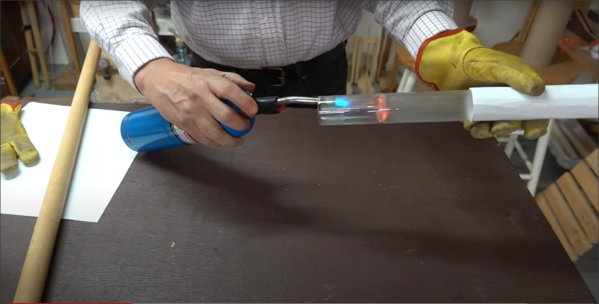
The Rijke tube is a very simple device that demonstrates the principle of thermoacoustics quite clearly. Construction is quite straightforward, simply place a metal gauze at the bottom end of a tube, approximately one quarter of the way up, apply a source of heat to the gauze, and instant sound. The heat produces convection, setting up a longitudinal standing wave. This is due to air passing over the hot gauze, suddenly expanding and causing a pressure change, which rushes out the tube. Next, the airflow cools and slows, and air starts to head back into the tube, and the cycle repeats. Adjusting the tube length by slipping a sleeve over it, adjusts the pitch of the note, simply because the air has a different distance to travel. If there is a flame aimed at the gauze from below, the sound will stop since the air is already hot when it hits the hot gauze, no pressure change occurs, and no oscillation.

As [Keith], the reader who sent in the tip, suggests it would be fun to attach a servo to a sleeve on the tube, build multiple units and hang the whole thing off a MIDI controller. This could make for some fun times, and we have to agree. The problem of keeping the gauze hot could be solved in a number of ways, direct resistive heating could work, but maybe inductive heating would be cleaner?

Now, we can’t find an instrument which works in this manner, which sounds like a hack in the making for someone out there so inclined.

There have been a few fire-orientated musical devices over the years, such as this Rijke Tube Organ, various variants on the pyrophone, including this neat one performing with a tesla coil, and while we’re talking about music fire, howsabout a two dimensional rubens’ tube variant?

Continue reading “Demonstrating ThermoAcoustics With The Rijke Tube”