
Collective human consciousness is full of imagined or mythical dream-like utopias, hidden away behind mountains, across or under oceans, hidden in mist, or deep in the jungle. From Atlantis, Avalon, El Dorado, and Shangri-La, we have not stopped imagining these secret, fantastical places. One of these, Xanadu, is actually a real place but has been embellished over the years into a place of legend and myth, and thus became the namesake of an Internet we never got to see like all of those other mystical, hidden places.
The Xanadu project got its start in the 1960s at around the same time the mouse and what we might recognize as a modern computer user interface were created. At its core was hypertext with the ability to link not just other pages but references and files together into one network. It also had version control, rights management, bi-directional links, and a number of additional features that would be revolutionary even today. Another core feature was transclusion, a method for making sure that original authors were compensated when their work was linked. However, Xanadu was hampered by a number of issues including lack of funding, infighting among the project’s contributors, and the development of an almost cult-like devotion to the vision, not unlike some of today’s hype around generative AI. Surprisingly, despite these faults, the project received significant funding from Autodesk, but even with this support the project ultimately failed.
Instead of this robust, bi-directional web imagined as early as the 1960s, the Internet we know of today is the much simpler World Wide Web which has many features of Xanadu we recognize. Not only is it less complex to implement, it famously received institutional backing from CERN immediately rather than stagnating for decades. The article linked above contains a tremendous amount of detail around this story that’s worth checking out. For all its faults and lack of success, though, Xanadu is a interesting image of what the future of the past could have been like if just a few things had shaken out differently, and it will instead remain a mythical place like so many others.












I would never have connected Vannevar Bush and his memex with Doug Engelbart and his Mother of All Demos and Ted Nelson Computer Lib/Dream Machines
You might add Norman Abramson and ALOHAnet to the hardware side of this thread…clunky, kludgey, but it gave Robert Metcalfe the idea for Ethernet (and nobody uses yellow cable and vampire taps today).
They had the right ideas, at least partially, and were working with the technology available to them. Nothing wrong with that, and others took inspiration from them to get us where we are today. You have to crawl and walk before you can run.
Maybe this post should be called, “How we got to the Internet we have today”, because there are pieces of these ideas included in what we use now. Well, except for Bush’s mechanical Differential Analyzer, parts of which are at MIT and Smithsonian. When you didn’t have a computer you made a mechanical one.
(I still like Olivia Newton-John’s version better)
Yes, I’m with you about her version.
She was really cool.
…and her father broke codes at Bletchley during WWII
Reading this was a bit of a horror (to me; the hyperlinked article).
I got an insight at toxic US American work/business mentality that I’d like to forget.
It’s beyond me how adult people couldn’t work together in a mature, respectful way.
I mean, they were so smart and educated here.
Yet same time, they couldn’t put their egos aside, grow a thicker skin, solve their differences and be a team.
Also, the deadline thing.. Why couldn’t they progress step-wise, at least?
I mean, I do understand perfectionism. I really do. But why not proceed on two fronts?
Finish one version to meet deadline and to save the project
and then finish the true, improved version when you have time?
But that’s just me. I don’t understand 1960s men, I’m afraid.
To me it was a generation of men that couldn’t cook for themselves or do the laundry.
They needed a wife as a mother replacement, basically.
It seemed like a generation that wasn’t mentally stable or self-reliant in some ways.
That would explain the childish outbursts to me.
Being one, it falls down to training or lack therein of. We aren’t so alike as you describe, my “liberated” mother would be aghast at the thoughts you proffer.
I remember reading praise for Xanadu in places like Wired and Mondo 2000 in the nineties, when print magazines were still a thing and the idea of something replacing the WWW was entirely plausible. But even then, it was talked about as a dead letter.
I think, more than anything, it was too rooted in the idea of media being centrally organized. The revelation with the web was that by having this (at the time) absurdly simple design, you got small-scale actors building out not only the content but the infrastructure itself. The web wasn’t just accessible to hobbyists, it literally put them on the same footing as Disney or CNN, and that’s where the explosive growth came from. Building out Xanadu would have depended on big organizations to get it rolling, as happened with radio and TV; but big media organizations were more interested in killing the internet until it was far too late.
It also can’t have helped that people had worked on this thing for decades without a serious attempt to launch it. You can only be the Next Big Thing for so long without showing some results. Not that I can think of any modern parallels on a global-economy-threatening scale.
To be fair, the internet wasn’t everything in 20th century.
There had been university databases and commercial databases that could be accessed via glass terminal over X.25.
Way back in mid-late 1970s, before the internet had started in 1983 or so.
The same technology was also used by banks and ATMs.
So even if the internet had never “made it” back then, a similar technology would have taken its place eventually.
Originally, the “internet” wasn’t one network but a network of networks, also.
Something that connects the individual networks with each others.
Internet=interconnected networks
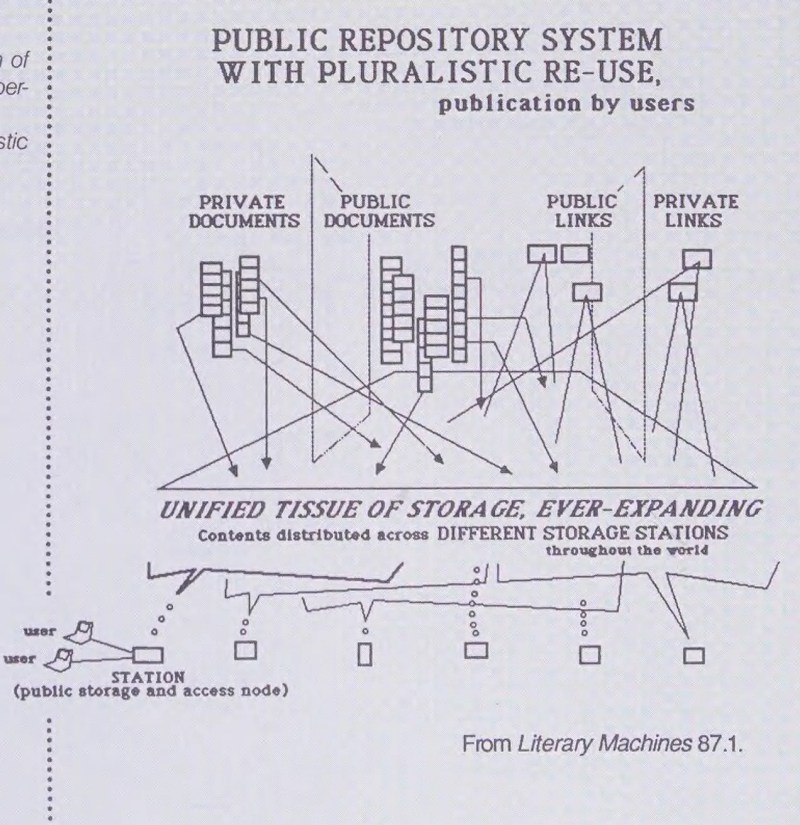
You can say that what evolved into the Internet is decentralized, but when you look at how it is actually used, it really acts as a “unified tissue of storage, ever-expanding, Contents distributed across different storage stations throughout the world”, and we DO use it as a “public repository system with pluralistic re-use, publication by users”. So what we’ve got is more like Xanadu than different from it.
I think we will get there. But the weird terminology, old concepts then becoming obolete and getting reinvented in another form, incomplete prototypes in not-so-mainstream languages, documentation being sketchy in the first place, and then much of it being kept secret for too long and then lost, all gets in the way. The “open source” code has so far not gotten us very far either.
I think I first heard about it from the 1995 Wired article. I bought copies of Computer Lib (that was already expensive and hard to find by the late 90’s) and Literary Machines (which was still in print at the time). Yeah, the books are quirky, long on philosophy, and short on how to implement it.
There is the rumor of a data structure breakthrough: The Ent, invented by K. Eric Drexler. http://udanax.xanadu.com/history/index.html The docs I have found for that are rather frustrating; I can sortof grasp how to implement the first couple of dimensions, but then it just keeps going, trees upon trees. For that, there is an implementation in Udanax Gold… in a dialect of Smalltalk that can’t run anywhere today AFAIK. So no matter which end you pull on, it always seems to unravel: it requires an understanding complete enough to reimplement it, at the risk of one’s sanity.
Structured version control is very much needed. git stores and tracks versions of whole files, then you use primitive old tools like diff to compare the versions. Why don’t we use a diff that can see changes in words (or in grammatical structures or programming-language ASTs) rather than in lines? Why don’t we track changes as they are made, rather than saving the whole file and having to guess afterwards what was added, what was removed and what was copied? If you insist on post-guessing rather than tracking, at least you can do
git diff --word-diffnowadays; it’s surprising that this was not a feature further back in time. It’s still not so common that you are likely to use a command-line word-diff tool every day to compare files, one that can see them holistically rather than as a sequence of lines.Distributed storage is a solved problem, kindof, as long as the chunks you are storing are big enough to be worth the trouble of referring to by hash, and as long as the chunks are immutable, and therefore don’t directly contain links to other chunks. Directly referring to chunks of text by their hashes would imply that they are immutable. So we need persistent data structures to enable version control and a growing set of links. Links have to be stored separately of course, to be 2-way links: just as in database link tables. But being able to search everyone’s link tables at the same time on the whole worldwide distributed system, without having to copy everything into one place, is harder. Kindof like how blockchains often needed to be downloaded in their entirety: but hey isn’t that a solved problem now too?
I think we can get to Xanadu eventually. Many building blocks exist in better form now than ever before. Some of those that are needed were just invented recently, and simply haven’t been applied to this problem yet.
The problem of our modern world is, I think, that we’re mentally stuck in established concepts.
Before everyone was on the internet, individuals came up with their own interpretation of things.
It’s like with old sci-fi stories, maybe. The concepts seem familiar still, but the actual implementation differed from the modern day.
I mean, just look at the impact of microcontrollers.
They’re everywhere, we’ve become basically unable to build new things without them.
Decades ago, we still had mechanical, electro-mechanical or discrete electronic circuit solutions.
If there’s a Xanadu finally, will it still be as conceptual groundbreakingly different
as it was in the 1960s-1980s or just another version of what we got used to know?
I mean, just look at operating systems. Everything is Unix/Linux now by design.
With the exception of BeOS from 25 years ago, when was the last time something fundamentally different had been imagined?
Xanadu has fascinated for for a long time. If you like this sort of stuff you should check out Dylan Beattie: https://www.youtube.com/watch?v=8JOD1AQGqEg
One of my favourite short stories is Walker’s “We’ll Return, After This Message” which he dates December 1989 https://www.fourmilab.ch/documents/sftriple/gpic.html
It includes the words “Back in ’97 Xanadu still wasn’t finished…”, which suggest that despite his optimistic description in 1988 he very rapidly started having second thoughts.
Clarke in “Odyssey Two” (1982) seems to have swallowed the underlying idea, with just about everything (including electricity bills) stored in a handful of DP vaults scattered around the planet: strongly suggested to be a shared resource. And I think it was in “The Fountains of Paradise” (1979) where he implied that the pinnacle of computer proficiency was being able to generate imaginative SQL one-liners.
Since then we’ve had the Semantic Web, not to mention indisputable duds like Chandler.
And everybody’s gone back to the DP bureau model, where they hire time from Google or Facebook without looking too closely at the fine print.