
Food poisoning is never a fun experience. Sometimes, if you’re lucky, you’ll bite into something bad and realize soon enough to spit it out. Other times, you’ll only realize your mistake much later. Once the tainted food gets far enough into the digestive system, it’s too late. Your only option is to strap in for the ride as the body voids the toxins or pathogens by every means available, perhaps for several consecutive days.
Proper food storage and preparation are the key ways we avoid food poisoning today. However, a new development could give us a further tool in the fight—with scientists finding a way to actively hunt down and destroy angry little pathogens before they can spoil a good meal.
Hunt Them Down
Food poisoning cases tend to boil down to two categories—those involving toxins, and those involving bacterial pathogens. In either case, affected food must be destroyed. Particularly in the latter case, as bacteria reproduce—even the tiniest contamination will quickly spiral in size.
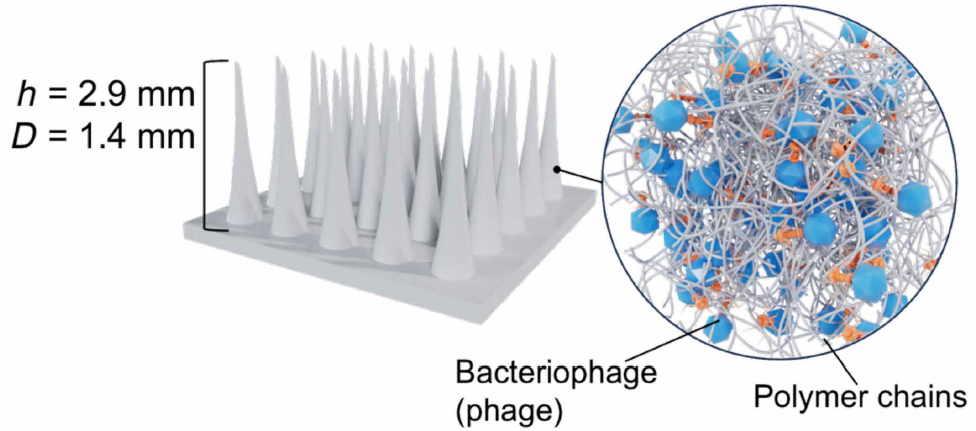
However, new research published in Scientific Advances may have a solution to the problem of bacterial-based food poisoning. It involves using patches to deliver specially-crafted viruses to fight and kill the bacteria that would otherwise infect and sicken a human who eats the food. The patches are to be applied to the food itself—attacking and killing the bacteria before the food is eaten.
The viruses in question are bacteriophages—specifically, viruses that can infect bacteria and reproduce within them from its own genetic material. When a bacteriaphage virus comes into contact with certain bacteria, it breaches the cell’s wall, typically with a syringe-like motion in which the viral genetic material is injected into the cell. Once inside, the genetic material is processed by the bacteria and reproduces more phages that can then go on to infect further bacteria. In the specific case of lytic phages, the bacterial cells are quickly destroyed as the virus reproduces inside, spreading the new phages quickly and killing the original host.
Two bacteriophages were used in this research. The T7 phage was chosen for its ability to infect and kill Escherichia coli bacteria, which are a common foodborne pathogen. The S.enterica phage was in turn chosen as it readily infects and kills Salmonella enterica bacteria, which are similarly a common cause of food poisoning.

To get the phages into food items, the research team developed a novel “patch” delivery system. This involved creating patches out of food-compatible polymers that were covered in tiny microneedles that could penetrate the surface of common foods. Once the microneedles penetrate the food, passing bacteria would interact with the bacteriophages, producing more phages as they burst open and die. This has the effect of propagating phages further to other bacteria in the food. The most successful microneedle patches were crafted out of PMMA polymer, after researchers investigated a wide range of other materials including PVA, PDMS, and gelatin. The microneedles are dosed with bacteriophages by simply incorporating the bacteriophage solution with a PMMA solution prior to casting in molds.
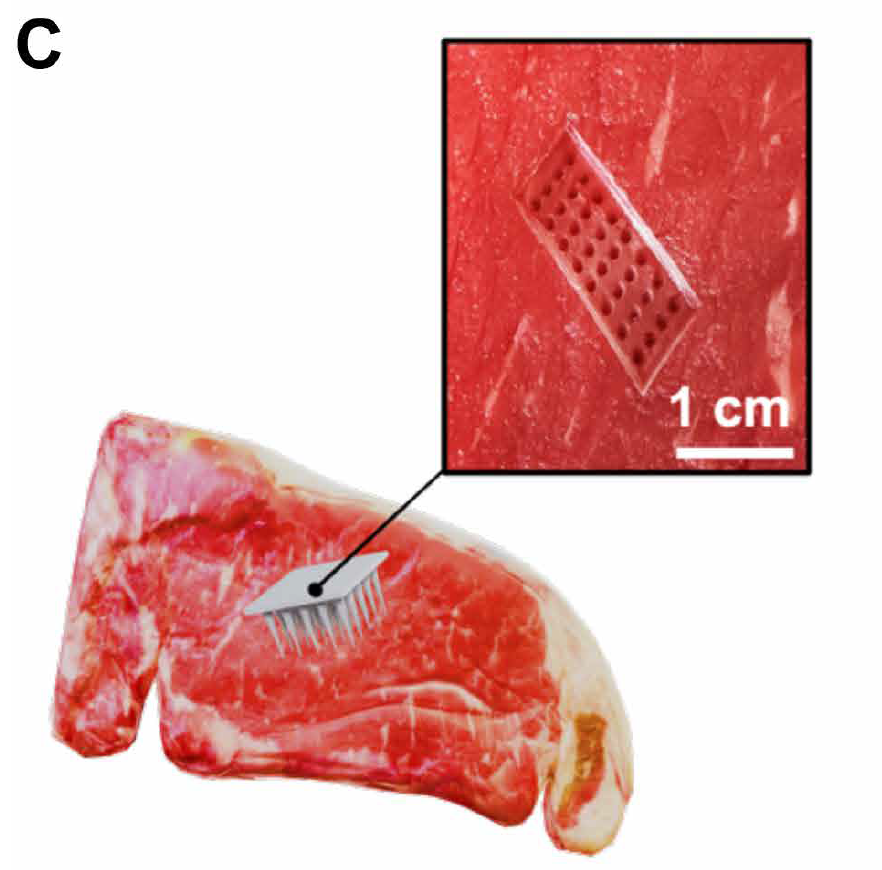
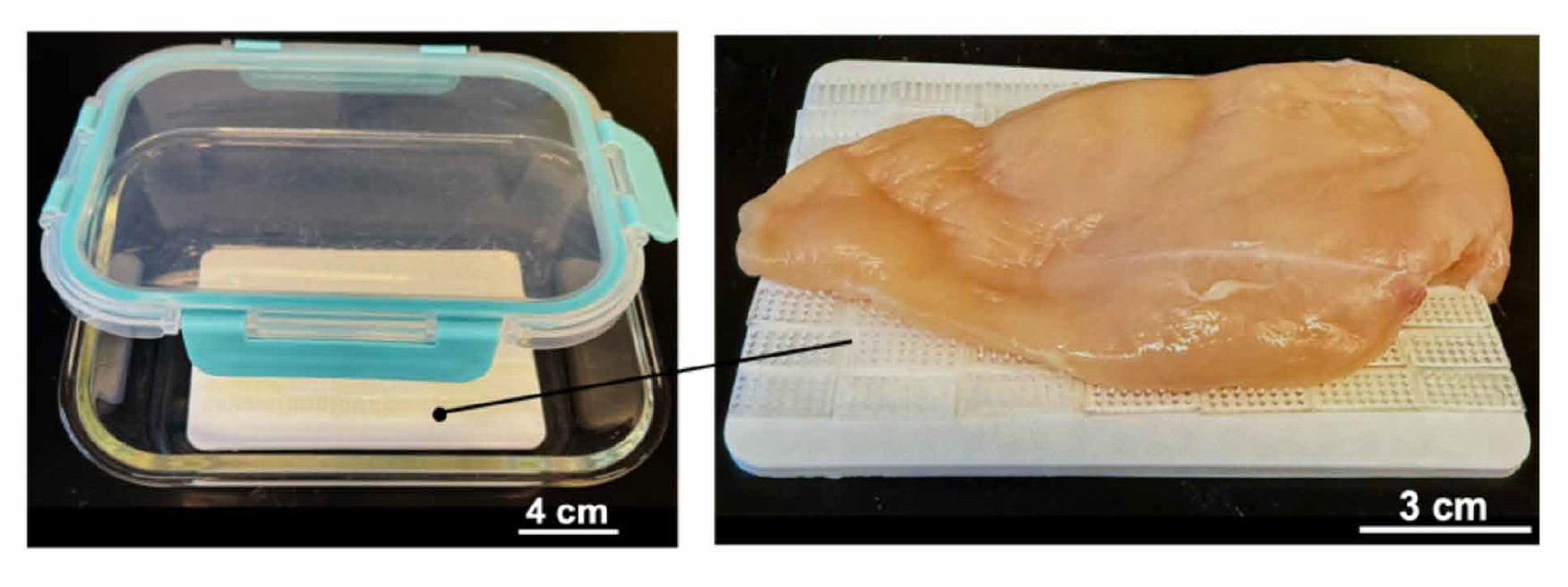
The patches proved effective in testing. One test involving contaminated cooked chicken saw 99.9% of E. coli bacteria wiped out in the sample. A similar test on raw beef saw a similar reduction of E.coli by 99%. These samples could effectively be considered decontaminated from the bacterial threat. The use of microneedles is key to the technique’s effectiveness. By penetrating up to a centimeter into the meat, it allows the bacteriophages to best get into contact with pathogens inside the food. In comparison, flat patches without needles performed less well, only reducing bacteria levels by three-quarters.
The research around using patches to deliver bacteriophages to food was only just published in October this year. However, the use of phages as a food safety measure actually goes back quite some time. The FDA first approved the use of bacteriophage products in 2006, initially for killing bacteria in ready-to-eat poultry and meat products. The same techniques can be applied to all sorts of foods, though use thus far has been limited. The US has actually been a leader in approving these food treatment methods; as a contrast, the European Union is yet to approve any use of bacteriophage products for food use.
As to whether these patches could enter wider use, that remains to be seen. There are some limitations with the technique. For one, it involves punching many small holes in food, which isn’t super attractive to those going to eat it later. There are also concerns about the effectiveness of phages in real-world use, and whether it would be practical to dose patches with a wide range of phages to counter the many strains of foodborne pathogens out there. It also depends on the perception of the tecnnology—we’d all rather eat food free of bacteria, but whether we want to eat food that is full of viruses is another thing entirely.
It will be a while before this technology reaches the mainstream food processing world, if it does at all. Regardless, the researchers can see a future where food packaging regularly includes a microneedle pad or membrane to take out any nasty bacteria before the product reaches the customer. That could promise to land better, safer food on our tables even if a few nasty bacteria did try to get involved in the action.
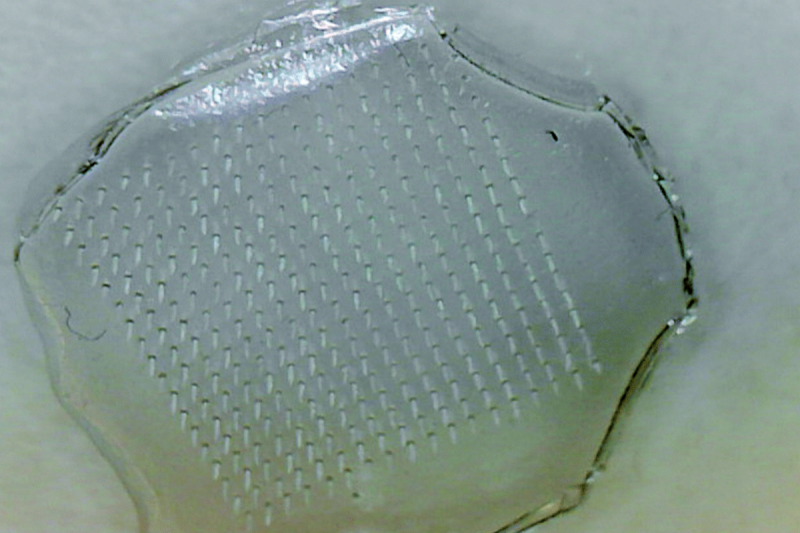
Featured image: microneedle array image from “Nanoparticle-infused-biodegradable-microneedles as drug-delivery systems: preparation and characterisation“.












“One test involving contaminated cooked chicken saw 99.9% of E. coli bacteria wiped out.”
Of course, there’s an xkcd for that:
https://xkcd.com/1161/
How do people like this even live within the world
Who do you mean?
– Randall Munroe (author/creator of XKCD)
– people who use/buy handsanitizer
– people who calculate 2×10^8 x 0,01 in their head
– who else?
people who think 0.01% is x0.0001
“That could promise to land better, safer food on our tables even if a few nasty bacteria did try to get involved in the action.”
Or more practically, make it possible to sell older and less hygienically processed meat.
But that’s just a happy accident wink-wink.
Yeah, that’s the only use case at scale I can see.
I heard someone make the argument that we should not irradiate food – not because it’s unsafe (perfectly safe to do so) or ineffective, but because it would allow food manufacturers/ packagers to get away with shipping nasty old food. I agree, and seems like the same thing here
Seems to me like a solution to a problem that shouldn’t “exist” in the first place.
Yeah I can’t really see this as a positive…
“GREAT NEWS! This chicken is old and rancid but adding viruses to it means you can still eat it and probably won’t shit yourself inside-out!”
What could possibly go wrong?
Yeah this seems like dropping a nuke to remove a wasp’s nest. Invent some expensive new revolting biopharma and then have a revolving door bureaucrat mandate a regulation that everyone needs to use it
bacteriophage-resistant bacteria strains being mass produced by food industry?
possibly in the 2050 post-antibiotic era…
Not quite. bacteria and phages have been at it almost since the beginning of life. So every bacteria has a lot of inherited resistance to phages already, both are nothing new.
But yes, if this turns into industry practice, that same meat will carry phage-resistant bacteria.
That’s one of the reason EU does not import US meat ( only small amounts from certified farmers, that has records of every animal, as required in EU ), bland, over vaccinated and roided meat. Good that it’s not happening here. I gladly pay extra for that clean meat from the start. YT is full of videos, where US citizens praise quality of hamburgers of US chains in EU.
The jokes write themselves
Oh please, did you miss the Mercosur deal which imports farm products, including meat, from Latin countries with zero of the requirements the EU places on their (or US) farmers
I wrote bigger response, seems to been ‘lost’ on filters, hopefully comes through
Unfortunately YES, I read that later that day.
Very sad, food industry (big producers) and chain stores have gotten their wish…. hope that parliament over turns it in voting.
I’ve ad eurpoean beef. Paid a premium for it, at a true 5 star restaurant.
It was the last beef I bought in europe that wasn’t a hamburger. \
You guys don’t know what good beef is. While I am against the common USA practice of hormones and all (There are big ranches that advertise not doing so, so its not that hard to avoid) the basics of feeding schedules should still be followed. Genetics are important too.
There are several breeds here in Europe, some make excellent beef steaks. Just to mention a couple Angus from Scotland or Chianina from Italy.
Was a time machine involved in writing the article ?
“The research around using patches to deliver bacteriophages to food was only just published in October this year.”
Should we account for evolution here? How likely are bacteria around the glove to develop a resistance to the viruses?
Would the industry account for the time that those viruses need to break down? as I would not like them to kill my gut microbiome, although I expect cooking would denaturalize most of them.
They probably chose specific bacteriophages that are easily killed by stomach acid which would make them less threatening to your gut micro biome. At least I would hope they selected for that (or will select ones before human trials)
Viruses that infect humans would be an exceedingly small fraction of random viruses.
Because ecoli is specifically relevant
Source: YouTube https://share.google/uSg6OZ34Fa2e9WEpf
Might be a fascinating start point for a lot of comments related here.
35years and counting ecoli evolution experiment in one lab.
“Should we account for evolution here? How likely are bacteria around the glove to develop a resistance to the viruses?” Not sure that’s how resistance works. More likely the majority non-resistant bacteria are killed off and the remaining resistant bacteria reproduce filling the now vacant ecological niche. Bacteria don’t think “uh-oh, we’d better start mutating!”
All this is so industrial meat packing can be done more
carelesslyinexpensively. They’ve been talking about wanting to spray phages on meat for years. Nothing beats hygiene. And sure, as an adjunct, fine, but the moment Tyson Foods realizes they can skip step XYZ, they’ll start shipping shittainted meat from sick animals.Aw neat, more manmade horrors beyond my comprehension.
what here is manmade though? bacteriophages exist to billion in water alone.
“Food poisoning cases tend to boil down to two categories—those involving toxins, and those involving bacterial pathogens”
You are forgetting viral food poisoning, by viruses like Noro and Rota.
That is a good point, because it’s a big issue in health and not addressed by this technique at all.
E. Coli is a fecal bacterium. The way that becomes foodborne is when the food handling is, eh, shitty.