
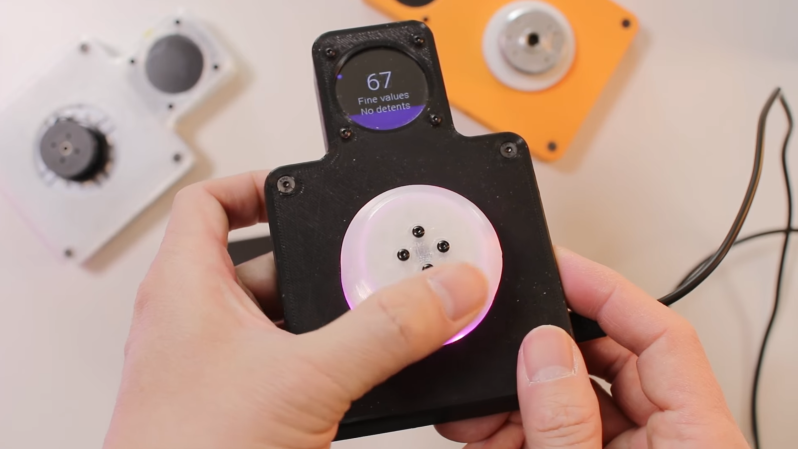
A knob can make a surprisingly versatile interface, particularly if it’s the SmartKnob, which builds a knob around a BLDC motor for programmable haptic response. It can rotate freely or with a set resistance, spring back to a fixed point when released, stick at detent points, and completely change its behavior as the interface demands. For people inexperienced in electronic assembly, though, smartknobs can be difficult to assemble. That’s why [Kokensha Tech] designed a simpler version, while at the same time letting it use a wider range of BLDC motors.
In addition to a motor, the original design used a magnetic encoder to detect position and a strain gauge to detect pressure on the knob. A circular LCD on the knob itself provided visual feedback, but it also required the motor to have a hollow center shaft. The LCD control wires running through the shaft proved tricky to assemble. [Kokensha Tech] moved the display out of the knob and onto a separate breakout board, which plugs into the controller board. This greatly broadens the range of compatible motors, since they no longer need a hollow shaft.
The motor now fits on a separate carrier board, which makes it easier to swap out different motors. The carrier board has mounting holes sized for a wide variety of motors, and four different types of motor connectors. [Kokensha Tech] also redesigned the rest of the PCB for easier soldering, while avoiding components with narrow pin spacing whenever possible. The original design used a LILYGO T-micro32 Plus MCU. The ESP32 is both cheaper and easier to solder, so it was a no-brainer to swap it in.
We’ve covered the original SmartKnob before, including a more in-depth look at its design. We’ve also seen another project use BLDCs and field-oriented control to make haptic knobs.












Very cool project from the perspective of the used technology, no doubt.
But a better title could have been, “simplifying the most complicated knob ever”.
I find it fascinating that the most functional piece of UI (a simple knob that does one, thing, does it very well, reliably and cheap and most of all repairable (and I mean a potentiometer with a plastic knob, that turns only 300deg. has an endstop and therefore absolute positions, you can control them even with your eyes closed and responds instantly). Why does the normal “knob” require a complete overhaul, with a motor, a display an microcontroller and ton’s of other things that can fail or be buggy or requires a development suite/compiler that is no longer supported within the next 5 years. Did I mention the power requirements for a ordinary pot-based-knob vs a smartknob? Or size?
Why.. what happened to K.I.S.S.? What happened to beauty is in simplicity?
Don’t get me started on touchscreen based “knobs and sliders” in cars (combined with bad UI and pop-up messages at the most inconvenient moments) but that’s a different topic.
You answered your own question, a simple knob ONLY does one thing well. Simple is a relative term that depends on the end game.
Well a normal pot can’t load a previously saved position, or record and play back an automation curve, for example. A motorised pot can of course, but you’re right back with the potential problems you mention again.
Feeling or not the detents on a pot verses a switch with multiple positions, change between one and the other depending on context. Pot or switch buzzes and refuses to be put non-allowed position, like eleven. Pot can be a ten-turn pot easily, gently bumps at each full turn. Ten-turn pots! There are 2 on my Arp instead of 4 coarse and fine pots to tune the VCO’s.
I like haptic feedback. I had a early mouse that let you feel lines in a menu as you moved the cursor down. Searching I find some are still out there but compatibility with page layout and such is a problem. This an accessibility feature that needs to be supported.
Is a Smart Knob an AI Codpiece?