
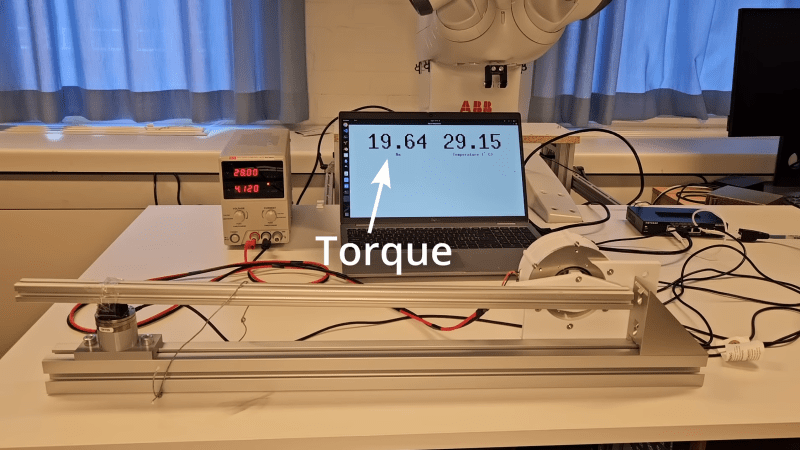
Unlike biological systems, which can use muscles, robots that try to imitate them don’t have particularly fast, powerful, compact linear actuators available. This puts walking robots at a particular disadvantage, since they can’t spread their actuators along a limb and have to place them right at the joint. [Food for Robots] took on the challenge of building such a joint-mounted actuator, and shared the results in a recent video.
[Food for Robots] is building a walking robot, so he needed a compact, lightweight, and backdrivable actuator capable of producing 20 Newton-meters of torque. He’d previously built a largely 3D-printed actuator, but when he tried to exceed 10 Nm of torque with it, various parts kept breaking. He therefore machined the second iteration out of aluminum; since it didn’t need to be 3D printed, he switched from a Capstan drive to a planetary gearbox. The gearbox sits in the center of the actuator, inside the stator, and uses several stacked layers of gears to increase strength within the limits of a small CNC.
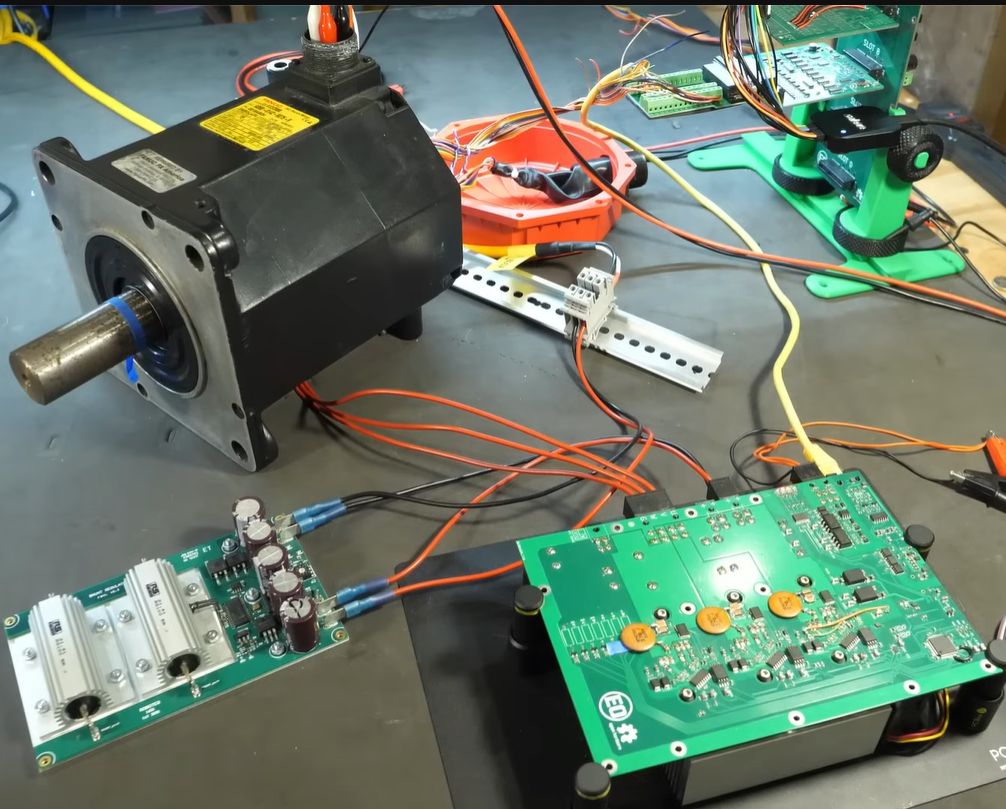
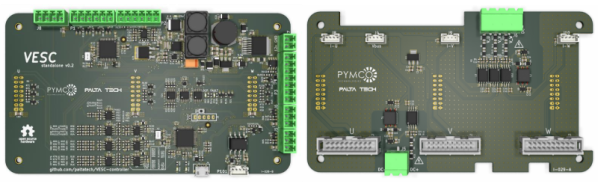
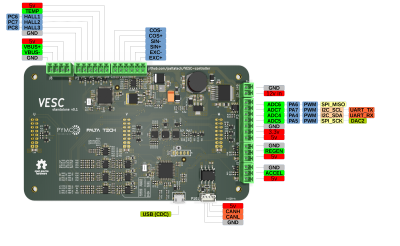 While [Vedder]’s controller is aimed at low power applications such as skate board motors, [Marcos]’s version amps it up several notches. It uses 600 V 600 A IGBT modules and 460 A current sensors capable of powering BLDC motors up to 150 kW. Since the control logic is seperated from the gate drivers and IGBT’s, it’s possible to adapt it for high power applications. All design files are available on the








