
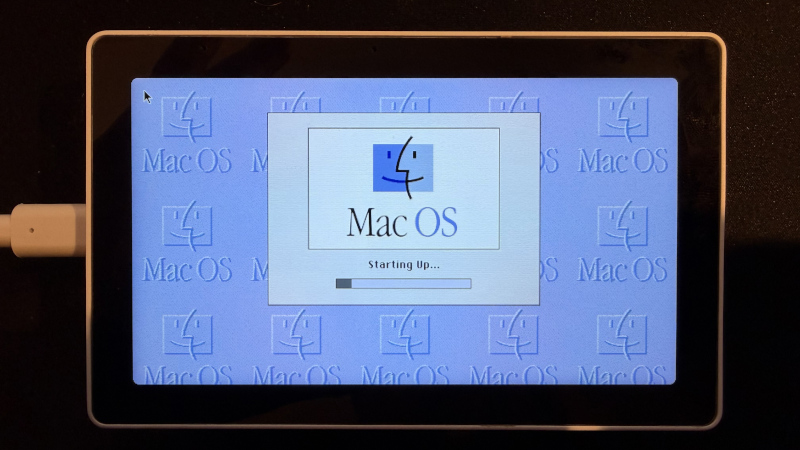
Emulating older computers on microcontrollers has been a staple of retrocomputing for many years now, with most 8-bit and some 16-bit machines available on Atmel, ARM, or ESP32 platforms. But there’s always been a horsepower limit, a point beyond which a microcontroller is no longer enough, and a “proper” computer is needed. One of those barriers now appears to have been broken, as microcontroller-based emulation moves into the 32-bit era. [Amcchord] has the Basilisk II emulator ported to the ESP32-P4 platform, providing a 68040 Mac able to run OS8.1. This early-1990s-spec machine might not seem like much in 2026, but it represents a major step forward.
The hardware it uses is the M5Stack Tab5, and it provides an emulated Mac with up to 16 MB of memory. Remember, in 1992 this would have been a high-spec machine. It manages a 15 frames per second refresh rate, which is adequate for productivity applications. The emulator uses the Tab5’s touchscreen to emulate the Mac mouse alongside support for USB input devices. To 1990 hackers, it’s almost the Mac tablet you didn’t know you would want in the future.
We like this project, both because it’s advancing the art of emulation on microcontrollers, and also because it delivers a computer that’s useful for some of the things you might have done with a Mac in 1992 and could even do today. Pulling this out on the train back then would have blown people’s minds. There’s even a chance that MacOS on something like this would turn a few heads in 2026. It’s certainly not the first emulated Mac we’ve seen though.












It’s worth being aware that Basilisk II is only a Mac emulator in the broadest sense of the term.
While it emulates an ‘040, it primarily only uses the toolbox ROM for the gestalt ID that it flags to software, while trapping out all (or nearly all) accesses to machine hardware. As the majority of Macintosh software didn’t directly bang on the hardware, this works for the purposes of running software. But you’re not going to find emulation of any of the underlying hardware found in any particular model of Macintosh.
For the latter, MAME or Mini vMac are the ways to go for 68k-based Macs, or DingusPPC for old-world PowerPC Macs.
Snow is a more recent emulator (written in Rust) that tries to emulate 68k Macs (128k to Mac IIcx/SE30 at the moment) on the hardware level as much as possible. It would be interesting to see if the ESP32-P4 is fast enough to run Snow with reasonable performance.
https://snowemu.com
By the way, you mentioned Rust.
I was told any information in parens not part of a mathematical formula can be ignored and could have been left out by the author all along. 😎
Interesting. That’s in parts also the reason SheepShaver hasn’t been ported to microcontrollers yet, maybe, I guess?
Because as far as I understand it, the PowerPC platform relies on PowerPC instructions in addition to the built-in 680EC40 emulation core provided as stock by the PPC MacOS/PPC Mac firmware.
So emulating a whole Power PC Mac isn’t as easy as “bending” Toolbox calls on a rudimentary 68040 core.
Instead, Power PC emulation itself rather would have to be complete enough to get the official 680EC40 emulator going on top of it, as well.
But I want to play Crystal Quest!
Unless it can play Marathon 2 at 30pfs, it doesn’t count