How Industrial Robot Safety Was Written In Blood

It was January 25th of 1979, at an unassuming Michigan Ford Motor Company factory. Productivity over the past years had been skyrocketing due to increased automation, courtesy of Litton Industry’s industrial robots that among other things helped to pick parts from shelves. Unfortunately, on that day there was an issue with the automated inventory system, so Robert Williams was asked to retrieve parts manually.

As he climbed into the third level of the storage rack, he was crushed from behind by the arm of one of the still active one-ton transfer vehicles, killing him instantly. It would take half an hour before his body was discovered, and many years before the manufacturer would be forced to pay damages to his estate in a settlement. He only lived to be twenty-five years old.

Since Robert’s gruesome death, industrial robots have become much safer, with keep-out zones, sensors, and other safety measures. However this didn’t happen overnight; it’s worth going over some of the robot tragedies to see how we got here.

Continue reading “How Industrial Robot Safety Was Written In Blood”
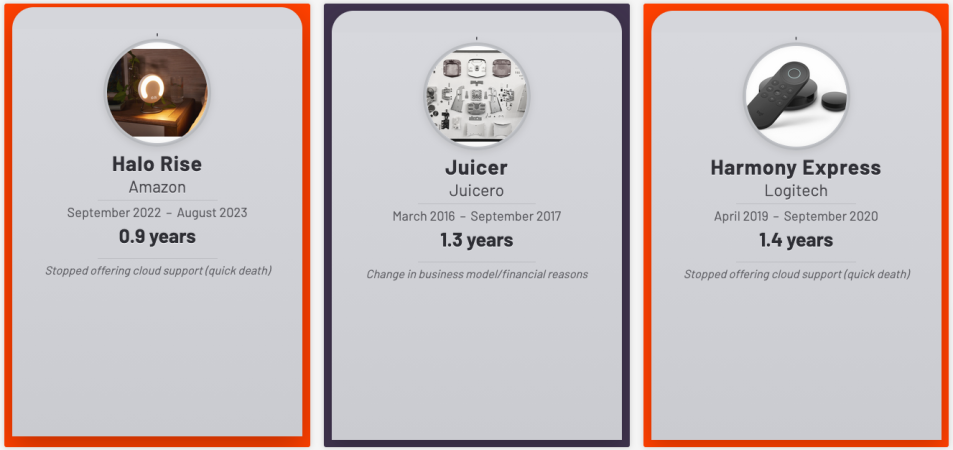
Electronic headstones. The first with an image of a circular lamp on a table. Text reads: "Halo Rise, Amazon, September 2022-August 2023, 0.9 years, Stopped offering cloud support (quick death)" Second is an image of a disassembled countertop appliance. Text reads: "Juicer, Juicero, March 2016-September 2017, 1.3 years, Change in business model/financial reasons" Third is an image of a black TV remote with the text: "Harmony Express, Logitech, April 2019-September 2020, 1.4 years, Stopped offering cloud support (quick death)"

Electronic Waste Graveyard Immortalizes Dead Electronics

Everyone here can think of a cloud-connected product that was killed because the company that made it stopped supporting it. While these corporations have forgotten their products, the US PIRG Education Fund has immortalized them in their Electronic Waste Graveyard.

With an estimated “130,000,000 pounds of electronic waste” produced since 2014, the amount of wasted resources is staggering. The advent of the cloud promised us reduced waste as lightweight devices could rely on remote brains to keep the upgrades going long after a traditional device would have been unable to keep up. The opposite seems to have occurred, wreaking havoc on the environment and pocketbooks.

Of course, we can count on hackers to circumvent the end of companies or services, but while that gives us plenty of fodder for projects, it isn’t so great for the normal folks who make up the rest of the population. We appreciate PIRG giving such a visceral reminder of the cost of business-as-usual for those who aren’t always thinking about material usage and waste.

If PIRG sounds familiar, they’re one of the many groups keeping an eye on Right-to-Repair legislation. We’ve been keeping an eye on it too with places like the EU, Texas, and Washington moving the ball forward on reducing e-waste and keeping devices running longer.

When Mains Networking Fails, Use Phone Wires

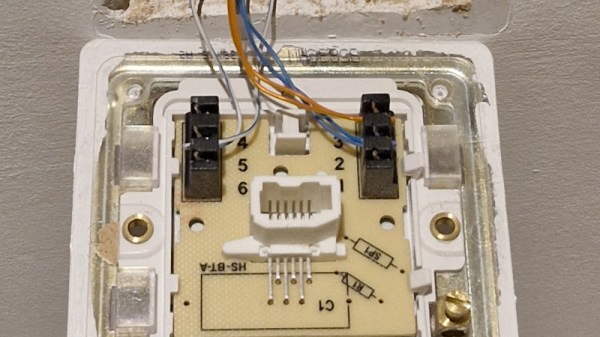
A quiet shift over the last couple of decades in many places has been the disappearance of the traditional copper phone line. First the corded landline phone was replaced by cordless, then the phone migrated to a mobile device, and finally DSL connections are being supplanted by fiber. This leaves copper-era infrastructure in houses, which [TheHFTguy] decided to use for Ethernet.

The hack here isn’t that he bought some specialized network boxes from Germany, though knowing they exist is useful. Instead it comes in his suggestion that they use the same technology as mains networking. Mains network plugs are a dime a dozen, but noisy power lines can make them of limited use. Our hacking curiosity is whetted by the question of whether a cheap mains networking plug can have its networking — in reality a set of RF subcarriers — separated from its mains power supply, and persuaded to do the same job at a fraction of the cost. Come on commenters – has anyone ever tried this?