
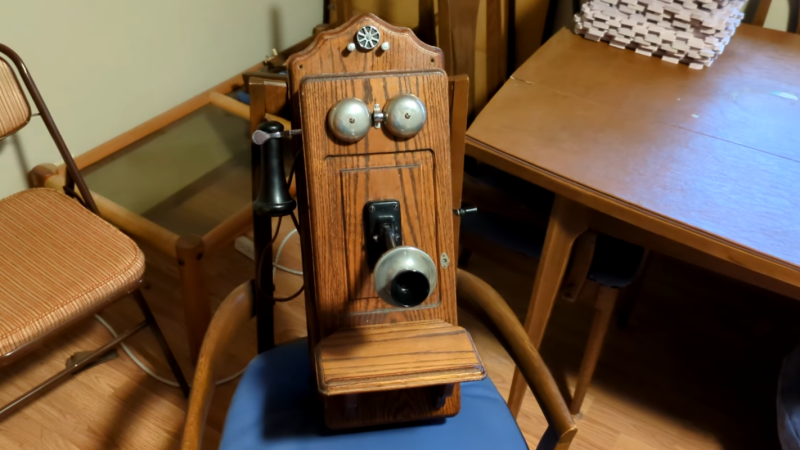
Although it can be hard to imagine in today’s semiconductor-powered, digital world, there was electrical technology around before the widespread adoption of the transistor in the latter half of the 1900s that could do more than provide lighting. People figured out clever ways to send information around analog systems, whether that was a telegraph or a telephone. These systems are almost completely obsolete these days thanks to digital technology, leaving a large number of rotary phones and other communications systems relegated to the dustbin of history. [Attoparsec] brought a few of these old machines back to life anyway, setting up a local intercom system with technology faithful to this pre-digital era.
These phones date well before the rotary phone that some of us may be familiar with, to a time where landline phones had batteries installed in them to provide current to the analog voice circuit. A transformer isolated the DC out of the line and amplified the voice signal. A generator was included in parallel which, when operated by hand, could ring the other phones on the line. The challenge to this build was keeping everything period-appropriate, with a few compromises made for the batteries which are D-cell batteries with a recreation case. [Attoparsec] even found cloth wiring meant for guitars to keep the insides looking like they’re still 100 years old. Beyond that, a few plastic parts needed to be fabricated to make sure the circuit was working properly, but for a relatively simple machine the repairs were relatively straightforward.
The other key to getting an intercom set up in a house is exterior to the phones themselves. There needs to be some sort of wiring connecting the phones, and [Attoparsec] had a number of existing phone wiring options already available in his house. He only needed to run a few extra wires to get the phones located in his preferred spots. After everything is hooked up, the phones work just as they would have when they were new, although their actual utility is limited by the availability of things like smartphones. But, if you have enough of these antiques, you can always build your own analog phone network from the ground up to support them all.












Very cool!!! My unle had one of these old wall phones in his house in Cicero, Chicago Illinois USA. He had it working with the regular phone lines except to dial out you had to remove the receiver and half press the hook to get an operator. You then had to ask the operator to dial the number you needed. That was early 1980’s.
When I was a kid we had a pair of toy phones, they took a couple of batteries and had a 50ft cord, you pressed on the dial and it rang the other phone. You could talk on it. On the one hand, it was obviously a toy, on the other it was working intercom.
I had the same ones. Quality product…lasted a week or so before something broke. Always wanted a real telephone setup between me and my friends’ houses.
I made sure my grankids had it — got a few cheap VOIP phones off Goodwill, and set up a FreePBX switch on an old laptop. Our grandkids can call us on their private line anytime (our phone rings with the Bluey theme song)
When I was a kid, a friend had some real phones that we set up as an intercom. He said you could ring it with 120VAC, but that only worked a few times.
I think we used a Wester Union 500 and a Princess phone.
Minus the ringing, you can do this with ordinary land line phone wired in series with a couple hundred ohm resistor and a 9V battery.
Of course, you’ll have a hard time getting the attention of the other party without ringing.
Make that two ordinary land line phones wired in series.
The Media Archaeology Library in Boulder, Colorado, recently set one of these networks up with two phones, a 9V battery, and for the transmission lines, a run of barbed fence wire. They did it because across the American and Canadian west, exactly these sorts of networks were set up in large numbers of rural neighborhoods in the 1890-1930 era before the telephone companies had found it economical to build out their networks. Fence wire phone networks were necessarily like party lines: everyone rang at the same time, and apparently they often stopped working during rain, but were surprisingly effective. There was a vintage fenceline phone network in Golden, Colorado, that was used for communicating about irrigation ditch water levels between the fill gate and the users 30km away, until the 1960’s.
Probably used the earth as the second wire too.
Brings back memories. In the 70s we had a set of these running between the main house and the pool cabin. They still used those enormous No.6 cells: three in series in their own separate steel box. They were handy to have around: I also used them for glow plug model engine starting.
I haven’t seen one of those Number 6 cells in years! Not since I was doing projects from kid’s books on electricity/electronics in the ’60s and very early 70s. I just checked Amazon to see if they still had them, but the closest thing I could find were those old square lantern batteries with coiled spring terminals.
Just wait till you see what’s inside those current lantern cells, aside from rust and grime anyway. It’s usually a large collection of smaller cells ( I’ve seen AAA ), poorly insulated.
They were also a great source of really big carbon rods for doing things like electrolysis and making carbon-arc lamps.
New batteries… not so much. Even a D cell contains just a puny little rod, barely 5 mm in diameter.
When I was little grandma and grandpa had a pair of those things, one in the kitchen and one in the shop. Grandpa would be out there fixing stuff and grandma would simply ring him on the telephone to get him to come in for dinner or whatever. By the time I was a few years older we all had a great time using the phones. They told us all about how there was a common phone line and every house on the line had a “number” that was like, two short rings then a long (for example) or just keep cranking for operator. You could listen in on everyone’s calls too. We had those phones after they died but they were sadly lost in a fire and I never got the chance to hang them in my house where they would certainly my be useful for my wife to… ring me up in the garage to tell me to come back into the house. Go figure.