
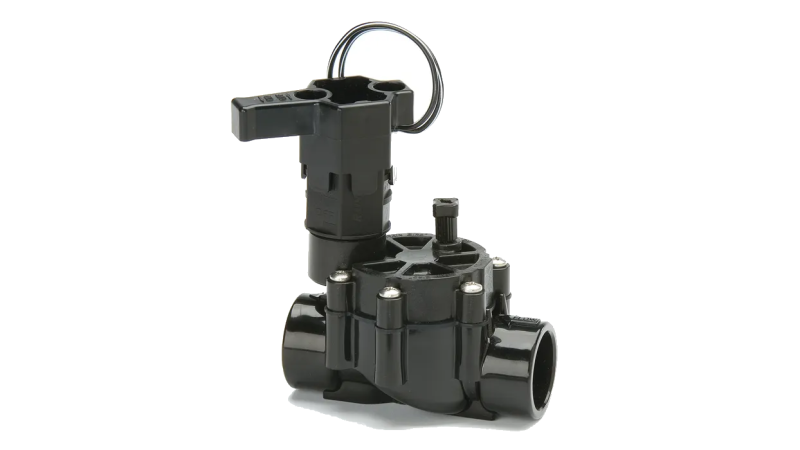
Due to historical engineering decisions made many decades ago, a great many irrigation systems rely on solenoid valves that operate on 24 volts AC. This can be inconvenient if you’re trying to integrate those valves with a modern smart home control system. [Johan] had read that there were ways to convert these valves to more convenient DC operation, and dived into the task himself.
 As [Johan] found, simply wiring these valves up to DC voltage doesn’t go well. You tend to have to lower the voltage to avoid overheating, since the inductance effect used to limit the AC current doesn’t work at DC. However, even at as low as 12 volts, you might still overheat the solenoids, or you might not have enough current to activate the solenoid properly.
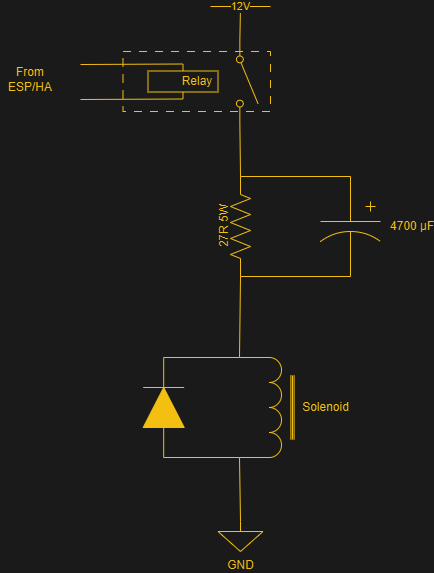
The workaround involves wiring up a current limiting resistor with a large capacitor in parallel. When firing 12 volts down the line to a solenoid valve, the resistor acts as a current limiter, while the parallel cap is initially a short circuit. This allows a high current initially, that slowly tails off to the limited value as the capacitor reaches full charge. This ensures the solenoid valve switches hard as required, but keeps the current level lower over the long term to avoid overheating. According to [Johan], this allows running 24V AC solenoid valves with a 12V DC supply and some simple off-the-shelf relay boards.
We’ve seen similar work before, which was applied to great effect. Sometimes doing a little hack work on your own can net you great hardware to work with. If you’ve found your own way to irrigate your garden as cheaply and effectively as possible, don’t hesitate to notify the tipsline!












Using AC helps prevent galcanic corrosion which elelectrical connections in irrigation control boxes a notorius for.
Since you need the relay board, why not just use the relay to switch 24vac?
Because you might have 12VDC but no 24VAC if you for example run on a solar system.
As mentioned in the third sentence, the “doer” was wanting to convert from the 24v AC system to a DC system.
Yeah but why?
From the original post:
Also done driving AC valves using DC but with PWM, driven by MCU trough a mosfet…part of a never finished project with 2 wire cable bringing power and data…cables are short and PWM frequency low so EMI should not be an issue.
The “historical reasons” still apply. These valves are often used to irrigate huge areas (parks, golf courses, etc) where they’re a long ways from the control box.
24v AC is much more efficient over longer distances than lower voltage DC: thinner wires and less power loss.
In that sense, it’s less about history and more about products developed for institutions but also sold to single-family-homes.
I guess you could still argue that the “history” is that institutional market came first and then the residential one came later.
AC isn’t inherently more efficient in transmission. The advantage is in the ease of transforming it up and down.
Sending 24 ac over long distances wouldn’t be any more efficient than sending dc
Garden wiring is unlikely to be fully watertight, so DC risks corrosion of wiring due to electromigration. AC doesn’t have this problem.
I don’t know if electromigration is significant in this case, but galvanic corrosion absolutely is a problem if you are using positive DC voltage that is Earth ground referenced. This is why telcos use -48V: the wet pair at elevated (negative) voltage isn’t the oxygen-forming electrode in a galvanic cell and therefore doesn’t corrode as badly when wet.
Obligatory XKCD reference: https://xkcd.com/567/
I heard years ago about a conspiracy that Ford with its positive ground wouldn’t rust out as fast and they changed to neg like everybody else. This says true and old Fords rust out slower and that’s why they changed and went with the rest.
they probably changed because conecting cables to a second car to make it start with a dead battery has a standard sequence, and having even one single car model that is different, is a big risc of cable fire, because you will usually connect positive to positive, then negative of good battery to bad car to avoid sparks near the battery, that would immidiatly cause a short on the good car, which wouldn’t be fun…
Actually, power efficiency is about the same. Power loss is determined by squared current times wire resistance ($P=I^2R$). Modern DC controllers regulate the output to match the holding current of the solenoid, so the actual current running through the wire is virtually the same as under AC. Therefore, the power loss is about the same.
The advantage of AC is anti-corrosion: the alternating current prevents electrolysis from eating away copper wire if the insulation gets nicked underground.
I’m pretty sure the “historical reasons” are simply that with 120VAC from the wall it’s a lot easier to generate 24VAC than 24VDC – all you need is a little transformer. AC is not inherently more efficient than DC, it’s just easier to convert up and down and higher voltage is more efficient than lower voltage.
Pretty much everything I know about computer hardware I learned when, as a teenager, Dad asked me to have the old Commodore 64 run the sprinklers. I added an extra 6522 via the cartridge port and used it to drive an optocoupler which in turn drove a triac to switch the 24VAC. It sparked (pardon the pun) a lifelong fascination with running on bare metal.
I did see ,somewhere, the same idea and there is a component that is doing it from Bur-Brown 2001 now TI :
DRV103 main specs: 8 to 32V 1.5A 0.5R PWM (internal) Low-side Driver.
Yes, a low-side DC driver is a simpler design: You’re driving a solenoid,m so you don’t care if it’s a little above ground on the negative terminal – there’s no electronics in it to care.
Unless like in most irrigation systems you have a common ground / return line for the entire network…
” This can be inconvenient if you’re trying to integrate those valves with a modern smart home control system. ”
Seems like he just wanted a more complicated way to do things. Smart Home control can control relays, so just take the AC and switch it through the relay.
“This can be inconvenient if you’re trying to integrate those valves with a modern smart home control system.” Seems like they just wanted to overcomplicate things. SHC can control relays. So just take the AC and switch it through a relay. Simple.
When I must drive solenoids with DC, I drive them with a PWM-driven FET. I hit them with 100% to engage the solenoid, then back off to a PWM that will reliably hold the solenoid in, without overheating. There’s variations in the amount of holding current required, so it needs to be tunable per solenoid supported.
Running AC-coil relays on DC is a lot easier than trying to make DC-coil relays work on AC.
An AC coil core is laminated to reduce eddy current losses, and also includes a secondary coil or loop on part of the core to make a shaded pole. A DC coil, without those features, is hard to energize enough to pull in without burning it up. It’s best to just put a bridge rectifier in series.
Put that one in your little mental library of tips.
The ultimate reference for designing a simple low-parts-count DC solenoid driver is from the analog genius himself, Robert Pease: https://base.imgix.net/files/base/ebm/electronicdesign/document/2019/03/electronicdesign_9780_solenoid_driver_anyhow.pdf
Just like this guy is doing, but skipping the intermediate relay.
The DC-powered OpenSprinkler takes a different approach to this problem: it uses an internal boost converter to generate a high impulse voltage to provide inrush current, then lowers to the input voltage to provide holding current:
https://opensprinkler.com/introducing-dc-powered-opensprinkler-v3-4/
The latest version (v3.4) leverages USB-C PPS to negotiates an optimal holding voltage to match the valve’s specific coil resistance and holding current requirements. Apparently the solenoid coil resistance can vary quite widely (as low as 20 ohm and as high as 60 ohm). So fine-tuning the holding voltage can be important to ensure the solenoid remain reliably activated while minimizing power consumption.
My home automation for the garden uses 24Vac. An ESP8266 drives a relay board that switches power to the solenoids. A 24Vac to 5Vdc converter powers the micro, which is integrated via wifi. Simples!
That’s the same circuit that’s often used to drive relays at reduced power.
It’s not really a tech-heavy solution, but you could just buy DC sprinkler valves. Any decent supply house selling AC sprinkler valves should also have DC ones. Rainbird, K-rain, Hunter (all the bigger US brands) make DC versions and they’re the same cost as the AC ones.
Could you provide some links? The only Rainbird and Hunter valves I can find (which are DC rated) are latching valves – they are very different and would require H-bridges to operate. Many motorized ball valves (e.g. by U.S. Solid) do work with both AC and DC but they are usually much pricier.
Use a cheap class D audio amp fed with a 60 Hz “tone” . That will get your 24VAC if properly setup (Small 1:2 transformer on the output).
I just run a transformer off a smart plug for each of the two valves in my far paddock.
If you have some stations long way off, say 250 ft, the round ft journey is 500 ft and voltage drop is significant. In addition, one has to send many conductors one extra for each station. Ideally, send 24V AC, use AC/DC to DC board to bring them to 12v which can power a zigbee board and then use the 24V capacitor/resistor innovation (let us not call it a hack). The current needed is about 1 amp max and this is much simpler and there is usually only one station on at one time. The Zigbee board can actuate the relay for the 12V DC circuit to be energized for the valve.