
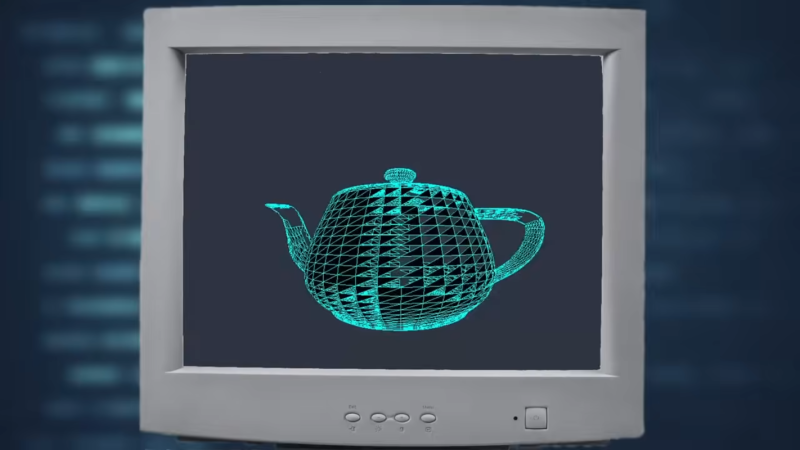
Plenty of our childhoods had at least one math teacher who made the (ultimately erroneous) claim that we needed to learn to do math because we wouldn’t always have a calculator in our pockets. While the reasoning isn’t particularly sound anymore, knowing how to do math from first principles is still a good idea in general. Similarly, most of us have hugely powerful graphics cards with computing power that PC users decades ago could only dream of, but [NCOT Technology] still decided to take up this project where he does the math that shows the fundamentals of how 3D computer graphics are generated.
The best place to start is at the beginning, so the video demonstrates a simple cube wireframe drawn by connecting eight points together with lines. This is simple enough, but modern 3D graphics are really triangles stitched together to make essentially every shape we see on the screen. For [NCOT Technology]’s software, he’s using the Utah Teapot, essentially the “hello world” of 3D graphics programming. The first step is drawing all of the triangles to make the teapot wireframe. Then the triangles are made opaque, which is a step in the right direction but isn’t quite complete. The next steps to make it look more like a teapot are to hide the back faces of the triangles, figure out which of them face the viewer at any given moment, and then make sure that all of these triangles are drawn in the correct orientation.
Rendering a teapot is one thing, but to get to something more modern-looking like a first-person shooter, he also demonstrates all the matrix math that allows the player to move around an object. Technically, the object moves around the viewer, but the end effect is one that eventually makes it so we can play our favorite games, from DOOM to DOOM Eternal. He notes that his code isn’t perfect, but he did it from the ground up and didn’t use anything to build it other than his computer and his own brain, and now understands 3D graphics on a much deeper level than simply using an engine or API would generally allow for. The 3D world can also be explored through the magic of Excel.












“Plenty of our childhoods had at least one math teacher who made the (ultimately erroneous) claim that we needed to learn to do math because we wouldn’t always have a calculator in our pockets.”
Arithmetic, not math.
I wish I practiced more arithmetic as a kid. I’m a bit slow. This year I’m going to practice doing faster mental arithmetic.
Interestingly, the class is called “mathematics” though. Hence teachers refer to it that way, I think.
Here in Germany, since about early 20th century, the class (-in elementary school at least-)
was originally called “Rechnen” (calculating) but has been renamed “Mathematik” (mathematics) for decades now.
Probably because it sounds more intellectual, not sure.
The short name casually used by pupils is “Mathe” (math).
In Dutch it’s still called “rekenen” (calculating) in elementary school. It’s addition, subtraction, multiplication, division and practical applications for it (calculating area, simple probability tree diagrams, adding up a bill). It leaves out powers (though many students to know about integer powers as repeated multiplication), algebra, trig and graphs.
The original teapot – along with a cup, saucer, and spoon – were made out of NURBS surfaces, not triangles. I don’t know if this is mentioned in the video.
I thought they were simpler Bezier surfaces.
(Different Paul)
Both. The original Utah (Newell) teapot was modeled with Bezier curves, but Bezier curves can be represented by NURBS.
Didn’t watch but the thumbnail is full of C++ code, and nobody used C++ to write 3D games back in the day.
Maybe C++ is the programming language the author knows best.
https://archive.org/details/CE3DC
This is why 3D Games now sucks and underperform lol
Where exactly does anyone claim that they did?
Nonsense: https://flipcode.com/
better way is making c lib and wraper for ruby / perl haskell and other language (read forth)
Exactly the same idea, but I thought Python would be better suited for beginners:
https://freehackers.org/orzel/PythonMeshViewer
It does most of what this article speaks about, using basic math/calculus.
Objects are moved either automatically or manually, and you can toggles features (face hiding, colorization, edges rendering.
Be sure to check the About box for key bindings.
Arrgh! Am transported back in time, reading paperback books on 3D graphics programming.
Maybe the book had a floopy disk come with it?
Still treasuring my copy of Newman and Sproull’s Principles of Interactive Computer Graphics that goes through all this stuff, from first principles.
My 1979 edition is dedicated to Bui Tuong Phong. Yes, Phong shading has been around that long.