
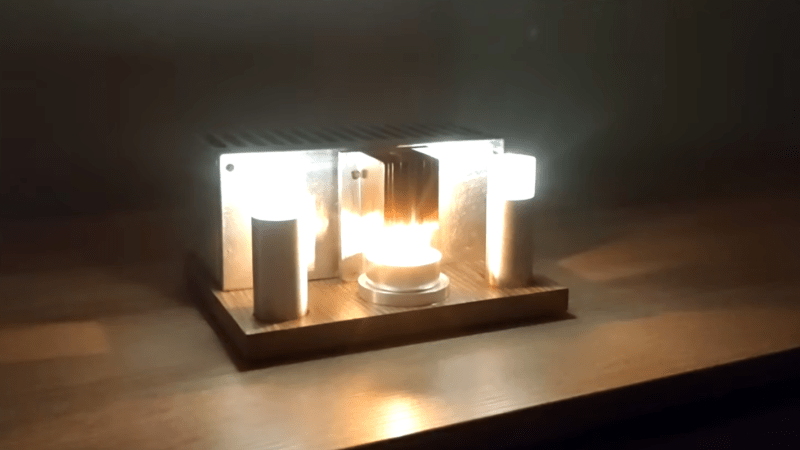
For a little over two thousand years, the primary light sources after the sun had set were oil lamps and candles. This was well before the age of fossil fuels, so these oil lamps were often fueled with a labor-intensive agricultural product like olive oil. Candles were similarly difficult to make, made from tallow, beeswax, or even butter. Labor and materials costs aside, though, there’s a surprising amount of energy in these fuels and [Maciej Nowak Projects] has a generator that help these ancient light sources generate some electricity on the side.
The generator is based around a piece of technology called a thermoelectric generator (TEG), which produces a voltage potential when placed in a temperature gradient. These aren’t new technologies, but their typically low efficiencies limit where they can be effectively used. In this case, however, [Maciej Nowak] has gone to great effort to boost this efficiency as high as possible by using a huge radiator on the cool side of the TEG and another one on the hot side, which in this case is heated by a small tea candle. The electricity produced is sent to a tiny DC converter which regulates the voltage to 3.3V, which then powers two custom-built pedestal lamps on either side of the TEG, each with a high-efficiency LED mounted to a custom-made circuit board.
Although this is certainly not the first time a TEG has been set up to run a small lighting system, we do appreciate this one for its polish, design, and high efficiency. It would make a fitting addition to anyone’s emergency power outage kit as it really increases the amount of available light produced from any given candle. When taken to the extreme, though, thermoelectric generators can be made to produce a surprising amount of energy, provided they are placed in the right environment.












Ah, yes. The Obligatory peltier-element experiment. The canon event every electronics person goes through at one point.
But i have to say, this is propably one of the best ones i´ve seen yet. 10/10 execution. Yes,, around ~1-1,4 Wh per candle is not much but make a pretty case and i would definitely use it in a remote cabin.
The efficiency is pretty abysmal at around 1% but that’s mostly because a peltier element is so good at conducting heat that there’s not much of a temperature difference between the hot and the cold side with the limited amount of heat coming from the candle.
It’s basically an impedance mismatch problem. If you stack more peltier elements, the voltage would go up and the temperature difference across the stack would increase, and the efficiency would improve to maybe 5%. Theoretically it could go up to 10-12% but I doubt these cheap peltiers are that good.
With that 5x improvement, you could get 2 Watts out of it, which is enough to power a proper CRI90 LED bulb with an equivalent output of a 25 Watt regular bulb. That’s enough for a mood light or a desk/reading lamp. Three or four will light up a room quite nicely.
I’ve seen designs that take an old soup can and put the heads of bimetallic junctions facing inwards to a chimney in the can and potted in plaster of paris. The candle heats up the chimney, heating the bimetallic junctions, and you wire the junctions in series and parallel to get the voltage and current you need.
That’s Seebeck effect and not peltier, but the result is the same.
The design was intended to power a small radio, so you could potentially listen for signals after a complete apocalypse. It was an example of something that was easy enough to build using only scraps you could find lying around.
Sounds like the Soviet Lamp Radio?
https://swling.com/blog/2020/05/soviet-era-kerosene-lamp-generator-gives-new-meaning-to-lets-fire-up-the-radio/
Technically the Seebeck and Peltier effects are reverse of each other. One produces current, the other moves heat. We just call them Peltier devices because of the more popular use in mini fridges.
LED bulb … : – ] … next to a candle … : – ] …
Seen something like this years ago on YT. Maybe on the “Our Own Devices” channel, which I welcome back after being hacked and banned.
“For a little over two thousand years, the primary light sources after the sun had set were oil lamps and candles” … No, well over 10.000 years B.C. (Lascaux, 10-15.000 years B.C.)
“these oil lamps were often fueled with a labor-intensive agricultural product” … Also not, since they predate agriculture. Animal fat was the easiest to obtain from gatherer-hunters.
Plus, candles are far more recent than oil lamps, by like several thousand years!
Beeswax predates both, though I am not exactly sure if there was suitable wick; probably.
Besides the usual complaint about confusing energy and power, raising questions about the competence of the creator…
If you want to skip the fabrication step, they’ve been available commercially for many years, like https://www.leevalley.com/en-gb/shop/home/lighting/lanterns/68887-candle-powered-led-lantern
What I want is a small cookie tin sized generator that takes camping gas bottles and outputs enough power to keep an e-bike charged up while riding.
It’s interesting to do the arithmetic on that problem: I went through a similar exercise a few years ago. Up to about 10 charges or 7-10 days it’s cheaper, weight- and cost-wise to simply carry more charged batteries. Only when your excursion is more than a couple of weeks does it make sense to carry even a tiny generator and fuel for it.
Carrying a generator for a long weekend trip doesn’t make sense.
(And if you’re really weight constrained and cost isn’t a significant concern, disposable lithium batteries win hands-down. Important for extended photography expeditions.)
I was considering one of those fat tire scooters that are classified as e-bikes. The main issue is that they only go for like 20 miles on a charge, in fair weather, with new batteries, with no load except the rider.
Longer range options are of course available, but what if I could just have “infinite” range by plopping a four-stroke suitcase generator on it. Strip it down a little and stuff it under the seat. That way there would be enough space for the groceries on board as well, or a pack and a tent.
A gallon of gasoline in the generator would give me a range of about 220 miles, which is also a pretty good fuel mileage compared to anything (1.1 L/100 km).
A Honda EU10i weighs 13 kg plus 2 kilos of fuel, minus the original battery which would be “reduced” to a minimum to still call it an e-bike. So about 12 kilos extra weight. An equivalent battery pack would be around 20 kilos plus mounting hardware. If I wanted to double the range I could take on extra 2 kilos of fuel, versus another 20 kilos of batteries.
The latter case would be impossible anyhow, because the scooter only has 40 kilos of capacity left with me on-board. With the generator and fuel I would have 26 kilos for gear, while with the batteries I’d have none.
Interesting… so you want to burn bottled gas… to generate electricity… to charge a battery… to run an electric motor… on your bike?
Reminds me of the guy with the Tesla truck who pulled into a gas station and told the attendant, “Give me 5 bucks worth.” The confused operator pointed out that the man was driving an EV. “Oh… it’s for the generator I keep in the back, for when I run out of battery juice.”
Seems like connecting your proposed gas bottle directly to a small 2-stroke engine would be a lot simpler.
All things accounted for, that’s probably the “greener,” solution, too.
Yes, because burning gas to turn an engine to push a bike is very restricted and highly regulated, not to mention costly with all the insurances and registrations and taxes, whereas an E-bike isn’t – as long as it can pretend to be an e-bike.
The two stroke engine idea would be sound if it didn’t make so much noise.
How about a tube radio that operates on the heat of a kerosene lamp?
https://onetuberadio.com/2018/08/18/1958-soviet-kerosene-powered-radio/
An early 60’s issue of Popular Science featured a project for a small single-transistor radio that was powered by thermocouples heated with a… hookah.
https://books.google.com/books?id=VyYDAAAAMBAJ&pg=PA156&dq=%22powered+by+a+candle%22&hl=en&sa=X&ved=2ahUKEwjf8K-3wfCSAxUOPUQIHbeoD3gQ6wF6BAgJEAE#v=onepage&q=%22powered%20by%20a%20candle%22&f=false
My tip to anyone trying to use peltiers in e teg config is to flip it “backwards”. That way the solder joints for the connecting wires will be on the cold side. I had trouble with “automatic desoldering” in a candle powered fan I once crafted. Also, copper paste works better as thermal compound when the temperature is high.
https://gigazine.net/gsc_news/en/20120618-tpod1/
I bought one (Kickstarter) and it still works and i use it still occasionally…
https://www.kickstarter.com/projects/tpod1/tpod1-thermoelectric-power-on-demand
Probably more efficient:
http://www.douglas-self.com/MUSEUM/POWER/thermoelectric/thermoelectric.htm#milne
Pics show several devices powering tube radios
I build one of these once. I found that a thick layer of soot would build up and reduce the output. It worked great with a small alcohol lamp though.
https://www.freepatentsonline.com/y2023/0029346.html
describes an in-between of SEEBECK and RICHARDSON-DUSHMAN – the vacuum gap of a ‘Thermionic Energy Converter’ TEC is filled with an ‘n-type semmiconductor’