The Farador Quack Medical Device

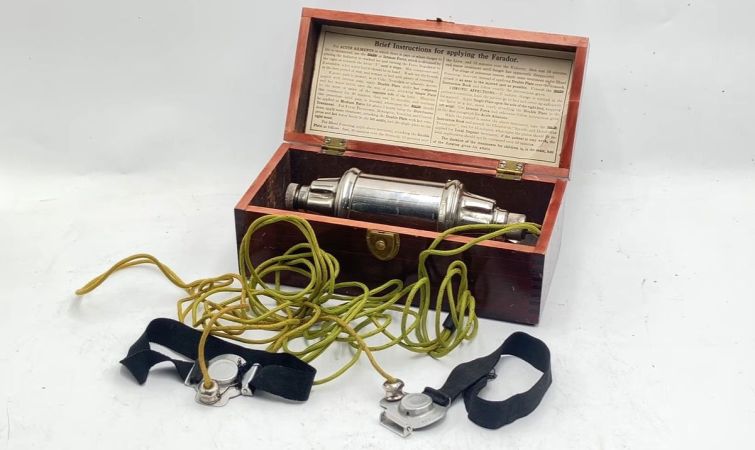
Over the centuries there have been an incredible number of purported medical devices released onto the market, with some having more outrageous claims than others. Released in the 1910s and produced into the 1920s, the Farador electrotherapeutic device claimed to be a thermoelectric device that would cure all disease conditions. In a recent video over at the [Our Own Devices] channel we get an in-depth look at this device and its usage instructions.
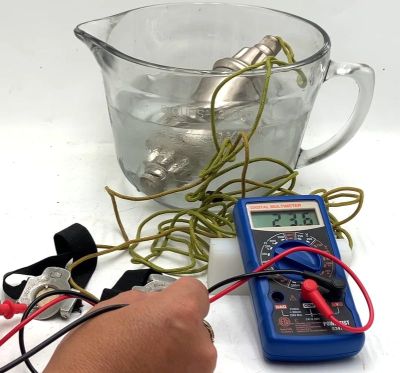
It's a thermoelectric generator. Sort of. (Credit: Our Own Devices, YouTube)
It’s a thermoelectric generator. Sort of. (Credit: Our Own Devices, YouTube)

On the Smithsonian’s website you can see the version they’ve got. It’s not identical, but the working principle remains the same — after bypassing the whole ‘is this the right treatment’ questionnaire because it’s a cure-all device, you take the main metal device and its connected electrodes out of the box.

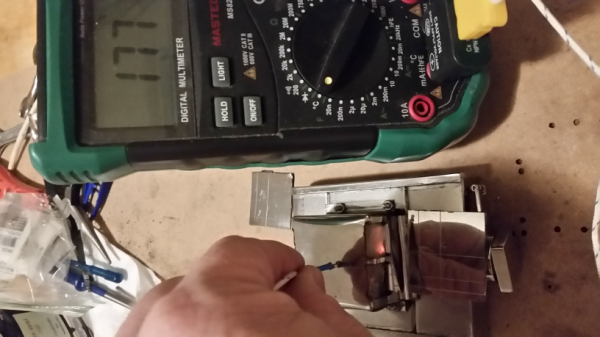
Unlike similar devices of the era that applied an actual electrical current using batteries or similar, this Farador purportedly uses thermoelectric power generation, but there’s no clear hot or cold side to what would be the generator. Despite this, about 20-30 mV can be measured across the electrodes, so surely it’s working?

As it turns out, the Farador is just one of many fake medical devices that cloned the original Electropoise. Naturally such devices have been disassembled by many over the past decades, and as it turns out they are all empty inside, or at least devoid of any mechanisms. Much like many of such fake medical devices today, they mostly bank on the placebo effect. This placebo effect can be so strong that it’s even a confounding factor in real medical trials and medicine.

The more involved and complex the purported medical treatment seems, the stronger the effect tends to be. For the Farador the complex instructions, apparently high-tech thermoelectric generator and such all help to create the illusion and could thus be construed to be the main feature of this product.
Continue reading “The Farador Quack Medical Device”

A Candle-Powered Game Boy For Post-Apocalyptic Tetris

We’re not exactly worried about Armageddon here at Hackaday, but should we end up facing the end of the world as we know it, having something to pass the time would be nice. That’s why we were intrigued by [Janus Cycle]’s latest video where he both plays and powers a Game Boy by candlelight.

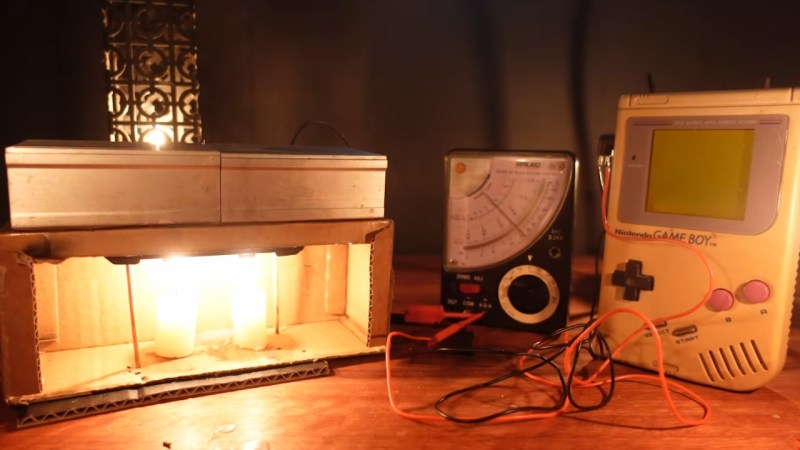
You’ve probably figured out the trick already: he’s using a Peltier module as a thermoelectric generator. Candles, after all, release a lot more energy as heat than light, and all that high-quality heat is just begging to be put to use somehow. It’s hardly a new idea; [Janus] references space-age radioisotope thermoelectric generators (RTGs) in the video, but back in the day the Soviets had a thermoelectric collar that fit around a kerosene lantern to power their tube radios.

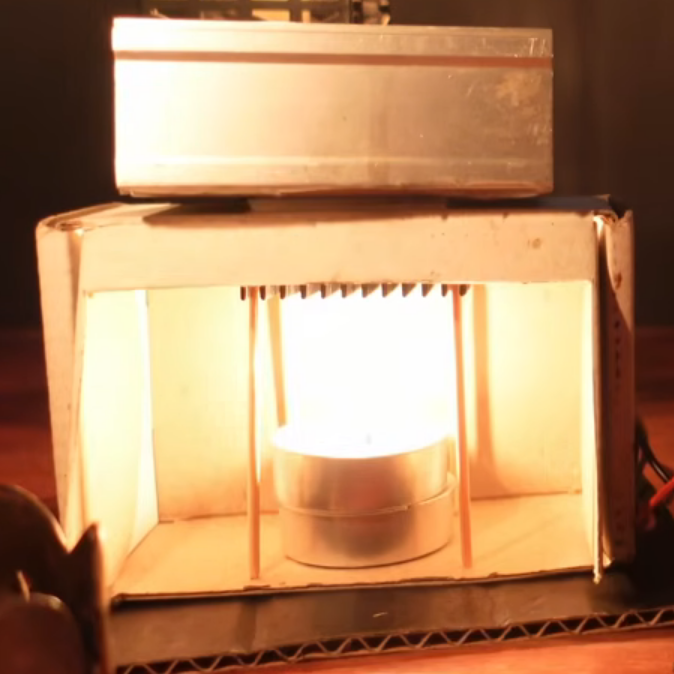
In [Janus]’s case, he’s using a commercial module sandwiched between two heatsinks with the rather-questionable choice of a cardboard box reinforced with wooden skewers to hold it over the candle. Sure, as long as the flame doesn’t touch the cardboard, it should be fine, but you will not be at all surprised to see the contraption catch fire in the video’s intro. For all that, he doesn’t get enough power for the Game Boy — one module gets him only 2 V with tea light, but he has a second module and a second candle.

Doubling the energy more than doubles the fun, since a working Game Boy is way more than twice as fun as an un-powered one. But one candle should be more than enough power, so [Janus] goes back and optimizes his single-Peltier setup with a tall candle and actual thermal grease, and gets the Game Boy going again. Any fire marshals in the audience should look away, though, as he never gives up on keeping a candle in a cardboard box.

The “power something with a Peltier module” project is probably a right of passage for electronics enthusiasts, but most are more likely to play with the irony of candle-powered LEDs, or fans to cool the cold-side heatsink. We did see a phone charger one time, and that didn’t even involve open flames, which seems much safer than this. Remember — no matter how much you want to game after the end of the world, it’s not worth burning down your fallout shelter.

Continue reading “A Candle-Powered Game Boy For Post-Apocalyptic Tetris

A Candle-Powered Light

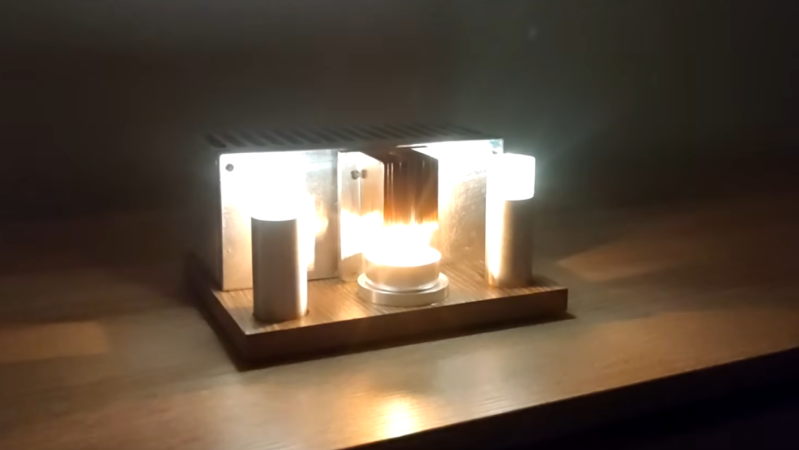
For a little over two thousand years, the primary light sources after the sun had set were oil lamps and candles. This was well before the age of fossil fuels, so these oil lamps were often fueled with a labor-intensive agricultural product like olive oil. Candles were similarly difficult to make, made from tallow, beeswax, or even butter. Labor and materials costs aside, though, there’s a surprising amount of energy in these fuels and [Maciej Nowak Projects] has a generator that help these ancient light sources generate some electricity on the side.

The generator is based around a piece of technology called a thermoelectric generator (TEG), which produces a voltage potential when placed in a temperature gradient. These aren’t new technologies, but their typically low efficiencies limit where they can be effectively used. In this case, however, [Maciej Nowak] has gone to great effort to boost this efficiency as high as possible by using a huge radiator on the cool side of the TEG and another one on the hot side, which in this case is heated by a small tea candle. The electricity produced is sent to a tiny DC converter which regulates the voltage to 3.3V, which then powers two custom-built pedestal lamps on either side of the TEG, each with a high-efficiency LED mounted to a custom-made circuit board.

Although this is certainly not the first time a TEG has been set up to run a small lighting system, we do appreciate this one for its polish, design, and high efficiency. It would make a fitting addition to anyone’s emergency power outage kit as it really increases the amount of available light produced from any given candle. When taken to the extreme, though, thermoelectric generators can be made to produce a surprising amount of energy, provided they are placed in the right environment.

Continue reading “A Candle-Powered Light”

Real Minecraft Furnace Generates Electricity From Coal

There’s a furnace in Minecraft that is used to power all kinds of things in the game. [Joel] of Joel Creates decided he wanted to build a real-world replica, and did exactly that.

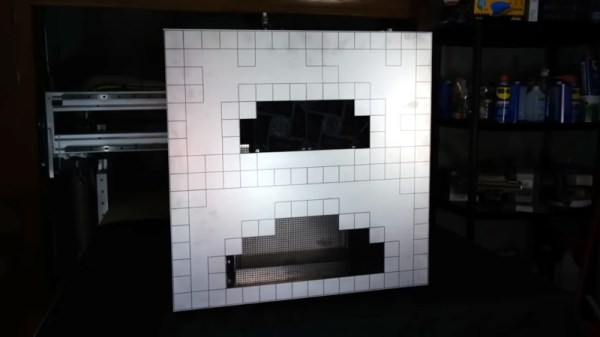
The furnace consists of a 30 cm aluminium cube, inside which the coal is burned. Thermoelectric generators (TEGs) are then placed on the sides of the furnace to turn the heat into useful electricity. The TEGs are installed in a sandwich of aluminium plates designed to maximize heat transfer through the TEGs themselves. They’re fitted with heatsinks to help create the maximum thermal gradient for greater power output. The entire setup is housed in a larger aluminium cube that’s finished to look like the Minecraft furnace — achieved by using a CNC machine to draw on the aluminium with high-temperature Sharpies.

With the coal a-burning inside, the furnace was able to generate enough power to run its own cooling and exhaust fans. It even had a little power left over to charge a phone. Overall though, [Joel] hopes that with some improvement, it can one day power his Minecraft car replica up to its top speed of 25 mph.

Continue reading “Real Minecraft Furnace Generates Electricity From Coal”

Powering A Cellphone With Gasoline

Batteries are a really useful way to store energy, but their energy density in regards to both weight and volume is disappointing. In these regards, they really can’t compete with fossil fuels. Thus, [bryan.lowder] decided to see if he could charge a phone with fossil fuels as safely and inoffensively as possible.

Obviously, with many national grids relying on fossil fuels for a large part of their generation, most of us are already charging our phones with fossil fuels to some degree. However, the aim here was to do so more directly, without incurring transmission losses from the long runs through the power grid. Continue reading “Powering A Cellphone With Gasoline”

Big Power, Little Power, Tiny Power, Zap!

Our Hackaday Prize Challenges are evaluated by a panel of judges who examine every entry to see how they fare against judging criteria. With prize money at stake, it makes sense we want to make sure it is done right. But we also have our Hackaday Prize achievements, with less at stake leading to a more free-wheeling way to recognize projects that catch our eye. Most of the achievements center around fun topics that aren’t related to any particular challenge, but it’s a little different for the Infinite Improbability achievement. This achievement was unlocked by any project that impressed with their quest for power, leading to some overlap with the just-concluded Power Harvesting Challenge. In fact, when the twenty Power Harvesting winners were announced, we saw that fourteen of them had already unlocked the achievement.

Each of the Power Harvesting winners will get their own spotlight story. And since many of them have unlocked this achievement, now is the perfect time to take a quick tour through a few of the other entries that have also unlocked the Infinite Improbability achievement.

Continue reading “Big Power, Little Power, Tiny Power, Zap!”

The Best Part Of Waking Up Just Got Better

If you ask us, one of life’s greatest pleasures is sitting down with a nice, hot cup of something of coffee, tea or hot chocolate. Of course, the best part of this ritual is when the beverage has cooled enough to reach that short window of optimal drinking temperature.

Often times the unthinkable happens—we sip too early and get burned, or else become distracted by watching cat videos reading our colleagues’ Hackaday posts and miss the window altogether. What’s to be done? Something we wish we’d thought of: using the beverage’s heat to cool itself by way of thermal dynamics. For [Scott Clandinin]’s entry into the 2018 Hackaday Prize, he hopes to harness enough heat energy from the beverage to power a fan that will blow across the top of the mug.

[Scott] enlisted a friend to smith a thick copper slab in a right angle formation. The gentle curve of the vertical side pulls heat from the ceramic mug and transfers it to the heat sink of a CPU cooler. Then it’s just a matter of stepping up the voltage produced by the thermoelectric generator with a boost converter. Once he’s got this dialed in, he’d like to power it with supercaps and add a temp sensor and a microcontroller to alert him that his moment of zen is imminent. We’ll drink to that!