
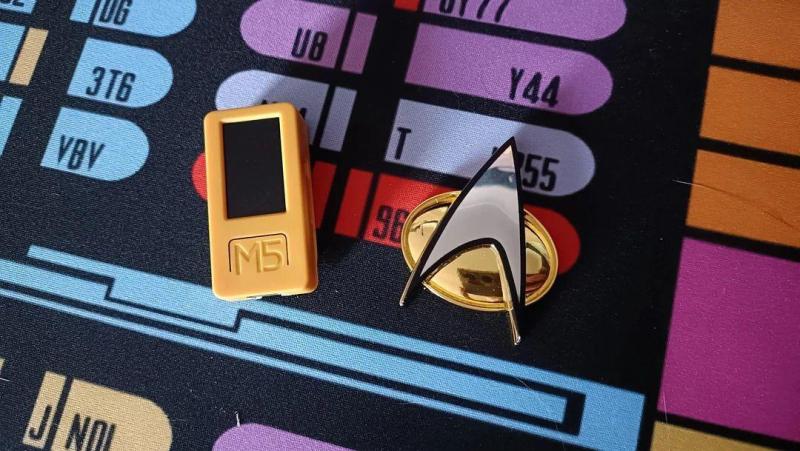
One thing some people hate about voice control is that you need to have a process always running, listening for the wake word. If your system isn’t totally locally-hosted, that can raise some privacy eyebrows. Perhaps that’s part of what inspired [SpannerSpencer] to create this 24th century solution: a Comm Badge straight out of Star Trek: The Next Generation he uses to control his smart home.
This hack is as slick as it is simple. The shiny comm badge is actually metal, purchased from an online vendor that surely pays all appropriate license fees to Paramount. It was designed for magnetic mounting, and you know what else has a magnet to stick it to things? The M5StickC PLUS2, a handy ESP32 dev kit. Since the M5Stick is worn under the shirt, its magnet attached to the comm badge, some features (like the touchscreen) are unused, but that’s okay. You use what you have, and we can’t argue with how easy the hardware side of this hack comes together.
[Spanner] reports that taps to the comm badge are easily detected by the onboard accelerometer, and that the M5Stick’s microphone has no trouble picking up his voice. If the voice recordings are slightly muffled by his shirt, the Groq transcription API being used doesn’t seem to notice. From Groq, those transcriptions are sent to [Spanner]’s Home Assistant as natural language commands. Code for the com-badge portion is available via GitHub; presumably if you’re the kind of person who wants this, you either have HA set up or can figure out how.
It seems worth pointing out that the computer in Star Trek: TNG did have a wake word: “computer”. On the other hand it seemed the badges were used to interface with it just as much as the wake word on screen, so this use case is still show accurate. You can watch it in the demo video below, but alas, at no point does his Home Assistant talk back. We can only hope he’s trained a text-to-speech model to sound like Majel Barrett-Roddenberry. At least it gives the proper “beep” when receiving a command.
This would pair very nicely with the LCARS dashboard we featured in January.











very much lazy-meh prop. It´s not doing anything, it´s just piping audio to ugly Grok. ESP32 on its own CAN do voice recognition, there are plenty of repositories around doing just that.
The projects I’ve seen doing it locally on ESP32 are restricted to keyword recognition, rather than transcribing what is said in full, which requires a larger model. Yes, he’s using Grok but you could pipe the audio to something locally-hosted if you so desired. If you know of a reliable transcription model that runs on ESP32, please let us know! It deserves an article.
That’s not to say keyword recognition wouldn’t work for this kind of voice control, just that it wouldn’t be exactly what [SpannerSpencer] set out to do here. Given the adjective you used, ‘ugly’, it seems like your objection is primarily aesthetic, which is fair. There’s no argument in maters of taste.
The PocketBeagle 2 has four Cortex-A53 cores and is designed to fit in a mini Altoids tin.
This has very little to do with the post you are responding to, and even less with full speech recognition, got anything more?
I would have thought that the implication that s much more powerful processor in a case that wasn’t much larger, as a reply to someone who talked about the esp32’s compute limitations would have been obvious.
But since it apparently wasn’t, let me suggest the device I mentioned might do what Tyler pointed out this one can’t.
Not Grok, Groq:
https://groq.com/blog/hey-elon-its-time-to-cease-de-grok
Groq, not Grok. Pay attention.
I have been wanting to implement something like this myself, but fully local and ideally no LLM for the simple things like lights and switches. Less failure points and less processing delay between command and response.
man, it looked so so wrong from the front page because for some reason he mirrored the image
Hmmm….. According to TFA
You might argue that [SpannerSpencer] has used a “Language Processing Unit” ASIC, attached to his M5StickC, but, again, TFA includes a requirement for a
So, no. Not “locally hosted”, and the privacy aspect that Tyler alludes to is just clickbait.
But the need of constantly monitoring every word you say is not there. The activation as I understand starts the “local recording” in the M5 to Groq via the API. So the constant monitoring that e.g. google are doing is taken away, and that is when the privacy comes in play.
So Groq (Twitter) has your info instead of Google? That’s ‘when the privacy comes into play’?
groq != grok
Nothing to do with X.
With how miniaturized bluetooth headsets are, I’m a little surprised no one has made one into a badge like this. Either Paramount or shady chinese sellers. You’d think there’d be a market for that.
Bluetooth comm badges have been around for over a decade now. I think I remember one from before the release of the iPhone. And yes, CBS licensed them.
Compared to today’s electronics they were thick and heavy. They were encased in injection molded plastics, so not exactly as attractive as a polished metal badge. You had to tap it to activate it (a la TOS), no auto-VOX. But still, it was a working comm badge!
Also, the battery lifetime was abysmal, both per charge and in terms of device longevity. Yes, I had one. No, I never bothered to open it up and replace the battery. It just wasn’t worth the effort.
So essentially it is a local CB radio to Grok.
I now think if I’d design such a thing, I’d start with two of those short-range CB radios instead.
CB has the advantage simultanous listening/speaking is prohibited. Only one side talks at a time.
So it’s different to an ordinary headset or telephone conversation.
In this application (talking to an LLM/digital assistant) the limitation is a good thing.
We’re only heard when we want to. :)
I forgot to mention, there’s the VOX feature built into some radios or mikes (voice operated transmit).
It switches to transmit if it hears a sound, basically.
Good points, and I honestly don’t remember if the the original STNG series they ever held two-way conversations with The Computer, meaning, it was probably meant to be close to CB, either RX or TX, but not both almost simultaneously.
In all fairness, short-range CB radios are fairly cheap, and thinking this slightly more, maybe it needs four cheap walkie-talkies tuned to two different channels at the same time.
Amazon Alexa can be set up to use ‘computer’ as a wake word, which is kinda fun. Only problem is, if you’re in the demographic that would set ‘computer’ as a wake word, you’re also quite likely to use the word in normal conversation!
Classic situation. That’s like with this clap switches, I guess. They were used to control lights in the house, for example.
Imagine you’re watching a concert on TV in your living room and the audience claps with their hands..
… What else would you clap with?
Trek is dead.
They killed it.
So is national beat-up an emo kid day. :-(
National beat-up a trekkie day?
Trek died when Roddenberry estate sold rights to the miscreants beginning with JJ Abrams, and then the abominations that followed. It’s over Johnny! It’s OVER !! ……. (as Col. Trautman said to Rambo).
(same infectious disease that afflicted a certain time lord across the pond)…..it’s over ! it’s OVER !!
Kinda sad we no longer have any gajillionaires who would be the modern-day equivalent of Lucy Ball, buying all the Star Trek rights and letting it be developed further.
Both the original series and SOME early STNGs were good, but then it seem to loose steam some time early 1990s. I, too, noticed back then that it started running dry with new ideas.
On a topic of good space soap operas, “Babylon 5” was quite good when it was gaining momentum (though, not the first low-budget season when they were they not sure which direction to go next). If anything I’d explore Babylon 5 connecting with Deep Space Nine and go from there, but that’s just naive me.
Babylon 5 was amazing!
I just watched a few seasons of TNG the other week.
Not once do I remember them using a com badge to talk to the computer.
That com badge is linked to other away team members, engineering, transporter control, bridge comms, and other people.
You don’t tap a com badge to talk to the computer.
And that’s only the first problem with this project…
In DS9, the members of the away team do use the communicator to call the shuttle computer a few times, I remember.
Motion sensor? No, sorry, that’s a poop idea. A switch, perhaps.
Nothing Trek will appeal to those who love the franchise.
They have ruined it.
A dead horse if you will.
I’m confident that both Star Wars and Star Trek will live on in the hearts of the fans.
The TV series are just some part of it. There are a books, comics, games, art and fan fiction that are still going well.
There are fans who build props or go to conventions, too.
Maybe the franchise will go down the drain, but that won’t matter as much as it may seem at first glance.
In fact, the situation, the suffering if you will, even unites both Star Wars and Star Trek fans. Which is positive, I think.
Because it’s the idea that matters, not a product.
Star Trek was (is) a positive view on humanity’s future, of what could be, of how we could evolve.
Other new shows or franchises may also transport that philosophy.
He did well. The delay would frustrate me, but I’m sure that could be reduced. Overall, I like it 🖖🏻
I couldn’t live with 5second latency.
I too wonder, after the latest Star-Trek shows and the so-called ‘space force’ stealing the logo do we still want Star-Trek gadgets?
It’s a sad state of affairs.
The Space Force emblem dates back to the Delta used by USAF Space Command years before Star Trek existed. This is why you shouldn’t get your so-called “knowledge” from social media.
The Space Force didn’t steal the logo from Star Trek. Star Trek stole the logo from the Air Force Space Division back in the 1960s.
I wouldn’t say “stole”, though. It’s rather that the makers of Star Trek did orient itself on real world examples of the time, because it aimed at realism, after all.
The Enterprise name, the ship size (similar to aircraft carriers), the whistle sound of the intercom, the language and ranks..
Even the space battles with the Klingons were almost realistic.
They were done at long distance at which the enemy can’t be seen visibly on screen (they used instruments most of time to track the enemy).
Which was similar to sub marine battles at the time.
That being said, Star Fleet wasn’t supposed to be exactly like a pure military organization.
More like an armed merchant navy, maybe.