An auspicious anniversary passed for me this week, as it’s a decade since I started writing for Hackaday. In that time this job has taken me all over Europe, it’s shown me the very best and most awesome things our community has to offer, and I hope that you have enjoyed my attempts to share all of that with you. It’s worth a moment to reflect on the last ten years in terms of what has made our world during that time. Continue reading “Reflections On Ten Years With The Wrencher”
Day: February 27, 2026
Why Peeling Adhesive Tape Is So Unreasonably Noisy
Although not as reviled as the sound of nails on chalkboard, the sound of adhesive tape being peeled is quite probably at least as distinctive. With every millimeter of the tape’s removal from the roll sounding like it’s screaming in protest, it has led some to wonder just why this process is noisy enough to be heard from across an open-plan office. Recently [Er Qiang Li] et al. had their paper on a likely theory published in Physical Review E, in which they examine the supersonic air pulses at the core of this phenomenon.

Using rolls of adhesive tape and two microphones synchronized with two high-speed cameras in a Schlieren imaging setup, they gathered experimental data of this stick-slip mechanism. Incidentally, in addition to this auditory effect, adhesive tape is also known for the triboluminescence effect, as well as the generating of X-rays, making them quite the source of scientific demonstrations, even when they’re not also being used to create graphene with.
What they deduced from the recorded data was that the transverse fractures that suddenly appear after the extended stick phase hold a vacuum until they reach the end of the fracture during the brief slip phase, at which point the vacuum collapses very suddenly. This produces a pressure of 9600 Pa and clearly visible shock fronts on the Schlieren images.
Now that we know why peeling adhesive tape from its roll is so noisy, it won’t make it any more quiet, but at least we can add another fascinating science fact to its roll of achievements.
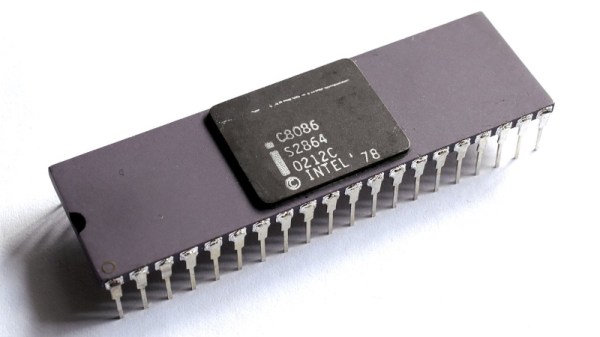
CSS, Now It’s Got Your 8086
The modern web browser is now far more than a thing for rendering web pages, it’s a multi-faceted environment that can provide a home for almost any application you could imagine. But why should JavaScript or Wasm have all the fun? CSS is Turing complete now, right? Why not, as [Lyra Rebane] has done, write an 8086 emulator in pure CSS?
The web page at the link above may contain an 8086, but missing MMU aside, don’t expect it to run Linux just yet. Instead it has limited resources, just enough to run a demo program. It needs a Chrome-adjacent browser because it uses some CSS functions not available in for example Firefox, but we’ll forgive it that oddity. Its clock is provided by a small piece of JavaScript not because CSS can’t provide one, but because the JS version is more stable.
On one hand this is of little practical use, but to dismiss it as such is to entirely miss the point. It’s in the fine spirit of experimentation, and we love it. Perhaps a better way to look at it is to see what could be done more efficiently with the same idea. A 1970s CISC microprocessor might not be the best choice, but would for example a minimalist and optimized RISC design be more capable? We’re looking forward to where others take this thread.
It’s not the first unexpected computing environment we’ve found, who could forget the DOOM calculator!
Header: Thomas Nguyen, CC BY-SA 4.0.