
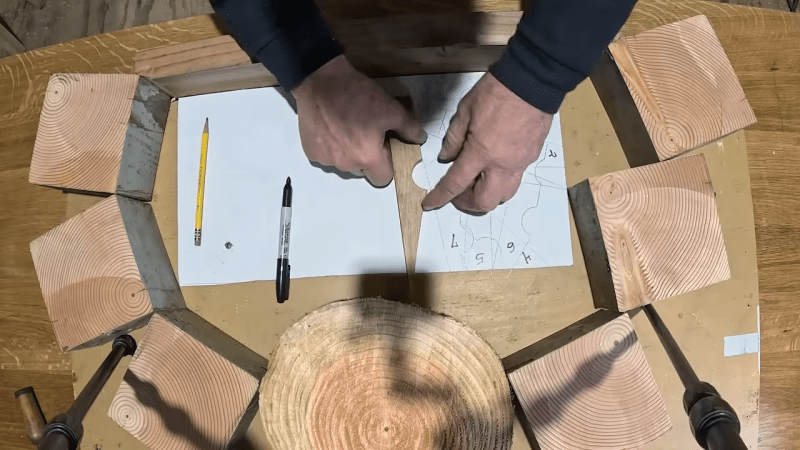
Picture this: you have an irregular opening you need to fabricate a piece to fill. Maybe it’s the stonework of a fireplace; maybe it’s the curved bulkhead of a ship. How do you get that shape? The most “Hackaday” answer would be to 3D scan the area, create a CAD model based on the point cloud, and route the shape with CNC. Of course, none of those were options for the entirety of human history. So how do you do it if you don’t have such high-tech toys? With a stick, as [Essential Craftsman] takes great pains to show us in the video below.
It’s not just any stick, of course. Call it a “tick stick”, a “speil stick”, or a “joggle stick” — whatever you call it, it’s just an irregularly shaped piece of wood. The irregular shape is key to the whole process. How you use it is simple: get some kind of storyboard — cardboard, MDF, whatever — that fits inside your irregular void. Thanks to the magic of the stick, it need not fit flush to the edges of the hole. You put the tick stick on the storyboard, press the pointy end against a reference point on the side of the hole, and trace the stick. The irregular shape means you’re going to be able to get that reference point back exactly later. Number the outline you just made, and rinse and repeat until you’ve got a single-plane “point cloud” made of tick stick outlines.
Your storyboard is probably going to look mighty confusing, but that’s what the numbers are for. Bring your storyboard and your tick stick onto the workbench and whatever you want to cut out– plywood, cardboard, 1/4″ steel armor plate, you name it–and simply repeat the process. Put the tick stick inside outline #1 and mark where the pointy end lands on the material. Then do it again for the other outlines, reproducing the points you measured on the original piece. After that, it’s just a game of ‘connect the dots’ and cutting with whatever methodology works for your substrate. A sharp knife will work for cardboard, but you’ll probably want something more substantial for steel plate.
It’s not often you’re going to need the tick stick– the [Craftsman] reports only needing it a few times over the course of a decades-long career, but when you need it, there’s not much else that will do the job. Well, unless you have a 3D scanner handy, that is.












This is brilliant!
I agree, you don’t need it often. I’m 63 and I can picture a half dozen times where this would have been very useful.
Now to setup a useful situation so I can teach it to my grandkids..
Brad
Interesting. I use a tool that has fine pins in a row that can independently slide. Press against irregular shape capturing it.
It’s called a contour gauge.
This works when you don’t have a 2 metre contour gauge.
If the area of interest is not overhead:
Cover all the critical surfaces with plastic film. Fill the area of interest with plaster of Paris or spray insulating foam. Allow the filler to solidify.
If you ever seek to rehab a boat or any kind of curved or irregular space you’ll be acquainted with this early and use it often for fitting bulkheads and other kinds of things. If you come to your senses and do something less maddening for a hobby it’s still useful in other odd applications.
If you’re given to geometric exploration, you can copy a curve more or less completely by adding a pivot point and reproducing the reciprocal curve on the board you’re drawing on; a pivot-pantograph in some sense. Reversing this in turn will give you your original contour at the tip of the tip stick.
You can also use a single piece of paper, hold it steady (or stick it to the floor with a piece of tape) and then push it with your nail or a pencil right into the corner to follow the contour.
Or use a piece of paper that is a bit too small, and then follow the contour with painters tape (that also sticks to the paper).
If you want the contour in your PC, then use a piece of grid paper that is a little bit too small so it lays flat, and make a photograph of both the paper and the contour. Pictures have less distortion if you make it from a larger distance, and use the zoom function.
and sort of related, to map out large areas like my back yard, plane table surveying is a kind of similar way to capture irregular shapes
Nice. A technique worth knowing.
In some smaller repairs it can be neater and easier to open up the hole to be filled to the size of the infill piece (just place infill piece over the hole and draw round it) rather than trying to cut the infill piece to the exact irregular shape of the hole.
That was a great watch and finally gave me an unlooked for answer. 50 years ago I got a bunch of tools from my father that had been his fathers. One was this weird shaped stick I could never fathom, but now I can. Sadly it didn’t make it thru the intervening years, but the lump hammer, wooden mallet and stone chisels are still around and occasionally used.
Goes to show that our ancesters were as smart or perhaps smarter than us.
Made good use of all those crashed saucers. :-D
Must say I love this. It is simple and works in a situation where you only have minimal tools – remote job, whats in your travel toolbox… I will remember this!
Indeed, though in most cases that long any old block that can slide on the contour while holding a pencil a reasonable and consistent distance off that curved wall will work much faster and just as well – you can just rest the part as close as it can get to that long curvy target and trace the contour right onto it…
This ‘Tick Stick’ sort of method makes sense only when you can’t do that sort of direct trace the shape method or fit your contour gauge in the space. Which generally implies fairly small and as in the header image awkward and detailed ‘curves’ rather than giant. Plus at giant scale you’ll only be cutting say 3′ to maybe 12′ sections of that giant curve at a time anyway – even if you can get suitable stock material large enough you still have to manipulate the parts into place and it just isn’t practical to do vast lengths in a single piece.
ancestors
I’ve done similar by starting with the largest cardboard that would fit inside then taping smaller overlapping shapes out to all edges, filling the space. No pencil work required just scissors, tape, and cardboard packaging leftovers.
Or have to fit it in a convoluted space, like a kayak.
Brad
OR, you could bore the irregular area to create a known-volume/dimension void and manufacture a known-volume/dimension plug for it.
This is identical to some types of probing with a CMM; the arm and fixture are doing a lot of the work for you but it’s the same idea of generating known points on a plane reference.