
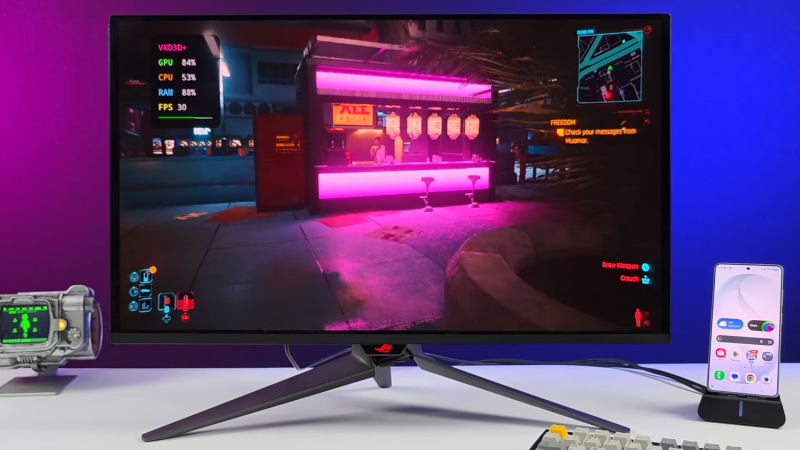
There was an ideal of convergence, a long time ago, when one device would be all you need, digitally speaking. [ETA Prime] on YouTube seems to think we’ve reached that point, and his recent video about the Samsung S26 Ultra makes a good case for it. Part of that is software: Samsung’s DeX is a huge enabler for this use case. Part of that his hardware: the S26 Ultra, as the upcoming latest-and-greatest flagship phone, has absurd stats and a price tag to match.
First, it’s got 12 GB of that unobtanium once called “RAM”. It’s got an 8-core ARM processor in its Snapdragon Elite SOC, with the two performance cores clocked at 4.74 GHz — which isn’t a world record, but it’s pretty snappy. The other six cores aren’t just doddling along at 3.62 GHz. Except for the very youngest of our readers, you probably remember a time when the world’s greatest supercomputers had as much computing power as this phone.
So it should be no surprise that when [ETA Prime] plugs it into a monitor (using USB-C, natch) he’s able to do all the usual computational tasks without trouble. A big part of that is the desktop mode Samsung phones have had for a while now; we’ve seen hackers make use of it in years gone by. It’s still Android, but Android with a desktop-and-windows interface.
What are the hard tasks? Well, there’s photo and video editing, which the hardware can handle. Though [ETA] notes that it’s held back a bit because Adobe doesn’t offer their full suite on Android. But what’s really taxing for most of us is gaming. Android gaming? Well, obviously a flagship phone can handle anything in the play store.
It’s PC gaming that’s pretty impressive, considering the daisy chain of compatibility needed last time we looked at gaming on ARM. Cyberpunk 2077 gets frame rates near 60, but he needs to drop down to “low” graphics and 720p to do it. You may find that ample, or you may find it unplayable; there’s really no accounting for taste.
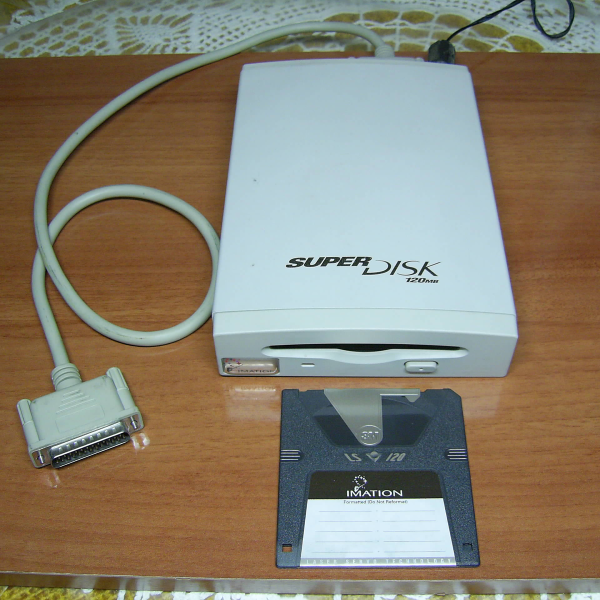
We might not always like carrying an everything device with us at all times, but there’s something to be said in not duplicating that functionality on your desk. Give it a couple of years when these things hit the used market at decent prices, and unless PC parts drop in price, convergence might start to seem like a great idea to those of us who aren’t big gamers and don’t need floppy drives.











Answer: No (with a resounding cackle)
Agree.
I’d say yes. But only in the sense of price and being spied upon by the OS.
Well, Microsoft seems to be trying to eliminate the concept of the Personal Computer, and substitute Time Sharing (from the 1960s) with terminals and the cloud as the mainframe. Those of us who are still using Windows will have to shift to Linux when Windows 12 makes this a reality, so maybe phones will pick up some sort of ancillary computing functions that MS decides to discard. A large part of society was built using tools that predated computers, so maybe phones will fill those functions (electronic sliderules).
Maybe not. :)
https://en.wikipedia.org/wiki/Betteridge's_law_of_headlines
Is Betteridge’s law true?
By the way, fun read! Especially when you are being paid engineer’s pay to read it!
Grok: Betteridge’s law of headlines is not strictly true, but it is a useful rule of thumb, especially for skeptical media consumption.
Like Hanlon’s razor, Occam’s razor, or Godwin’s law, it’s not an absolute but a general rule.
In the 80s, a comedy book (based on Not The 9 O’clock News) had on the cover: “Is the Shah of Iran really dead? (See page 39)”
On page 39, they wrote: “Yes”.
Yes, if you want to leak all your data to Google and US goverment.
Hope you aren’t on a Windows PC.
they all do it now. id say linux can save us, but i have my doubts. especially if age verification becomes mandatory in most governments. id rather just make it illegal for children to use the internet outside of walled gardens designed for them. sort of like how old people use yahoo for everything. even then i think this should be a paranting problem and not an everyone else problem. try as i might i cant stop people from voting in overreaching governments in favor of the false promise of free stuff.
[citation needed]
It’s extremely hard to control people in any case. The only real solution would be to make the real world more desirable than the Internet, but I don’t hear of much work trying to make that a reality.
Only if you make a phone with a 32″ screen maybe.
Casting?
I am honestly puzzled as to WHY none of the cell phones come with a built-in projection thingiemabob that can easily do if not 32″ then perhaps 12″ – 14″ LED projection, which would still be plenty usable for my humble needs.
Having said that, since all even the cheapest car radios can now double as a larger cell phone touchscreen, there is already a wireless way to get external projector going. Maybe I should just get one of those ~$100 car radios and move from there.
Display glasses
Not even. A phone lacks the proper user interface to be productive.
DEX is a desktop user interface, available throught the USB-C port on DP alt mode. Corded and Bluetooth Keyboard and mouse work fine as well.
It looks like a lot of commenters didn’t read the article and/or didn’t know what Dex is for.
Or maybe the question should be rewritten as
“can a dex Smartphone + keyboard + mouse + screen replace a desktop PC”.
Dex is for slapping a desktop window manager on an OS and application library that is fundamentally built around handheld touchscreen interaction. It works about as well as those early phones that were just Windows XP on a small touchscreen.
Tried that (wired version) last year and my middle-grade budget Android phone stubbornly opposed any keyboard attached to the USB-C port. It insisted there was nothing attached, even when presented with the average USB keyboard that works with anything under the sun (presently the said keyboard is working with a PicoVision nostalgia erm I won’t call it “PC”, more like “TRS-80’s child of a sort”).
If you have ever used desktop Ubuntu, Canonical in 2013 had showcased Ubuntu Touch phones with a feature called convergence. When the phone is plugged in to a screen, the UI changes to the normal Unity desktop and all the apps would switch to the desktop mode. Normal Linux desktop apps are also supported, most are already compiled for ARM anyway, and the graphics stack is almost the same. The project is still going but don’t expect Android level of usability (some proprietary apps don’t work even with emulation, many phones are old, VoLTE is supported only on some models, etc.)
No. Swapping out memory, graphic cards, hdds, ssds, networking cards. Don’t see a RJ-45 plug on my phone for example for hard-wired ethernet…. May work for some, but don’t see it working for me :) . That’s just on the hardware side. Then software (like FreeCad, etc.) and favorite DE on Linux, and …. List goes on. So nope!
Laptop would be a lot closer than a phone to replace a desktop. And with the likes of a RPI-5 class SBC, that is doable too.
That all said, it is how you ‘intend’ to ‘use’ your system that dictates what system will work. One size doesn’t fit all.
“would be”…? The only desktop computer I have left, is an old P200MMX computer with Windows ‘95, because there are still some handy old tools related to (really) old vintage computers that have never been ported to newer systems. I can, for instance, directly format, read and write TRS-80 floppies with this system. I also now have a GreaseWeazle of course ;), which has already caused the P200MMX to be banned to a shelf somewhere.
But the gist is that I have no desktop computers anymore. Only laptops and a few mini dekstop systems that are in use as headless servers.
So laptops have definitely replaced desktops in my house.
Says more about you than anything else.
Not at all a surprise, given your posting history.
I have a USB 3.0 to 2.5 gbit/second Ethernet dongle. But in my case I mostly use it to provide internet access, using the 5G from my phone, for temporary access on normally standalone machines (e.g. when upgrading firmware on a satellite TV box).
Forgot to add local storage only as criteria which the phone doesn’t offer. I want nothing stored in cloud. Period. But cloud storage is ‘pushed’ heavily by tech companies and phone vendors….
I dunno, Dont get me wrong, I wish they hadnt stopped putting sxdc slots in samsung phones but My phones got 1TB of local storage. Thats quite a bit of local storage. Not sure I really need more.
Didn’t realize they had that much! Mine has 64GB which plenty for phone usage. So, yes, 1TB would be plenty if you could slap a proper OS on it.
Mines a 3 year old s22 Ultra. The s26 Ultra also offers 1TB. Even the cheapo Galaxy A16 5G comes with 128gb but amusingly unlike the premium line, the a16 has an sd card slot and can support up to 1.5TB of storage., a card that costs more than the phone LOL.
Samsung A phones can’t DEX. You need S line
I’d not call any of the hardware your list a real no – much of it can be available at least in limited number to a phone anyway (not that it usually is mind, but at least an analouge like the SD card if not an M.2 etc would be plausible in a practical sized phone device still). And all of it in huge quantities is not hard to have in its docking cradle at the big screen as the bandwidth available over a compact single connector now is so high you likely won’t really saturate it even with a box full of drives, the relatively weak for pretending to be a workstation/server CPU will scream for mercy first! That docked location is also the only place you’d really need Ethernet ports, multiple networking cards and crazy data capacity.
And really most of it are things most folks never change once a system is built anyway – even if you can upgrade your RAM the price of more RAM compatible with your now older system vs the performance you can gain replacing the whole computer potentially for not much more money and getting a more energy efficient system in the process etc…
GPU are probably the most common thing to change, and I’d suggest again the value of a new GPU on an older system is often poor enough it isn’t really worth it, but obviously your specific needs and existing system will change that picture some too.
It is the software is the big issue – DEX might be close enough for many, I’ve not tried it to really know, but the emulation on emulation on abstraction layer upon layer is going to a security, performance and debugging nightmare really – it might work, doesn’t mean its actually good. That obsolete insecure Android install on a locked down hellscape device so you/the community can’t easily do it yourself is likely to matter so much more when it is also supposed to be your workstation full of sensitive client files etc.
Really for convergence to work you need something more like SteamOS and its desktop mode you can toggle your “phone” between built upon more direct to hardware common framework – In effect a native Linux phone (though Windon’t or Mac could work too I suppose) with suitable GUI and HID profiles you can toggle manually or automatically for the two rather different use cases. Sure you’d not want to run freecad in phone mode on the phone screen sitting on the train most likely, but technically you could, and now at any desk you can dock the device and your files, program hotkeys, layout etc config are all right there with you without needing to have them on that potentially expensive insecure cloud, or all the work of hosting your own WWAN accessible solution. And that just doesn’t look like happening any time soon.
component swap isnt all its cut out to be. because it seems by the time my computer is dragging ass begging for an upgrade, i need new cpu, new mobo, new memory, new everything pretty much. and soldered ram can actually be faster. other than graphics cards and storage, i really dont upgrade systems anymore, and haven’t since the mid ’00s.
however id rather the phone just be another form factor option. if we go all in on performance socs, its theoretically possible to use the same soc on a laptop, a phone, a desktop, whatever, all running the same software. a strong soc standard also allows you to easily swap architecture as well, running an arm, x86, risc-v, retro architectures, whatever meets your power, thermal, and performance requirements. and plug it in to your chassis of choice, so long as the ins and outs are the same.
I haven’t had the ‘slow’ experience since before my first AMD Ryzen 1600. My upgrades from then was a 2600, 3600, 5600x, 5900x …. Nothing else changed but the CPU. Granted on my workstation, I did change out the ‘budget’ AM4 motherboard to an almost top of line AM4 motherboard and maxed it out with 64GB of RAM ‘for kicks’ after the AM5 platform was released. Also, the used CPUs trickled down to our general use PC desktop (now using the 5600x). Something you can’t do with a cellphone. Also have two network connections for my internal network (server, projects, printers, etc.) and other for Internet only access. Oh, and then being able to upgraded internal network to 2.5Gb with a new PCIe card in each computer (and of course all the switches). So multiple PCs, multiple networks, upgrade-ability just doesn’t hack it with ‘one’ cellphone (that you are basically renting to be able to use). And I still have my cell phone in my pocket for what it was designed for — calls and text — not general computing.
I will probably skip the AM5 generation as it gains me nothing at this point…. Oh, and with the higher memory and SSD pricing, it puts the buy “just because I can whim” on definite hold! Most of my projects are with RPI Pico level performance anyway. Cross-compiling for ARM is very fast on the workstation.
All said and done I will stick with actual desktops for home computing/programming. Laptop for travel, and cell-phone for talk/text. One mid-tower that will disappear this year will be my home data server (running on a AM4 2400G Platform) as I have a RPI-5 setup as a second data server which is working really well as a live backup right now. The RPI-5 server just sets on a shelf (actually runs my PiDP-10 front panel) taking up a lot less room, the performance is great, and less power. All wins. So will change over to it sometime in near future.
Slow day at YouTube eh? Maybe post some amazing tool restoration video from Pakistan.
I think a video about how they make all those fake ‘restoration’ videos would be more interesting.
I presume there is one and the hundreds of ‘restoration’ channels are built on it.
Zoomers hardly use PCs now. Next gen may make PCs to vanish.
wait till they reach their 40s and start having vision problems.
I tried this many times using large tablets or usb displays, and often websites would default to trying to use the mobile page, or point you towards the apps. Even when using the ‘request desktop site’. It seemed to behave better if you spoofed user agent, but still janky. Also using the company outlook refused to log in on the web and wanted to install the app and the user control app to manage your device as a company device. Annoying as I can log in on the web from windows or Linux.
So hardware wise it’s all possible, but they need to make some changes to stop pushing mobile and app links.
I think some sites look at your IP to decide if you are using a desktop/laptop or phone. For example, are you connected through ATT’s phone network. The user agent string clearly isn’t enough.
Really? Not doubting you at all, but that would be an outstandingly dumb way to fingerprint a device… ok, ok, I forgot, this is the modern web we’re talking about, where “outstandingly dumb” is a core value! What about those of us who use our phones as personal hotspots for our laptops, and so on.
on firefox: ask desktop site. works perfectly with sites like slack, ali, google lens
Im sure there is an plug in or add on, whatever, out there, but it would be nice if you could set firefox to ALWAYS desktop site, or at least remember when youve asked for a specific site to be desktop’d
And that is exactly the reason I don’t use Firefox on my tablet. I use Brave.
Can you replace Android with Debian or any other OS?
There’s doubtless going to be a Postmarket OS build for this particular phone in a couple of years, and you’ll be able to piggyback on that to boot other distros.
Honestly, looking at the specs of older flagship phones, that’d be a good cheap linux box as long as you’re not trying to do PC gaming. A five-year-old flagship phone is still a supercomputer by the last century’s standards.
The answer with Android as a rule is really NO, well kinda, sorta, maybe…
As assuming the vendor hasn’t locked the bootloader or is at least playing nice enough to let you unlock it at the most basic bare metal level all that hardware is probably useless without those hardware access layer tweaks as supplied by them – and that likely keeps you stuck on whatever kernel with the magic sauce was the last one your vendor shipped as an update – you can to reasonable extent still dress it up like other and actually updated Linux based system, so it might well be possible to get a Debian like experience, but it really won’t be at its core Debian.
This is a big one for me. Can I download any application I want to on my phone hardware, like an operating system or an ide? Nope. Then I’d have to say I absolutely cannot replace my computer.
Also here is a funny thought. Can you write phone apps from your current phones OS? For 99.99% of people on the currently available phone OSs the answer is no. So if you can’t download the applications you want, and you can’t write them, there is no chance at replacing my computer.
Tons of other issues but I’d rather not beat a dead horse here.
Apple seems to think so, given the SoC in their new laptop. So convertible phones might be more viable now than they were in the early android days.
They would need to be purpose built for a dual role as the difference in the amount of RAM provided is important.
Apple sells to MacIdiots…
An etch a sketch duct taped to a Walkman is computer replacement for them.
So long as it’s expensive enough to impress other MacIdiots.
“Are you a middle schooler?
You sound like one. ”
Reflect
F-off self righteous hippie.
Go find a drum circle.
Are you defending status symbol obsessed twits or people who believe in economic wishing?
“Are you a middle schooler?
You sound like one. ”
Those are your words. This is your behavior.
Im not defending anything, I just pointing at your hypocrisy since you chose to engage with my completely reasonable comment with this childish negativity.
Reflect
And stop throwing stones if youre too fragile to eat one in return,
I bought a Pinephone while Plasma Mobile seemed tantalizingly close with the hope of ending up with a KDE-based Linux phone, but the developers seemed to get lost in the unification rabbit hole at the expense of actual phone functionality, time moved on, and it never seemed to happen satisfactorily for my phone needs.
I have been waiting patiently for DeX to continue to evolve and for Google to finally adopt it on the Pixel line so that i can get a lapdock.
Will this replace all of my devices? No, of course not.
But will this give me a nice screen and keyboard to work as a terminal when I am sitting on the couch at home, and save me from buying a new laptop? Yes, for sure!!
Several days before you wrote your comment G released an update for Android that moved the Desktop mode from developer options to being available by default.
There is clear pressure to normalize this use.
Then again it’s G, and they just LOVE to kill products. So who knows if it will simply disappear next year.
I know personally was waiting to upgrade my 8yo phone until the ‘cheap’ ones started coming standard with display port alt mode enabled in hardware.
It is more than grating to replace my current phone, which still does it’s job perfectly fine, just because I don’t want to do a 4th replacement battery (and new old stock batteries are super long in the tooth).
If this old phone could be used in projects it would be smooth sailing.
But alas, a perfectly good ARM computer is getting stuffed in a drawer because batteries are now unobtanium.
Well shoot, yeah, It is there now, I just needed to reboot the phone to enable it.
I guess that I am going to go looking for a lapdock now.
Hooray!!!
I’m personally going the modular route for now since I have multiple external battery packs that will do USB PD and USB C docking… sticks(?) with USB for KBM and HDMI or DP.
This has actually stalled out my un-lapdock project.
My goal was to make a lapdock with an internal KVM and small ARM PC inside, so it could be a minimal computer for terminal use AND a KVM cart for headless machines.
I dont think Ill ever stop using a PC.
I know my company will never stop using workstations (beefy PCs)
But I would appreciate phone companies trying harder to replace PCs. Specifically, lets see some 2026+ qwerty sliders hit the market. I prefer a physical keyboard and I know Im not alone in that. Im not saying every phone should be a qwerty slider but every major phone maker should keep one in their lineup.
PS while Im giving unsolicited advice, Not every phone user wants a giant phablet. Bring back mini models. My daughters hate full size iphones, Theyre still using Iohone 13 mini’s. Youve missed out on 12 (3×4) phone sales in my household alone.
I agree. Smaller phone. Mine is currently an IPhone SE. It is the right size in my mind. Only thing better would be a device of same size, but thicken it, to provide for a replacement battery and a qwerty keyboard. Seems like a ‘no brainer’. Anyway, resisting getting the latest bigger one as this phone still works just fine — even though my company would pay for it.
Desktop/Workstation forever here. That said, sticking with current systems as memory and ssd prices are keeping me from upgrading right now. Suspect the AI garbage will really start to bite PC upgrades soon. It has stopped me cold (maybe that is the master plan by the Tech overlords to move everything to the cloud, tin foil hat comment).
Some antiAI billionaire needs to step in and make a ram/ssd company that wont do bulk sales to anyone but PC/laptop manufacturers. Its an established market with built in demand. Someone just needs to step in and fill it.
Just picked up an excellent quality, used RTX 3090 for my desktop to run (100% on GPU) Aiarty video editing software and a local LLM for various software projects I’m working on. Curious how close any phone system can perform vs that. My guess is “not close”. Simple logic may be wrong but if phone companies had figured out how to deliver the same level of “GPU performance” in a much smaller package with much smaller power usage, then NVIDIA would be offering up RTX 5090 cards the size of a postage stamp.
Are you a middle schooler?
You sound like one.
says the guy running around the internet name calling and mocking others.
I think the question is about using a dex smartphone + usb adapter + mouse+keyboard + screen to replace your desktop.
and I think its about using a smartphone to run every computer application you would use a desktop for. SO I want my keyboard back.
Only if I can uninstall Samsung’s bloatware and have root access. So no.
You can use Universal Android DeBloater app to un-install Samsung shenanigans. Root, I dunno, it’s not all that necessary these days.
Speak for yourself because root access is 100% necessary.
Running out of youtube videos to cannibalise into articles?
Actually, android does support floppy drives via usb.
The answer is (and has been for ~10-15 years): Yes, if you mean a computer that is 6-7 years old.
So the answer is YES.
Because, except for AAA games, your brand new computer does nothing more fancy than a 7 years old one.
Are we to assume that’s a bluetooth keyboard? It’s not connected to anything.
Yes, it is a bluetooth keyboard. Not pictured is the bluetooth mouse.
Sure, just install a real operating system, and you’re good to go. Throw in a scaled-down tablet-style keyboard case and you have a modern-day Jornada. It would be as portable as a phone and as usable as a laptop.
Given that the new MacBook Neo has a phone chip I’d say there is little practical hardware limits between a low end laptop and a high end phone. It’s mostly held back by software and convention.
All macs are ‘phone chips’, for years now.
Phone chip clocks are stupid fiction, the can only do it for a fraction of a second before thermal management kicks in hard.
Short answer.. no. Unless you like spending 2x for the performance so you can get the opportunity to spend it again in a year to upgrade the phone instead of buying 1 new componant in your desktop.
pc upgrading aint what it used to be. other than gpu and storage (and this less so as i find it hard to fill 4tb), i really dont upgrade as frequently as i used to. when i do i usually need to upgrade everything, because there is a new ram standard, a new pcie standard, a new usb standard, a faster built in network port, and a new cpu socket. id also like to see the cpu and the ram become an soc module so we can start seeing the performance gains of soldered ram vs slotted ram.
soc also lets you plug it into a device that matches your use cases. id like to see an soc that works just as well in a phone chassis as it does in a desktop. when your soc starts looking dated, swap it with a new module, keep your chassis. break your phone screen, get a new chassis and salvage your soc. also since most of the performance is on the soc and you get a lot longer socket life. from an ewaste perspective this is the way to go.
its a lot easier to break out pcie from the cpu than all your system busses and easier to standardize too. your mobo gets cheaper because you dont have to rout those busses to memory slots, they stay on the soc, and now you have more room for pcie lanes. need more rams spec a higher end soc with more ram on it. if by chance you need more memory, you might have a l2 system memory out on the pcie bus somewhere, at 16x 6th gen speeds, and you have another 16 lanes for your gpu if you need them and another 16 for nvme storage, need even more stuff, get a workstation mobo with a pcie hub. smaller form factors break out less stuff or integrate everything tightly. you can even use banks of socs on a server mobo and salvage them when the server goes eol.
just need to change the upgrade paradigm, not eliminate it.
The hardware theoretically could; but phones are basically the most dramatic examples going of just how badly software can damage a computer’s security, privacy, and usability.
The ones that are best behaved tend to be among those less likely to be fully viable replacements; as you need to go older or more niche to have mature software support and no bootloader lockdown; while the newer stuff is pretty punchy; but it works for someone other than you first and foremost.
No a phone can absolutely not replace a desktop PC. Hell, depending on what you use your PC for, a laptop can’t even properly replace a desktop PC.
My DTR laptops want a word, dual GPU and desktop socketed processor.
And yes, my Fold has pretty much replaced my PC for most things, and I have a Ryzen 6850U with 32GB DDR5 6400 for most of the rest. But if I have to I can break out the Clevo with the MXM card 3080 16GB.
I paid around EUR 550 for a Ryzen 5600G, Mobo, 16GiB of RAM, 512Bib SSD and power supply. Put it all in a recycled Windows 98 case. And that was during the virus peak, video cards were unobtanium, and I paid around EUR 50 extra for the processor at that time.
If this thing can outperform that for the same price (including docking station so I have normal plugs), then I may be interested. Provided it runs a normal OS too of course.
And Linux on ARM does work, but it’s still much more of a hassle to install it. For X86 you just get an image for your favorite distribution, put it on an USB stick and boot from it, then click the install button and wait a few minutes.
Linux on ARM isn’t that hard. Take any of the RPI boards. Just transfer the .img to a SD card, SSD drive, or M.2 card (if RPI-5) and good to go. Not hard at all. No different than an loading ISO on a thumb drive on a PC. Phones I suspect are a different animal though is that was what Linux on ARM you were thinking of.
The problem with Linux ARM is the lack of a UNIVERSAL installer– on x86 you can just download the ISO, flash to USB drive, and it will boot on most x86 PCs.
For ARM, you have to find the image that’s specific to the device you’re using: for example, I wanted to check out one of the Orange Pi boards because it was dirt cheap, but Debian Wiki had it listed as explicitly unsupported (won’t boot). No, I don’t want the vendor image that’s woefully outdated.
S26 is not necessary, the Fold 2 is available with nearly the same hardware, and cheaper because people abuse the screen. 12GB of Ram and a crazy Snapdragon processor as well (I’m sure it isnt quite as fast, but I’m also fairly sure that long-term heat soak is going to be the limiting factor).
My working Fold 2 was only $200, it’s my second one because the first lost half the touchscreen (display still ok) when I dropped it on a hard floor. My new case protects the hinge now.
If S26 isn’t necessary then Fold2 is neither.
Any S Samsung since S8 will work on Dex.
FWIK S are way cheaper than Fold of the same year.
Who wouldn’t want an always on PC running malware you can’t uninstall on a network you can’t control?!
Sorry I don’t consider iPads and smart phones running crippleware in a corporate sandbox a PC…an advertising and tracking device yes, PC no.
no. And smart pencils won’t either. I have 10 fingers, might as well use them all.
Can’t and won’t because just no (according to the cell phone sellers/manufacturers).
Make it truly modular, and we’ll see where it will go from there. Right now “modular” is not in the cell phone makers vocabulary, and I am afraid won’t ever be.
Open source cell phones for under $100 per, time to shine like now. Globally. Any provider. Any country.
No.
Not for Gaming:
It’s all about TDP. Regular laptops don’t replace gaming laptops. Gaming laptops don’t replace gaming PCs. Smartphone hardware and software is not optimized for sustained high load. It would quickly start thermal throttling. No eGPU support. But it may be suitable for retro gaming.
Not for office PCs:
Ignoring performance and the lack of peripherals. Limited hardware and software support.
For a PC you can better buy a mini PC. Those don’t need a screen or battery and have more physical space and more TDP available for more peripherals and more performance. Some have support for eGPU.
ETA Prime is a shiller of garbage. EVERY thing he “reviews” is the NEXT GREATEST THING HERE BUY THEM FROM MY AFFILATE LINKS!!!
The question remains… why. Tech compression into a single device means all your working data needs to be uploaded somewhere for backup purposes.
The benefit of something you cant drop in a toilet by mistake can’t be minimised.
all your working data needs to be backed up regardless.
Id much rather carry my data from place to place and have a backup sd in my home firesafe than count on it always existing on the cloud until something goes wrong and it doesnt.
we have been there since atrix 4g
but i still prefer desktop computer
I use Dex with my Samsung S24+ and a NexDock.
It’s soooo close. But I’m beginning to think they will never get it right.
First… you can’t run every Linux program on a non-rooted phone. And Samsung makes rooting not-a-thing. I’m not that demanding. For you it’s probably something. For me the missing app is OpenSCAD. No, not ScorchCAD which is incomplete and abandoned. No, not the no-gui OpenSCAD that comes with Termux. How does one develop with that? Code, render to SVG, view and repeat? Some of my projects can take 15-20 minutes to do a full render! I need the GUI where one can preview.
So I access my Linux desktop via Remote Desktop.
But wait! There’s more! There is some sort of scan code mismatch issue between Android and everything else. As a result… it’s basically impossible to type the ‘<‘ character in a remote desktop connected to a Linux computer from Android. It works when connected to a Windows computer.. But it also works from a Windows computer to the same Linux one. So I guess in Windows there is some sort of hack to make it work. I wish that hack was in Linux. I wish a lot more that the remote desktop clients would just send characters instead of scan codes so I didn’t have to care about this.
Also with the keyboard… it often jumps into this false-caps lock mode where everything is capital with or without shift. Then you have to toggle into caps-lock, type something, toggle out, type something and repeat several times until it fixes. Sometimes this repeats every few minutes. Sometimes I can use it all night without seeing the problem happen at all.
And if I had a dime for every time the keyboard shifts languages without me wanting it to. It’s a physical keyboard! It’s not like the keys morph to match. I installed additional languages to use with swype on the on-screen keyboard when I use the phone handheld. I certainly didn’t install it to suddenly not know what button does what on my physical keyboard! And switching it back isn’t easy from the Dex environment!
Besides that, Dex is locked into only allowing certain resolutions. If you think you are going to make yourself a “workstation” by plugging an old monitor lying around into a USB-C hub… forget it. You will need to buy something new to get a resolution Dex will accept.
Speaking of resolutions… it’s not fully capable as a desktop until you can use multiple monitors! And yes, the ability to use your phone screen as a second monitor is kind of neat but I mean a real second, third, etc… monitor.
Also, whenever I do try to use the phone as a second monitor… any app that uses an overlay causes the phone screen to go faded and grey. Being able to watch a YouTube video on the phone while coding in Termux on the dock would be cool. But instead doing so, it’s like watching the video through a glass shower door that is full of soap scum. WTH Samsung?!?!
And the UI is so bare! You used to be able to group apps into folders at least. In the latest version they took that away. It’s just a big window full of icons which you can’t even rename!
Try contacting Samsung about a bug. “We know about it but we don’t care and we aren’t fixing it.” If you push hard enough to get an answer, that’s the answer you get.
I don’t understand why, if Samsung wants to produce something like this they don’t just throw an X server or Wayland Compositor on there and give you a container with an everything-but-the-kernel “full” Linux distro. That would be less work I think than developing Dex and yet so much more useful!
I’d love to switch to a Linux phone but they are all such a hardware downgrade.
Then there are Motorola and Google phones. Those companies both have a bad history of putting out desktop-like environments then crippling them in updates or removing them in the next generation of phone. Samsung’s crappy half-baked solution seems to be the only one that can be counted on to still exist tomorrow.
Exactly what I was thinking to point out: https://www.jeffgeerling.com/blog/2026/macbook-neo-replace-m4-air/
Good cooling, desktop OS, apps made for desktop. Any phone that touches those 3 points can be a desktop replacement. The S26 Ultra (or any other android phone) still lacks all 3.
Answer:
No, never, physics says no
Explanation:
Until a phone has the exact same relative performance as a high end desktop/laptop in all tasks that you may perform it cannot replace a desktop/laptop
We must also discard cloud compute, because most video games and productivity software (video editing) are undeniably best in a local-only render+storage
Some games are acceptable remotely, and some software, but the existence of even one thing that should never be cloud means physical is required
So, can a phone do those tasks that cannot be done cloud? Absolutely never, physics makes it impossible to have that much performance in a pocket sized aio device
Can it be a mobile tool that does most tasks when moving or on low-power? Certainly
I know for a fact typing this that a keyboard is on another level better, and no crappy Bluetooth unit will ever replace my full mechanical keyboard in usability, ever, don’t even try to argue
The hardware may be capable, but I would need the ability to install Linux or BSD on it before it could replace any of my computers.
I’m not much of a techie, A normal phone and normal PC suit me just fine. Based on that, id say absolutely not. I realize the processing and ram on my phone (tank 2 pro) are substantially higher than that of any laptop I use (MacBook pro from early 2010s or Lenovo from late 2010s). However web and apps are still scaled down or adapted for touchscreen navigation. Hardware peripherals aren’t supported in any meaningful way as far as drivers go. And gaming is a fkn joke. I know I supposedly can connect to the PSN and play games from my PlayStation on the phone. I haven’t tried it however, and with the native games on the android app store….. They’re a joke for the most part. Mobile gaming is stuck in the Sims,/risk/clue/ RPG style final fantasy era. I’ve played a few fps games. The ghost in the shell call of duty release was kinda cool for five minutes but was Soo jerky and lagged with latency that it was nearly unplayable, then factor in all the ads and in game junk trying to sell extras and that made it completely unplayable. There have been a few gam8ng peripherals that I enjoyed. I have 6 various versions of 1-4 generation moto z phones and the gaming pad controller and the projector kept me loyal to the brand for years until they totally cut support for the platform and a lack of updates saw the projector bricked, I’d still be using them with the gamepad however unfortunately the actual phones lacked the durability of any of the mod peripherals, and the platform obviously will never be resurrected so it goes the way of the experia play and blackberry and every other mobile device with features that appealed to me as a consumer.
IMO, the issue isn’t that phones aren’t capable of replacing PCs. The problem is the market and phone manufacturers have no incentives or desires to sell products with the utility and functionality that consumers need. U will have a hard time convincing me that phone makers today have a greater priority and place emphasis on manufacturing devices that serve a primary role of utility to the consumers rather than creating products that serve as platforms for extracting continuing revenue streams from consumers in the form of data collection and tracking, sales of 3rd party apps, subscriptions, licencing, service plans, etc. I honestly would need convincing that the engineering from day one is not focused solely on the phone being a vehicle for resource extraction from the consumer first, with functionality and consumer demands a secondary. 🤷🏽
Like I said I’m not a tech-spert. This is just my take from what I see of the tech. I’ve no doubt however that a mobile device could be made that would serve every bit of utilitarian functionality that a PC can, but there’s nothing pushing manufacturers to do so. Maybe if people would boycott the generic pop tech culture garbage released every year by Samsung and apple (haven’t purchased or used either company’s devices in nearly a decade) there would be a incentive for the market to begin to release products that actually are innovative and have features that push boundaries again.
This might be useful to swing the balance: https://www.androidauthority.com/qualcomm-snapdragon-8-elite-gbl-exploit-bootloader-unlock-3648651/
Could possibly be used to unlock the Samsung S26 Ultra, and let you run your own code on it.