
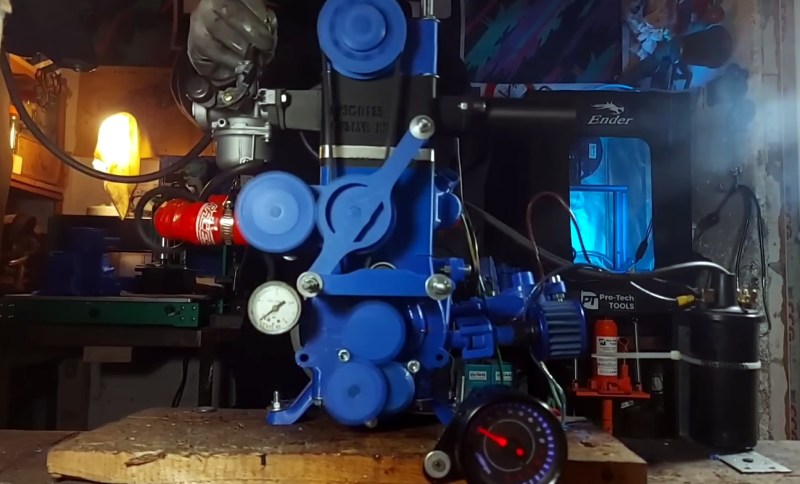
Although 3D printing it a great tool for making all sorts of things, the nature of the plastics used in most desktop FDM printers means it isn’t the first tool most would think of to build an internal combustion engine. [Alexander] is evidently not most people, as he’s on his third generation 3D printed engine.
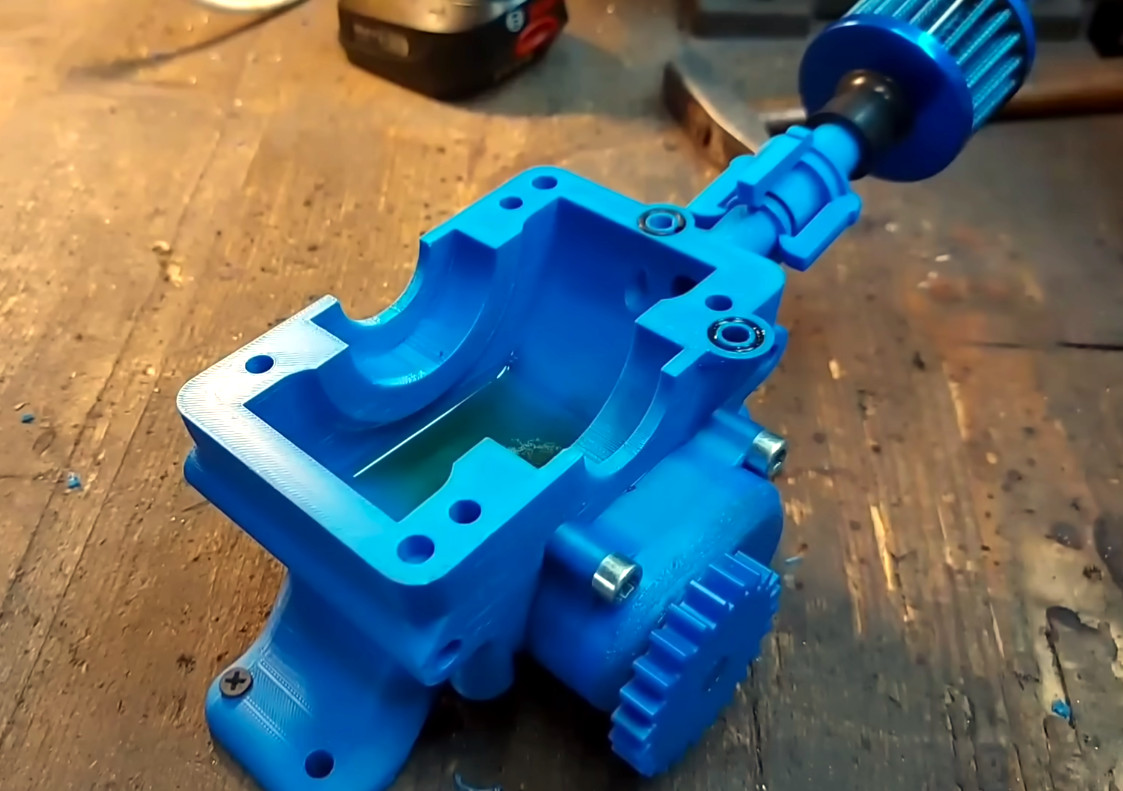 There are 3D printed pumps to distribute coolant water and oil, plus some clever engineering in the head to make sure they don’t mix — a problem with a previous iteration. As you probably guessed, the engine isn’t fully printed. Assembling it requires add-on hardware for things like bearings, belts, and filters.
But it’s still impressive just how much of this beast is actually made of plastic. Not even fancy engineering plastic, either — there are a few CF-Nylon parts, but most of it is apparently good old ASA and ABS.
If you’re looking for “cheats”, the plastic engine block does get a stainless steel sleeve, and the head is CNC’d aluminum, but we hesitate to call anything that gets a homemade engine running a “cheat”. It’s hard enough using all the ‘right’ materials. Just like another 3D printed engine we featured, the carb is also an off-the-shelf component.
Still, it’s the dancing bear all over again: it’s not how well it runs that impresses, but the fact that it runs at all. We’ve also seen hackers use 3D printing to make steam engines, hot-air Stirling engines, and electric motors— all with varying amounts of non-printed parts.












You actually have options if you dont want to cheat.
Markforged has metal-infused filaments that include materials like titanium and Inconel. They have to be sintered in an oven of course, and they are not cheap. But on the other hand, where I work we purchased a Mantle 3D printer ($400k including the oven that requires argon!)
Matterhackers also carried metal filaments. They also have “The Virtual Foundry” so you can sinter your own prints.
You would have to address shrinkage, though I assume the material has specs for that (it also an issue with injection molding, so its not anything new)
The accessibility of DMLS and SLM have made these types of filaments obsolete, from my perspective.
At this point, you can get a DMLS/SLM print couriered to your door in a week for the same price weight-for-weight as compared to this specialty filament.
We’ve gotten used to the idea of 3d-printing referring only to FDM or equivalent processes. Even 3d-printed concrete is still extruded (even if just poured) from a nozzle.
But SLS is still a thing, and it’s not the only way to directly print metal.
The idea of an argon enclosure isn’t really that specialized, even welders use purge chambers all the time. You go through a lot less argon that way, as opposed to just using it as stream of shield gas that immediately dissipates, like with tig welding.
Ready for the apocalypse*.
*The real one, not the AI.
Its a good way to prototype the fit and mechanics before pulling the trigger and ordering appropriate metal and composite parts online. Printing durable materials currently needs far too great an investment in plant, materials and knowhow to be viable for prototyping and small scale manufacturing but there are companies that you can send your files to who can quickly and economically turn out parts using various materials and manufacturing techniques. (The bad news is that they all appear to be in China so you are going to have to run the gauntlet of Trumpentariffs etc.)
CO poisoning
As soon as it is possible (more importantly affordable) I will most certainly illegally download and print a truck. The only counter to piracy is to offer something better. SAS in vehicle form bet it TESLA, GM , or someone else, is not a sustainable option.
I wouldn’t mind GM simply existing to keep the UAW afloat if they turned out decent products with longevity, but I’ve had to swap too many parts put in place by engineers who’ve never had to eat their own dog food to trust that company ever again.
That said, this build is an impressive step in the right direction. Looking forward to seeing what’s next.
They also seem to feature a lot of kids on others’ lawns.
This would be a great first step in prototyping before doing lost-PLA casting to make a real one.
People are already using 3D printing to make higher performance engine parts, SuperFastMatt just did a video where he showed what you can get from JLC these days compared to having to cobble something up at home to solve a problem.
A question to the gear-heads, but let me preface things.
I have a great love of models of the Starship Enterprise, but connecting the two nacelles to the secondary hull is a big problem.
All three are cones, so there will be problems with toe-in/out, alignment….droop, etc.
Now imagine a side view of a completed 1/650 AMT ENTERPRISE.
And I take a water jet to it. I cut straight down dorsal to ventral…top-to-bottom just in front of the two pylons and just behind.
I now have a V shaped “bracket” with the tops have small cylinders and the lower point of the V terminating in a wider circle–the secondary hull segment.
So help me, but I seem to remember seeing that on an engine block somewhere.
Here, the attachment points are not slots or tabs, but actually part of the model segment so un-droopable. The front and back of the two nacelles and the secondary hull can be attached to the front and rear of this V bracket fore and aft.
Flat on flat.
Anything similar on engine blocks?