
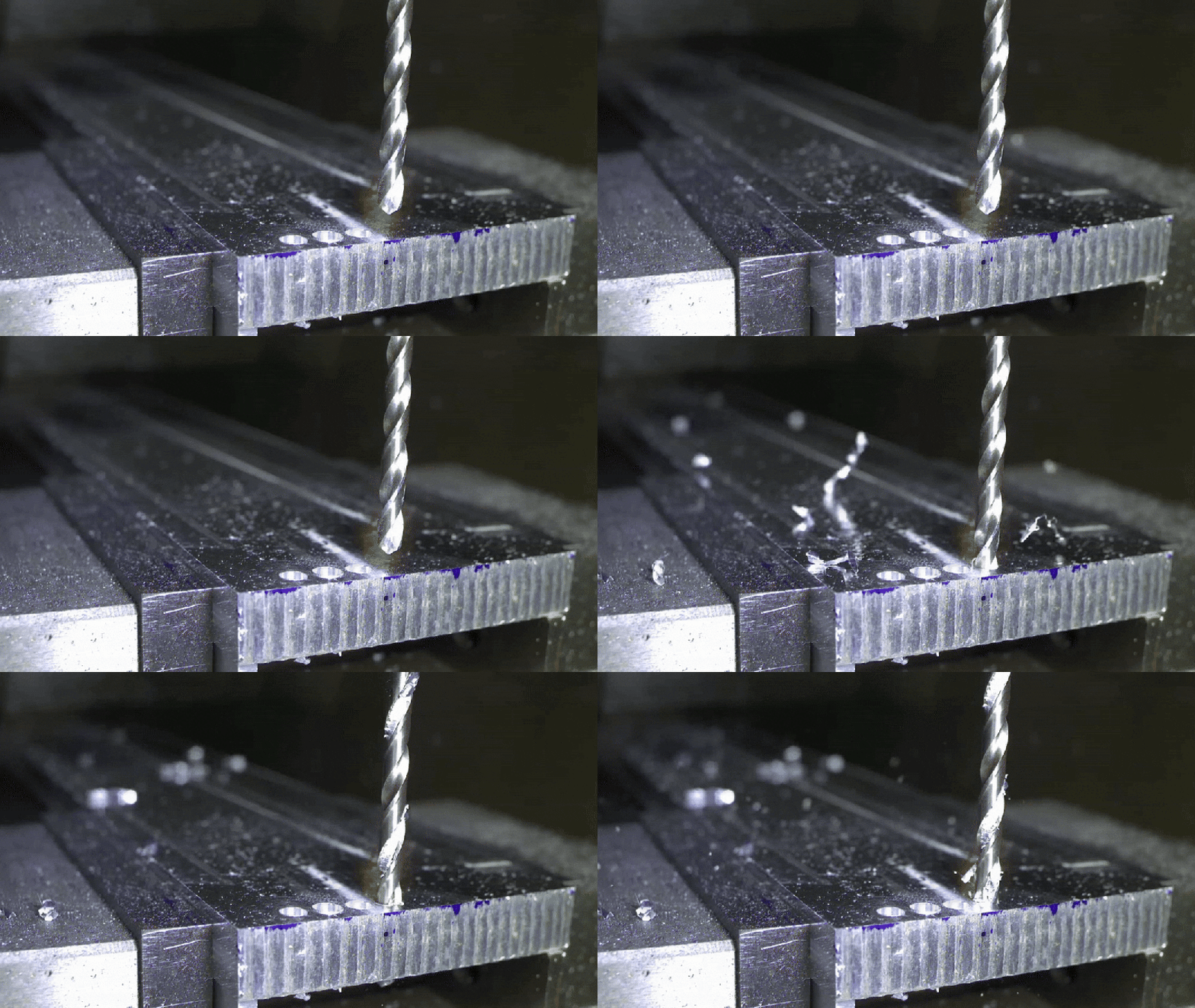
If you take a video of a spinning wheel, you’ll probably notice that the spokes appear to turn more slowly than the wheel is actually rotating, and sometimes in the wrong direction. This is caused by a near match in the frame rate of the camera and the rate of rotation of the wheel – each time the camera captures a frame, the wheel has rotated a spoke into nearly the same position as in the last frame. If you time the exposures carefully, as [Excessive Overkill] did in his latest video, this effect can seemingly freeze moving objects, such as a fan or saw blade.
Most cameras only allow relatively coarse, fixed adjustments to frame rate, making it difficult to synchronize the shutter to an object’s motion. To get around this, [Excessive Overkill] used an industrial camera (previously used in this aimbot), which has fine frame rate control and external triggering. He connected the external trigger to a laser sensor, which detects a piece of retroreflective tape every time it passes by (for example, on one blade of a fan). When the laser sensor sends a signal, it also triggers a powerful LED flash. The flash is so powerful that dark materials create a hum when exposed to it, as pulses quickly heat the material, but each pulse is also so brief that the flash board doesn’t require any cooling.
Even to the naked eye, these stroboscopic pulses make rotating objects seem to stand still – an effect which made [Excessive Overkill] extra cautious when working around a lathe. When using a suitably long exposure time to avoid rolling-shutter distortion, the effect worked even using a normal camera without frame-rate matching. [Excessive Overkill] took videos of debris flying away from a seemingly motionless bandsaw, milling machine, chop saw, and jigsaw, though it was harder to freeze the rotation of a weed trimmer and a drone.
We’ve seen this effect used to freeze motion a few times before, both for art and for entertainment. If you’d like to recreate it, check out this high-speed LED flash.
Thanks to [Keith Olson] for the tip!












That’s always been considered a bad idea…. you know, for safety.
it´s standard on some tools. Jigsaw from Festool for example, has a stroboscopic blade LED lighting. It´s convenient when precision is needed
Neat idea. You could even use it to measure the phase angle of the part. Maybe even something like measuring when in the rotation cycle a spark plug fires in an engine!
Couldn’t you just take a video normally with no special hardware required and get your video editing software to only keep 1 frame out of x frames and discard all other ones?
Say, you record a 120FPS video of something that rotates at 3037RPM. You won’t be able to freeze the movement as you would get a frame every 151,85 degrees. Only one frame per minute of recording would be viable.
On related note there is the matter of shutter speed, depth of field and motion blur. To avoid motion blur you need high shutter speed. To get a decent depth of field you need a small aperture. This limits the light that gets to the sensor, and you can’t really crank up the ISO value if you want a decent quality and lots of details. That’s why strobe lights were invented.
This phenomenon is called aliasing.
You could allow for some slight wobble, it does not have to be THAT precise.
So you’d get more than you suggest, but perhaps still not enough though.
So we’ve reached a point where no one remembers putting a chalkmark on a timing belt with a strobe gun to tune the engine?
Or “Doc” Edgarton aka “Papa Flash”?
No critique of the project but man it seems like we’re forgetting more than we’re learning.
I may be old, but I still remember last week! This effect is also why I’ve got high frequency tubes in the garage lights, and will only consider fully-rectified led lamps when I catch up with the 21st century.
The other day I was looking for a way to add text-to-speech to Cardputer ADV app, and the only suggestion from a search engine was to use a small AI model. This was done in software in 1990’s on ordinary 486 PCs using software called Syntalk that was developed in Poland. My blind friend used it at school with DOS and Norton Commander. This kind of software could run on ESP32-S3 in the background as another standard library with little penalty to its performance. Yet today this is completely forgotten technology, and only AI things get promoted by search engines.
That’s where the advanced search comes in handy. Exclude anything newer than about 2022 to find useful information.
Maybe Mr. Overkill does remember this and that’s what help inspire this video?
No.
Because that wasn’t how it was done.
Timing mark is on crank pully.
WTF is a mark on a belt supposed to tell you?
Last line back at ya.
There are new people created all the time who have not had a life’s experience. Which things should we bring forward to them? Which should we (culturally) forget?
I have a stroboscopic tachometer and use use it often for finding out of balance fans and the like. If you have an out of balance fan you can put a mark on one blade and by speeding or slowing the strobe you can determine the out of balance blade. Works great. Just be careful of using it around people who suffer siezures.
I remember talk about florescent tubes not being allowed as illumination for machine tools, (because it’s can make the parts/cutting tool appear stationary. ) I guess this this must have been the anglepoise lamps commonly fitted to old lathes, etc.
I haven’t watched the video but from the above clip of a drill bit it seems quite pointless to use a stroboscope when you can’t see the cutting edges of the tool. Watching the drill stand still and see bits of swarf fly off IMO doesn’t tell you anything useful. Surely the analysis of observing a rotating cutting blade actually slice the material is key?
For interest’s sake on a tangential note, some decades ago whilst watching ‘The New Inventors’ on Australian TV there was a fascinating microbiology device that used a stroboscope and a high-speed rotating conical two-slot mirror to excite living organisms on a microscope slide. The mirror would block the flash of light pulse that provoked the cells from going up to the eyepiece, and turn off just before the slot opened and the observer could see the results of the excited organism.
Re needing to actively remember that things are moving: reminds me of the old observation that hot objects and cold ones usually look the same. Folks working with them are taught the danger, preferably not by experience, and you try to keep untrained folks out of the workshop.
I would bei more interested in the light source he built. Inductors next to the LEDs? Like for a driver chip?
Just follow the link and look at the schematics. Each 68 uH coil is in series with 6 LEDs and a 33 milliohm resistor (for current sensing). Nice and simple way to modulate it efficiently, right out of the driver datasheet.