
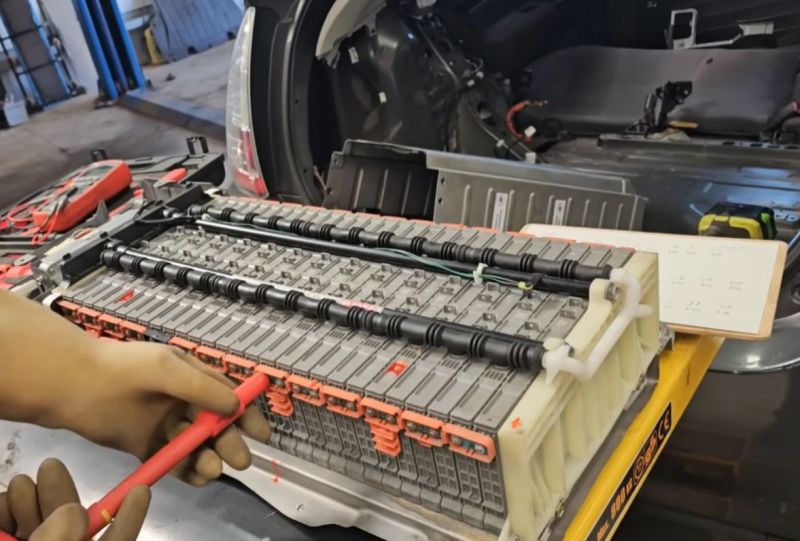
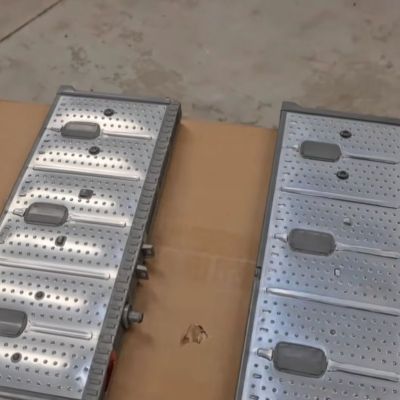
It’s possible to get a pretty good deal on used Toyota Prius cars, but as with all hybrid cars that also means a used battery pack and resulting issues. In the case of the Gen 2 Prius that [HubNut] recently acquired it was clear that its battery was effectively toast, with the engine running constantly and the car often giving up due to detected issues with the pack. After getting to an EV-focused garage for repairs, a spare NiMH module was used to replace a problematic module to bring it back to good health, while raising the question of how sensible such a repair is.
Certainly, compared to the average BEV where a much larger battery is generally integrated well into the frame, a Prius makes things very easy, with the compact battery readily accessible and removable from the trunk. It is also a very modular battery, with some elbow grease and bolt-twisting enough to disassemble it.
Even with that it still a high-voltage battery with all the associated risks, and as raised in the comments there’s a big question about putting a new(er) cell into a pack with more worn-out NiMH cells as generally the cells wear out fairly evenly. While this fix can give the pack some more life, the new cell won’t match the internal resistance and other parameters of the pack, leading to issues like voltage drift. Then there’s the issue that if one cell failed, others probably aren’t far behind, so this hack would soon become a regular ritual.
Much like swapping one bad 18650 Li-ion cell in a bigger battery, it’s probably a more sustainable solution to simply replace the entire battery at once, or at least replace all modules or cells to properly refurbish it. For [HubNut] this fix suffices because he suspects that this pack was already assembled from random modules, it’s an important consideration to make if you don’t enjoy ending up stranded during a trip.












solar panels these days are often paired with a per-panel “optimizer” or “micro-inverter” so that one shaded (or faulty) panel doesn’t take out a string of them. i wonder how the costs / tradeoffs will be negotiated in the future for battery packs. seems like a lot to ask of your BMS but the number and quality of transistors embedded in everything seems to be growing still
A shaded or faulty panel doesn’t “take out” any string because bypass diodes are build in – dunno since when that’s standard but I guess it’s pretty much since forever.
The one time I stumbled over these thingies I couldn’t figure out what they are even supposed to do (electrically; I didn’t find good explanation / documentation – but I did not look for long).
Correct, but it does not take much to take out a whole panel. And if the MQTT algorithm tries to keep that panel included (keep voltage high) then it could degrade a complete string.
MPPT. MQTT is the internet-of-things messaging thing. MPPT is maximum power point tracking.
One version of solar panel management is called a string inverter: it does maximum power point tracking for that panel. The panel string inverters are in series, and the power from each panel is converted to a standard current (eg 10A) and as much voltage(eg 10-12V) as the power can manage. The output of the entire string is then 10A at some variable voltage, then converted to whatever is needed. . Keeping the current low reduces IR loss, which would be higher than the losses from the multiple dc-dc conversions
Would you pay that much money to fix a 17-23 year old car? How many years till you have to scrap it anyhow?
The eCVT transmission on these is rock solid. Prius’s regularly run for more than 500k miles.
It’s not about the miles, it’s the overall age and wear on all parts. Plastics and rubber become brittle, windshield is blasted, rust is setting in… all sorts of little things start to break down, even in a Toyota.
It’s approaching that age where you have to fix something every single year and the extra maintenance cost eventually exceeds the yearly depreciation of a newer car, so you’re better off scrapping it and getting another.
Plastics and rubber only become brittle if not properly maintained. Wiping down your plastics with a cleaner/protectant every 1-3 months is pretty simple. Door weather stripping can last 10-15 years and only costs a couple of hundred bucks.
Windshields are only blasted if you tailgate, and replacing a windshield is not a big deal anyway.
Rust should not be setting in. Rust only happens when your paint or undercoating has failed and youve done nothing about it.
Every car requires basic maintenance every year. Depreciation only matters if youre looking to sell your car. Buying a new car is always going to be more expensive than maintaining the one youve got, ESPECIALLY if you started with a new car.
Found the Californian. Come up to the rust belt and see how well your undercoating holds up.
@mattew
Its all about PROPER MAINTENANCE. Oil and wax undercoatings are only good for a year or two. Rubberized undercoatings will get you 3 to 5 years. Asphalt based undercoatings get you 5-10 years. If you deep cleaning and spot retouching these materials and recoating as necessary, you dont really have an undercoating anymore.
When I restored my nova I knew this was my forever car. I went with which is rated for 25+ years. My car spent its first decade after my restoration driving through colorados salted roads. It also spent 3 years in Detroit. Im proud to say that at 22 years its still looking good, though Ill probably do a respray in a few years just to be safe.
Just bought a 2007 Prius with my son. Almost 200k miles but it’s in excellent condition as 1.) it’s a Florida car 2.) they kept it in a garage. I have seen these sold with 500k miles and 300k is a very reasonable expectation. His has the original battery pack so we’re gonna replace all of the cells at once using a refurbed kit with a two year warranty for $900. Car was $6k so that’s $6.9k for a rock solid long-lasting vehicle.
Also bought my sister a 2008 last month for $2.5k with 225k miles. It’s more rough around the edges but it has a new battery. After an oil and belt change we promptly drove it from Orlando to meet her in North Carolina to then take it to her home in Chicago with zero issues.
Soon as I can I want to buy one for myself.
They’re fairly easy to DIY fix, yes even the plastics and rubber. In the top 10 most reliable vehicles of all time. Even repairing things every year, the overall lifetime cost still beats buying new.
Excellent vehicle, but they sure are ugly :-D
That’s a pretty tall ask if you consider all the plastic parts in a car, not just the door seals or whatever you can wipe down with a rag. We’re talking engine parts, stuff hidden inside the door panels, the dashboard, etc. that require you to pull other things apart to reach them – and when you do, you’re liable to break the brittle plastic parts anyhow.
Or if you’ve been driving the car for over 20 winters.
Makes no difference. You simply calculate depreciation down to zero value. It still costs you something per year of ownership, for what you paid for it and how many years you’re able to keep it before the maintenance costs start to increase.
Say, you paid 10k for a car that works for another 10 years before it starts to fall apart at the seams. That’s 1k per year. Once you’re spending more than 1k per year on things like towing, shop hourly rates and parts, etc. you’re better off scrapping the car and getting another one that’s losing 1k a year in value but not giving you all that trouble.
@Dude
“You simply calculate depreciation down to zero value.”
If you maintain a car properly, and it continues to perform reliably, It never reaches zero value.
The average transaction price for a new vehicle in the U.S. is currently hovering around $49,450.. In late 2025, the average car payment was $767 per month for new vehicles and $537 per month for used ones.
Unless you are paying more than $6444-9204 per year on things like towing, shop hourly rates and parts, etc. you’re better off keeping the car, rather than throwing away money on a pit of depreciation that you have no intention of maintaining.
Im driving a car that is older than I am, That Ive owned for more than 20 years that I have less than $20K invested in, and I rarely put more than oil, transmission fluid, and tires into keeping it on the road.
You do understand that plastic doesnt just degrade on some timed schedule. The vast majority of plastic degradation is the result if UV exposure. There is very little if any noticeable degradation of the “hidden plastic” youre whining on about. You wouldnt know because you dont maintain your vehicles, you run them into the ground and buy another.
That’s begging the question. Ordinary maintenance does not keep a car going forever – at some point you have to rebuild.
Don’t buy new vehicles. Let someone richer than you take the first drop in value.
Yep. It varies from plastic to plastic and part to part. They all do eventually though.
I do the same as you. Only, I don’t put $20k into a car that’s older than me.
I bet under ten years time you’ll do the same as me. You keep maintaining what is reasonable to maintain while the little problems keep accumulating, until one day you’re faced with the choice to rebuild or re-buy.
“Only, I don’t put $20k into a car that’s older than me.”
I haven’t spent $20k total on 2 cars in the 15 years I’ve owned them, including purchase prices. Not remotely close.
Personally I wouldn’t go farther back than about 25-30 years, because the overall technology basically plateaus around then, and because they standardized on parts things are so ungodly cheap that maintenance just isn’t an issue. Also once you get back that far it’s not like cars actually get cheaper anyway, they basically flatline in value at that point.
i’m the last person to take sides on the underlying debate here…i don’t have a car, and in bicycles i like 1980s/1990s bikes best but i also have come to accept certain faults aren’t worth repairing. i see both sides.
but i really enjoyed this comment! yes! everything requires maintenance — even new things. but let me burst your bubble: most things don’t receive it!
example…my hot water heater is supposed to be flushed every year, and it has a sacrificial ‘anode’ in it to prevent corrosion, which is supposed to be replaced on some schedule too. i’ve never met anyone who does either of those things. the fact of the matter is, it eventually wears out and you throw it away, whether you maintain it or not. i don’t know how much extra life i’m missing out on but no one maintains a water heater.
most cars are only a little better off than that water heater.
@Greg A
Depending on your water quality you can expect a water heater to have around a 5-7 year lifespan if you do nothing at all. If you flush the tank annually and replace the anode every 2-3 years you can double that.
I own 4 rental properties, two family condos, and a house in the country and I DO annual inspections of all of our systems and keep a standard maintenance schedule on everything. Even our rental units get a monthly swap of their permanent washable air filters with a freshly cleaned one.
If you want the things in your life to last you take proper care of them.
That just isn’t true. Every car will require maintenance, you seem to be conflating neglect with age.
I just replaced a 30 year old headlight because the entire reflector unit was leaking water through glued seams that were disappearing into dust and the beam lifting motor had seized. How do you keep maintaining a sealed unit that was never meant to be serviced?
The electrical plug in the wiring harness was also dry as bones, 30 year old plastic just about ready to fall apart. These things don’t last forever, and replacing every single part is not a realistic option because doing it bit-by-bit takes so much shop time pulling everything out and putting it back together again, over and over.
If you’re a restorer, then you might strip the entire car down to the frame and fix or replace everything that needs to be replaced all at once. If you’re a regular commuter who relies on the services of others, who needs the car to drive every day, that’s not an option.
There’s a huge irony in saying “how do you service this thing” and then use “headlight seals failing” as an example when there are literally hundreds of examples of how to do it.
The second generation Prius holds up really well, plastics included.
A prius battery isnt very expensive you can get a new one for ~$2-3k.
I daily drive a 56 year old car Ive owned for 22 years.
Unless youre beating the crap out of the car and doing no maintenance I cant see any reason you cant keep any car on the road indefinitely.
That said. I bought mine for $500 and all told i have around $18k invested in it. I could get around $35-45K for it today. I seriously doubt a prius will ever gain value the way my car has.
Keeping it going by fixing little problems one-by-one is very expensive, unless you have your own garage and do it yourself.
There comes a time when everything starts to break and you’re spending more time fixing the car than driving it, until you’ve basically rebuilt the whole thing and then it’s good for another 20 years again.
Thats the thing though. If you adhere to a proper maintenance schedule and take proper care of a car there is not a time when everything starts to break. Thats the result of doing NOTHING.
Its been 22 years since I restored/rebuilt my nova. It was beat to hell by someone like you, someone who thought all you need to do is gassing up and doing oil changes once or twice a year.
I do regular routine maintenance. and Its in just as good condition as it was then. It will probably still be on the road in another 22 years.
You’ll never beat the rust if you live in a place where the roads are salted half the year, or in a humid marine environment. Never. Doesn’t matter what brand of car, it will rust, you’ve got 20 years, max.
It’s not a moral issue, it’s a climate issue.
@halyard
Sorry but youre wrong. Rust is not inevitable. You just have to maintain your undercoating and paint properly. Doesnt matter where you live. It matters how you take care of your car.
@justsayin Is it really inevitable within a reasonable timespan? I was just under my 2006 Sienna, a Florida car, was surprised to find no rust, and I do ZERO to the undercarriage, completely neglect it, and we live down a dirt road. I know it’ll fall apart from rust at some point, but at this rate it won’t be in my lifetime.
It really matters where you live and if they salt the roads.
@justsayin Oops, you didn’t say rust is inevitable, I misread it. Wish HaD had an edit/delete button.
Some places can’t be reached to do rustproofing, places that will nonetheless be attacked by salt water.
Where in the regular maintenance schedule are things like, “replace the engine wiring harness before the insulation starts flaking off”?
There are parts of a car that area meant to be serviced within the designed lifespan of the car, and there are parts that you can do practically nothing about unless you strip the whole thing and rebuild.
@dude
I currently own a 56 year old car that was rewired 22 years ago. At 34 years old the only issue with the wiring harness was a number of previous owners splicing accessories haphazardly. I replaced everything because I was doing a full restoration.
I also own a 42 year old german sportscar. Its wiring is all original except for a custom ECU/MAF update modification I installed 15 years ago. The insulation on its wiring is pristine. The connectors arent magically crumbling. Everything is just fine. I know this because unlike you I actually can and do work on my cars.
As so many subjects on HAD youre here again posting idiocy that does not align with reality convinced that you and you alone have any understanding of the world and all it contains.
Im not sure what planet you live on but like so many other HAD topics that you obsessively attempt to dominate the comment section of, you are once again woefully incorrect in almost every assertion you make.
Go run your car ragged, Allow your mechanic to CONvince you every issue is a major one and every repair an expensive one, Go buy a new car every few years. ENJOY YOUR BLISS!
Says the person who appears to be claiming that my experiences about crumbling plastics in old cars don’t count for some reason, and that I don’t maintain my own car.
If you want someone to work for 8 hours on your car, you’ve got to pay them about three days of your own wages. One third goes to the mechanic, one third to the shop for rents and stuff, and one third to taxes, give or take.
That’s why the service is so expensive, not because they’re trying to cheat you. The business and tax overhead means that hiring someone is always 2-3 times more expensive than your own time, and labor time is the major cost when it comes to troubleshooting and fixing older vehicles.
If you can spend your weekends under your vehicle in your own garage full of tools and equipment, good for you. Saves money. Save for the bit where you had to buy the garage and the tools…
Another thing is how well they’ve galvanized the body. I don’t have any rust down the bottom of my car either, but the doors are starting to go where the paint and the galvanization is thinner on the inside.
“There comes a time when everything starts to break and you’re spending more time fixing the car than driving it”
I mean, I’ll tell you when I get there, I guess? Been to the moon and back with multiple cars and haven’t gotten there yet.
Rust in the salt belt WILL happen. No matter what coatings are on the vehicle. Undercoating will not stop rust coming from the inside out. Your coating just bubbles off. Salt belt = rust. Guaranteed. It’s not if. It’s when.
Do any BEVs have battery packs with similar easily replaced separate cells? I have been wondering about if there are economical ways to do a DIY fix on a battery pack if one fails. Right now if I were to buy an electric car, it would have to be pretty far down the depreciation curve.
“Undercoating will not stop rust coming from the inside out. ”
See, that’s weird, because a lanolin undercoating literally penetrates into the metal, so it does.
My 2001 Silverado has 80,000 miles on it. Other than oil changes and a few tune ups. Nothing has been done to it. My daily driver is a 2017 Chevy bolt. The bolt is disposable tech my truck will be on bring a trailer in ten years. Care for your stuff and can out last you
Ok I exaggerated…. Tires, hoses belts and 4 batteries. Never taking my vehicles to an automated car wash. Both vehicles serve specific purposes. Both are paid for. Both satisfies my needs.
I mean, you’re missing some obvious things, you’re not going 25 years and 80k miles without changing brake pads or filters and such (unless you haven’t, in which case… change your brake pads and filters, lol).
The key is really to make sure you buy a car that’s common, or at least its replacement parts are common (tons of vehicles are basically hodgepodges from different models on a different body, so even though the vehicle itself isn’t common, the parts are).
At 80k you’re still at the point where stuff like bearings, starter, alternator, radiator, aren’t expected to go: but for tons of vehicles those are dirt cheap parts.
And the installation’s trivial: they’re Toyotas, they made them to be a joke to fix. You need like 4 sockets to take apart the entire car. There’s no real risk, the cutoff prevents that.
Given the fuel efficiency of a Prius and the boost from a fresh battery, it pays for itself in like a year. Or jeez nowadays like two weeks.
Except when the bolts are so crusted in place that the heads shear off from the attempt to remove them. Been there, done that, can’t use the blowtorch or the welder because of plastic parts and paint right next to it… yada yada.
New cars go together and come apart as the designers intended. Old cars have their own ideas.
“can’t use the blowtorch or the welder because of plastic parts and paint right next to it”
Wow you must buy the most garbage of vehicles. In any case, if you shear a bolt head you a blow torch or welder isnt really the tool you want. Apply a generous amount of penetrating oil. Flatten the broken head with a file or rotary tool. Then use a left hanbded drill bit and if necessary an extractor bit.
All cars, new or old, go together and come apart as they were designed to. Some people just arent prepared to deal with issues when they arise, apparently.
We’re talking about Toyotas. If you say they’re crap, who am I to argue…
Yep, you would apply the torch before trying to open the bolt, so the head wouldn’t shear off in the first place. And I did drill it out – that wasn’t the point.
The issues was the point. You don’t just take old parts out and put new parts in, you have to deal with the issues that come from everything being old, crusted, rusted, brittle… and it takes time. Or money if you make someone else do it.
“Except when the bolts are so crusted in place that the heads shear off from the attempt to remove them.”
Yeah. That’s why you 1. don’t try to remove rusted bolts without treating them first and 2. replace stuff on a schedule and use antiseize. Rust penetrant nowadays is extremely good, it just takes time. Also you can always use heat. Heat shields will protect stuff from blowtorches, and worst case you just use an inductive heater. They’re like 200 bucks or something.
Rust is 100% a maintenance problem.
My youngest car is 22 years old, it’s still solid, everything works, and it owes me nothing. Yes I have to fix bits from time to time but that’s true of almost any car.
If you look round car forums/subs/etc. there’s an enormous amount of discussion because modern cars are coming rammed with so much unnecessary nonsense that even people who would buy a brand new car can’t actually find one they can tolerate living with. A lot of people reckon the late 90’s into the 2000’s are becoming a golden age for cars in terms of having all the main problems basically solved but before we get to “everything through a touchscreen” and intrusive driver assistance systems that cause more problems than they solve.
Personally I can well imagine there’s a whole group of people for whom a Prius is all the car they ever need and there’s a lot to be said for keeping a car going, especially since running an older EV/hybrid isn’t throwing out bad emissions like running an old muscle car or pickup.
I have used green bean tech to replace my worn out battery pack in my 2014 prius. The solution offered a reconditioned battery pack with a 3 year unlimited mileage pack. Crazy thing is they have a contractor schedule the install at your house. He came out around 6 pm scheduled and was done in about 45 minutes. Swap, program, and test drive. It got my prius back in the 40s mpg range. I would not hesitate doing that again. Total in 2022 money was about $1500.
They did take my pack in trade and will presumably swap the bad cels with similar worn models. My understanding is you want the packs to be of the same age or wear to balance better.
Then you are about where I was with my VW Golf diesel station wagon 20 years ago: 56 MPG average.
Rather, about where I am with my VW Polo gasoline 4 door: 46 MPG
Also slightly better than the Skoda Fabia station wagon I had for 15 years: 38 MPG.
I do not see the advantage of the hybrids. They don’t seem to get any better mileage than the cars I’ve had without the hybrid functions.
The Golf was a company car. I lost it when I changed jobs.
The Fabia was our family car for a long time, so hauling kids and groceries.
I could open the rear hatch on either one and stuff in a couch. With the seats down, of course.
We gave the Fabia to our daughter when we bought the (used) Polo. The Polo is a little sportier. Four doors instead of a station wagon, bright metal flake red, and zippy.
Don’t forget it’s a different gallon. Anyone who’s referring to the Prius mileage as “40” is probably from the US, and anyone who drives a Skoda Fabia is probably from the UK.
40 MPG US is around 48 MPG UK and the Prius is a considerably bigger and heavier car than a Polo.
I’m in Germany. I calculated MPG from the liters per hundred kilometer number that my car(s) reported.
Yeah, and so was the VW Golf station wagon. Can you open the rear hatch on a Prius, lower the seat, and stuff a large couch in and close the hatch to transport it around town? I could do that with the Golf and the Fabia.
Using US conversion rates. 3.875 liters = 1 gallon, 1.609 kilometers to the mile.
So which gallon did you use?
And, the Golf station wagon was a diesel. Apples to oranges.
“I do not see the advantage of the hybrids.”
Toyota literally has scientific journal papers about the efficiency gains of those engines. It’s not hard to see – because you no longer need high power density (the battery provides the additional benefit), you run as an pseudo-Atkinson cycle to just extract all of the energy from the fuel.
The issue with comparing between different cars (especially between countries!) is it’s not apples-to-apples. Diesel to gasoline isn’t a fair comparison because of the higher energy density of diesel (and you get less of it per barrel of oil so fundamentally the only way it works out to be less money is due to weird economics, which tends to be temporary). And with the other cars, the issue is that tracking gas mileage is hard because of any number of factors, both driving behavior and weather, and primarily size of the car and power output of the engine.
The best example of why you can’t easily compare between different cars is simple: try beating 100 mpg, which is what motorcycles can easily hit. But obviously comparing motorcycles to cars doesn’t make sense, right? Neither does comparing a car with 50-60 kW max power output to one with over 80 kW.
And driving behavior and power output isn’t something that you can necessarily control. You can’t just say “well, you don’t actually need an 80 kW output engine” – yes, in plenty of areas, you do. I can’t control how the other drivers around me drive, so driving an underpowered car is dangerous (classic example in the US is a Mitsubishi Mirage, which had the highest driver death rate in the country).
It’s also frustrating because part of the problem with the “small engines = better, but kill you in the US” is that no one in the US drives a manual, which somewhat helps (although my God you burn through gas dodging crazy people when the engine’s small).
Like, look, I wish my country could restrict vehicle accelerations and build onramps that are safe, but f’crying out loud, that’s the least of the concerns in the US right now.
50-60 kW in a regular compact car would spell difficulties getting up to speed even on a good highway ramp and no crazy drivers. If there’s someone ahead of you who’s hesitating, and delays your acceleration, you won’t be able to merge properly. If you have to slow down to slip behind someone, it takes so long to get back up to speed that the car behind you has to start braking.
70-80 kW is just about right in that regards. Smart cars and tiny hatchbacks can do with less.
“would spell difficulties getting up to speed even on a good highway ramp and no crazy drivers”
Yeah, but this is a country and laws thing. A 50 kW car in the 80s/90s was no big deal (I mean, I owned one, and probably so did a lot of people) because highway speeds were 55 mph and all the other cars were similarly powered and sized. Since 1980 in the US, power-to-weight has nearly doubled and acceleration time has basically halved. The fact that we’ve been able to maintain fuel economy even close is really impressive from an engineering standpoint.
That’s my whole point – you can’t really compare things across years or countries just because the environment’s so different.
In the US things basically flatten out around the turn of the century (still dropping, scarily).
You should put electrified truck nuts on your car, the kind that light up via the trailer connector.
You’ll be the second German to have them.
First outside my family.
You’ll get pulled over for making drivers laugh on the autobahn.
You might want to rewire them for euro regs.
IIRC left and right blinkers are supposed to be yellow.
Standard electric truck nuts blink red.
My young-at-heart Tacoma celebrated its 25th trip around Sol this year. Other than the typical recurring maintenance stuff/tires/fluids/plumbing, I have only replaced coil packs, both clutch cylinders, and am on the 2d brake job (although I suspect the ball joints will be a near-future failure).
A back of the envelope calculation, including increased gasoline costs, indicates a savings of approx 81k USD over the past 25 years (car reg, new vehicle insurance, new car financing, reduced reliability for all ICE vehicles made after 2012, inability to home-repair anything made within last 7 years, and the intangible benefit of driving an ugly old machine that disgusts the sensibilities of my wealthy neighbors). At over 350k statute miles, there are limits to the associated long-term costs for my beloved Taco; but not an issue – recently bought a 2006 Taco with 60k miles that had been sitting in a garage for 15 years.
If it were not for the enviromental issues associated with an ICE and fuel costs, I would be metaphysically and physically set until my end.
Holy Christ, I did not mean to start a war.
I have an 08 Gen 2 with a rebuilt battery pack that I bought for 3k in 2019 with 250k miles on it. It’s needed some repairs. I’ve bought lights, tires, brakes, and batteries for it. I rear ended someone on the freeway (my bad) and my nephew pulled the frame straight and slapped a junkyard cowl and hood on it.
It’s still rolling.
Leather seats. The best greenhouse and instrument panel of all time. Built in military inspired MFD/GPS (updated to 2014). Huge cargo space.
It has 320k on it now.
It’s a damn tank. And I’ll fight you if you say it isn’t.
If I still lived in the salt covered tundra I’d get on an airplane whenever I needed a new old car, drive home in a new project.
I’ve wrenched in both environments, there is no comparison.
Old cars in the cancer belt are done.
There is no tearing down to a frame, their is no frame or unibody left.
One rusted solid bold has more cost than a plane ticket to someplace warm and gas back.
Undercoatings are a bad joke, they just don’t work.
Many hold road salt rather than repel it, none have a guarantee worth anything.
Are sold to new car buyers that will sell the car before the first rust bubble appears anyhow.
Undercoating is like a timeshare…
What they really want is the chump that comes back year after year to get the rust warranty.
Those guys are only good for one car each though, nobody will fall for that twice.
See also:
Fargo. He was hard selling the undercoating because it’s pure profit for the steelership.
Also:
You are all missing the current problem.
The newer cars are unfixable, by design.
Not just the German ones, they were just ahead of the curve.
Newer cars do have better paint, but they have for sometime.
Will only delay the rust.
CA IS the granola state.
Fruits, nuts and flakes (I’m a nut).
But love the weather.
Rebuilt packs are a thing, aren’t super expensive, and include core recycling. That seems like the most eco and permanent solution for this. Replacing a single cell like that is definitely a temporary fix.
If you are willing to spend the time, you can absolutely do a partial rebuild on a battery pack. Unlike lithium, most of the cells in a Nickel hybrid pack are only suffering from the “Memory effect”, which still happens on NiMH packs with enough time (10-20 years). You need to refresh each cell unit and identify which unit isn’t recovering, then replace the failed unit with a new or known good used unit.
Of course, it’s more time efficient to just buy a reman battery pack, but you can argue the same thing over rebuilding alternators, engines, transmissions, axles, etc.
Considering the current state of the economy I can understand why people are fighting to maintain their EV/Hybrid.
I replaced two modules in my 2005 Prius and it worked for years. Of course you should follow guidelines to eliminate electrocuting yourself, but two $41 modules on eBay gave my car new life. I’ve actually thought about finding another one, now that I own a 2024 Prius that expects a subscription to keep working.
The Prius is truly the cockroach of cars. And I mean that in a good way. Change the oil. replace the tires and that’s about it.
Wear items are about the same as all cars. The 12 volt battery is a pain to get to when it’s dead because it’s in the trunk which won’t open without the 12 volt battery. Passenger side headlight is a pain to replace. Can’t think of anything else.
The plastic fender liners get scraped off if you have as casual an attitude for parking off road as my mom.
Testing , replacing, and load ballancing the individual cells is cheap and easy.
The only real drawback is the people who freak out if you pass them driving a Prius.
Second gen Prius. The third gen Prius is the brief period where Toyota tried to cheap out on the rings and screwed up multiple engines. On the 3rd gen Prius that causes oil burning and carbon buildup in the EGR which clogs it and causes differential heating which blows up the head gasket near cylinder 1’s side.
Third gen Priuses are good deals if changing head gaskets and cleaning the EGR manifold is cheap for you (fundamentally it’s all labor).
Biggest problem with second gen Priuses is that the cats are so expensive and get stolen.
I have a third gen, and at 130,000 miles it uses no measurable ammount of oil. Certainly less than a couple ounces between oil changes.
I replaced a noisy rear wheel bearing, a couple sets of tires the annoying 12 volt battery and that’s it.
Still on the first set of brake pads even.
I might change the spark plugs, I’m only getting 48 mpg, but I drive by it pretty fast.
When I fixed the battery pack on my 2nd gen Prius (many years ago before all of these rebuilt/renewed pack options existed), I broke it down to the module level and individually load tested each module. It is just a 6 cell nimh battery. After a few charge/discharge cycles, recording the values each time, I culled the bad modules and sorted the good ones so that each group had the most similar performing modules. Worked great. It sounds like the OP just didn’t put the work in.
I learned a new word today from this video “whizzy gun”.
Let’s face it people.
It’s not the Prius tech that everyone hates so much.
It’s the type of people who drive them.
And also the way they drive.
There, someone had to tell the truth….
Some people. I dislike those kinds of people for their moral superiority; and yet this year I bought two 2nd Gen Priuses; one for my sister, and one for my son, not thinking at all about the morality but thinking entirely about how much money they’ll save because 1.) they’re gas sippers, 2.) they’re super reliable, 3.) they’re fairly easy to DIY repair 4.) low up front cost.
Lowest overall cost of ownership of any car I can think of. Soon as I can, I want to get one for myself, as well.
My daughter bought a 1999 geo metro for $1200 in babysitting money summer 2017 before her junior year in high school.
During the pandemic she bought a $300 engine rebuild kit, and an $80 clutch. It took her about two weeks, with surprisingly little help from me to tear it down and put it back together again. It gets 45-50mpg and she only pays $68/mo for insurance.
It might not be the fanciest ride but she loves it
My dad had one of those. Drove it into the ground. I think he put 400k miles on it.
Forgetting about insurance costs is like the biggest issue I have with people who buy expensive cars. The difference between insuring a Tesla and insuring my car is literally more than I pay for gas in an entire year.
Most Prius owners also own a big gas guzzler. My other vehicle is a Dodge ram. My prius gets over twice the mpg. Not a hard decision which I would like to commute with daily; although the truck is superior when stuck in traffic. Your not stuck looking at the a$$ end of the vehicle in front of you.
“It’s the type of people who drive them”
God, people are weird. It’s a damn car, not an extension of my personality. I use it to get from point A to point B, not advertise my world views to people.
It’s not nearly as bat at the morons that freak out if you pass them driving a Prius, and feel the need to pass you, then realize they are driving 95mph, cut in front of you and slam on the brakes.
This BTW is in California, 85 is generally the flow of left lane traffic.
Before doing any pack replacements I suggest it would be wise to check the fine print with your insurance company first. Here is what Google AI tells me:
“An insurance company will typically only cover a Toyota Prius battery rebuild or replacement if the hybrid battery was damaged as a direct result of a covered accident, fire, or flood. Wear-and-tear or standard battery degradation is not covered.”
With that last sentence, perhaps this article’s rationale for replacement due to worn cells might not be something that safeguards your insurance.
You don’t know how car insurance works, you think posting AI slop is helpful?
That’s pretty much the same for everything else on a car. The engine v blows v up and it’s not covered. You rebuild the engine and the car gets wrecked and they don’t pay extra for the rebuilt engine. I don’t think insurance covers anything wear and tear item except maybe windshields, but I have cars with 60 year old windshields. Other cars seem to go through them every five years.