
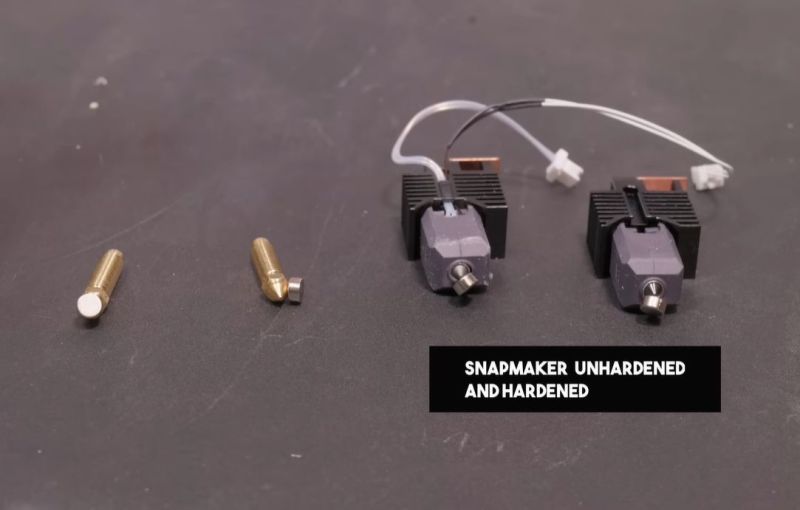
Adding magnets to a 3D print can be very useful in a design, but there are some things that can trip you up if you’re not aware of them. In a recent video by [Lost in Tech] some of the essentials are covered, including why you shouldn’t get magnets near most extruder nozzles or the printing bed.
The easiest method is of course to add magnets in after printing, using friction fit with or without ribs, or with a dab of glue. Here making sure that the magnet stays in place is the trick, as you do not want the magnet to get lost or end up in the tummy of a curious pet or toddler.
Things get spicy when you’re talking about adding magnets during the printing process, as some extruders are made of a ferromagnetic material and thus a magnet will happily stick to said nozzle if it’s not pure brass or similar. As seen in the video even some purported ‘brass’ nozzles aren’t pure enough to not be significantly ferromagnetic.
Another issue is that of heat, which is something that magnets generally do not like much. Using magnets like you’d use heat inserts for bolts is a recipe for disaster, as the heat from a soldering iron will demagnetize the magnet, which for the typical magnet is less than 200°C. At least this should mean that the magnet stuck to your extruder nozzle will eventually fall off by itself after it demagnetizes.
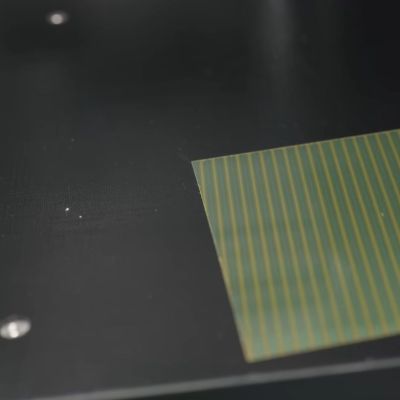
With the bed of the typical FDM printer these days you’re talking about magnetically attached plates, with the underlying heated bed using a Halbach array configuration as is typical of flat magnets, yet with the gotcha that these aren’t typically real Halbach arrays, but knock-offs with simply alternating north-south pole magnets. As it turns out, these types of magnetic arrays can be disturbed by another magnet, such as a powerful neodymium magnet near said printing bed, flipping polarity in a way that cannot be easily undone.
You can still install magnets during printing, but it’s recommended to use something like side-insertion, where the extruder nozzle cannot pull out a magnet. Regardless of your approach, it’s good to know of the risks with ferromagnetic nozzles, the magnetic bed and treating magnets like they’re just heat inserts. While you can get higher-temperature magnets, many of the same issues still remain here.











Embedding magnets in prints is abusing them in the first place. Magnets like short air gaps, so you’re pretty much wasting your high grade neodymium magnets by separating them with millimeters of plastic. If you want two parts to stick to each other by magnets, something like magnetic tape on both surfaces would perform better with less stray fields around where you don’t want it.
As the author says, one purpose is for Halbach arrays, where the magnets don’t stick to anything. They create a magnetic field, which can be used to measure the position and orientation of an object in the field.
While you can use magnets for that purpose, I’ve never seen anybody do it in a 3D print, and I’m pretty sure Maya said nothing about that kind of use.
Why would they like short air gaps?
“f*cking magnets, how do they work?”
because air is bad at conducting magnetic flux and you’re wasting the strength of the magnet by not giving the flux a good path to follow that is useful for your purposes.
Magnets work a lot better when in direct contact. The field strength goes up quickly the closer you are to another magnet or ferromagnetic surface.
inverse cube law
Came to say this, and it bears repeating. If you double the distance from a magnet, the field density doesn’t drop by a factor of four, but rather by a factor of eight. Triple the distance and you’re down by a factor of twenty-seven.
I think this misunderstanding is responsible for a lot of the disappointment people experience when using magnets. “It was hard to get off the fridge – why does it have so much less pull when it’s only three millimetres away?”
The inverse cube characteristic is also partly responsible for how dangerous strong magnets are: once they start moving – especially toward each other – the acceleration is REALLY high.
Also worth noting: sometimes you see magnets in steel cups. The purpose of the cup is to provide a shorter, more conductive path between the back pole and the “business end” of the assembly. This can give weak magnets a much more useful amount of pull, and can make strong magnets absolutely wicked.
Think they meant short gaps as opposed to long gaps. But the way it’s written it sounds like short gaps work better than no gaps, which is not the case.
When I put magnets in prints I usually only do 2-3 layers (so 0.4-0.6mm or so) before putting int he magnet so it doesn’t los emuch strength.
Measure the magnet with calipers. The hole should be only very slightly bigger than the magnet to get a good “friction” fit. You don’t want a hulk grip. Just enough for it not to get picked up. The magnet should also be 0.2mm or less from the surface if you want it hidden. Rule of thumb for me is to know the layer height I plan for then have at least 2 layers of material covering it.
If I need anything stronger then I either use a stronger/bigger magnet, or I don’t hide the magnet and glue it in place.
You can also make a tight hole, heat the print a bit and press the magnet in.
It reduces the insertion force to avoid breakage, and the plastic will settle into a snug fit. If the hole is slightly deeper than the magnet, there will be a tiny edge that will hold it in really well.
I just stick ’em in with cyanoacrylate glue. Quantity of glue varies with my confidence in the fit & finish of the part…
three gallons if the fit is very approximate?
decrease approximation
If the magnet really needs to be embedded at print time, then here’s a possible approach: use un-magnetized magnets, and then use a couple of VERY strong magnets to magnetize them post-print.
I don’t know about using neodymium in this way, as I’m not sure about the availability of blanks nor the strength of field required to magnetize them strongly and permanently. But un-magnetized ceramic blanks are definitely available – not sure about shapes and sizes though. So my idea may not be practical, but it might be worth investigating if the magnet just needs to be embedded in the print.
The problem with that is you will likely not be able to achieve the magnetism that you get with magnets you buy. Neodymium needs a very strong magnetic field anyway so you are limited to weaker magnet types, then you are limited the the strength you can magnetise them to which probably isn’t very high.
Embed steel rectangles instead.
I was expecting this obvious approach to be discussed towards the end… anyway, two ways to use bits of steel:
1) flat steel insert that gets buried in the print, with a pair of magnet holes above it. Provides attraction during magnet assembly and flux return path when in use. Alternating poles assumed.
2) single magnet embedded sideways, adjacent vertical holes for steel plates to press into after printing. This replicates cabinet door and welding magnets that take impacts and abuse on the steel edges, not the brittle magnet itself.
Off the shelf options: shaft key sets or rectangular nuts.
Maybe a threaded insert and a threaded magnet?
Anchoring is one problem that needs addressing. What the constructions above also deliver is a U-shaped flux path with low reluctance.
(There should probably be an entry-level article on how to compare various permanent magnet + yoke – configurations via using tools like FEMM)
Many magnets used in 3D prints are wider than the OD, let alone the ID, of any threaded insert I’ve ever seen (not that I’ve looked for wide ones, but they’re certainly not common in makers’ inventories). And do threaded magnets even exist?
I remember discussing brass quality- particularly its propensity to do something suspiciously similar to rust- and was told that almost all brass is melted down from scrap which is almost always contaminated.
The only solution is to insist on “Admiralty Brass” (or bronze etc., depending on how strict ones terminology is) which is made from the appropriate pure metals.
If American or middle-eastern: Just chop some off from the bronze statue of himself that tr*mp put in your town.
But remember to scrape off the gold paint before melting.
You might just have magnets in a metal mix now
https://techxplore.com/news/2026-06-looping-lasers-whisk-molten-metals.html
Yeast lords
https://techxplore.com/news/2026-06-yeast-based-materials-power-3d.html
On the Moon?
https://phys.org/news/2026-06-laser-origami-astronauts-moon.html
like others, i always had luck embedding magnets by friction fit. i use my printer as a 3d pen with like “G0 Z100\nG0 E100 F100” and it dribbles out filament in midair for a minute and i just rub my part on it…for those cases where hot melt glue doesn’t seem good enough.
does a good job of sealing the magnet in. my kids did not manage to eat a magnet in a toy i made. ymmv. fwiw, my kids were heavily supervised :)