
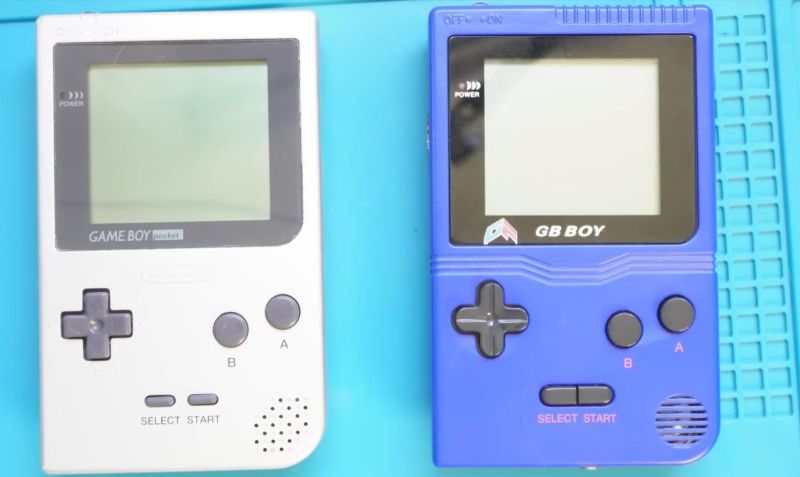
There’s no shortage of cloned Nintendo hardware out there, and most of it is pretty poor. A few are actually pretty interesting though, such as the GB Boy by Gangfeng, which takes real cartridges and thus in many ways should provide the original Game Boy Pocket experience with modern hardware. But as you might imagine, even the best of the clones comes with various technical issues at no additional charge — with this particular unit having a habit of running the game too fast. It’s an issue that [Sharopolis] addresses in a recent video with a partial fix.
As can be seen in the demonstration, it runs games just too fast to make it very usable or fun, hence why it sat in a drawer for a few years after purchasing off AliExpress. This raises the question of what’s wrong with these units, as others report similar issues with this and other ‘GB Boy’ variants.
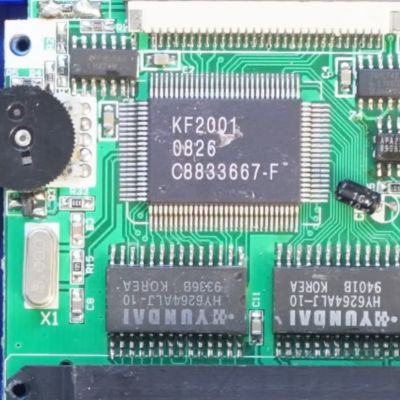
Fortunately the unit is easy to open, revealing the PCB with a couple of chips on it, one marked KF2001 being the brains of the operation alongside two memory chips. The crystal resonator marked X1 for the main IC is rated for 5 MHz, whereas a quick look inside the Game Boy Pocket shows that its crystal resonator runs at 4.1943 MHz, which is a bit of a difference.
Because of how buying components and pricing works, [Sharopolis] ended up with a reel of 100 of replacement resonators with the right parameters for a drop-in replacement. After swapping the resonator, the GB Boy now does indeed run games at the right speed, but a new issue has now cropped up in the form of flicker on the display.
In the comments it’s suggested that replacing the cheap capacitors on the GB Boy’s board can help here, but it highlights just how these clone systems keep managing to snatch defeat from the jaws of victory by pairing what looks to be a pretty good IC with either the wrong or sub-par components.











As for the “pretty good IC”, the CPU in the GB Boy is pretty much chip die identical. So they cloned or got the production data somehow for the official chip. Which in turn, makes it actually one of the most accurate devices (if the frequency is proper)
Both Maya and Sharopolis can’t make a distinction between crystal resonator and oscillator. You need to realize that lots of people are reading and learning here, so you need to be more responsible when sharing information.
it is a common mistake that has near zero consecuences, don’t be silly
This is hackaday, not eevblog forum. If you don’t like the content we strive to deliver, just leave.
Same can be true in reverse – if you don’t like the comments, don’t read them. Hackaday used to have really high technical standards back in the day.
If they could, they wouldn’t need to earn they’re bread paraphrasing latest YouTube clickbait.
They are bread? I am croissant!
Hi, as far as I know there are three base types:
a) ceramic resonators
b) quartz crystals
c) oscillators
a) and b) are often used to create a sine oscillator,
while c) ready-made oscillators do take 5v power and output TTL square wave signals with harmonics.
Driving an oscillator circuit with a ready-made oscillator (the metal can with four pins) can have weird effects, I’m afraid.
Crystal resonators are passive resonant elements with very high Q-factor and excellent temperature stability of parameters. Can be used to build different type of filters in terms of bandwidth, order, tunability, and can be used also for building oscillators. Crystal oscillators are active circuits and can provide different output signal waveforms, frequencies, signal power, depending on the design and needs.
Crystal resonators are frequently used as external components for on-chip clock generators of various ASICs when the clock frequency needs to be accurate and/or needs to be temperature stable (more stable than RC/T-bridge feedbacks, LC or ceramic resonators). On designs where the cost allows for little more expense, crystal oscillators are used. They provide better output signal strength (thus better isolation between the crystal and load), and have much better PSRR compared to the on-chip oscillator (thus improved frequency stability). Some oscillators have also integrated temperature compensation which comes handy for more challenging projects.
Human disclaimer: no AI was bothered to write this answer, all explanations came from my own human experience.
Is it me, or is the GB Boy still too fast, even after the crystal swap?