
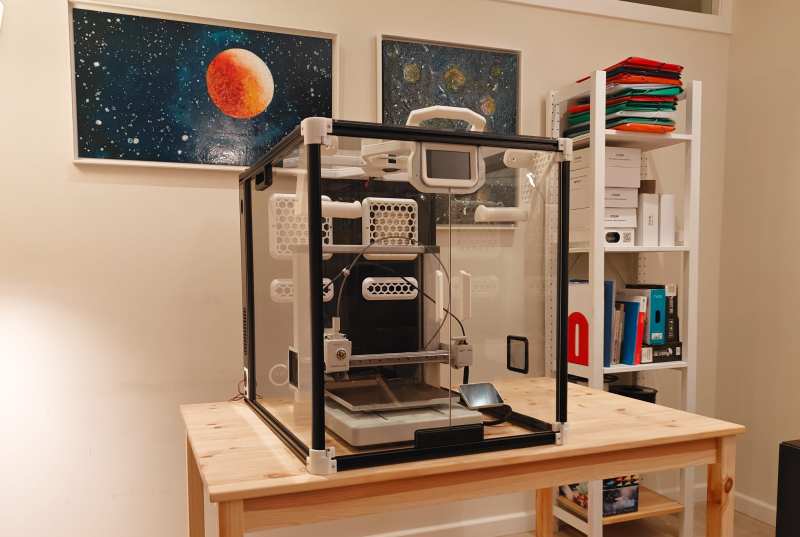
3D printing has had its time to spread its wings into the everyday home, yet many of those homes lack the proper ventilation to prevent the toxic VOCs from escaping. Because of this, [Clura] has put together an entire open-sourced smart enclosure for most open concept printers.
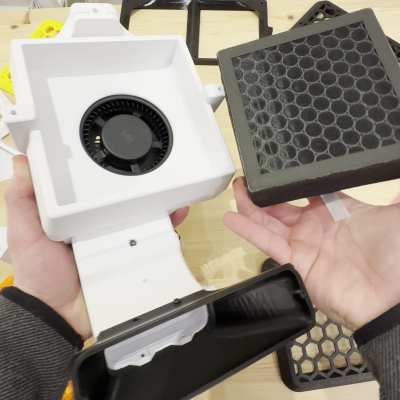
While certain 3D printers or filament choices lend themselves to being worse than others, any type of plastic particles floating around shouldn’t find their way into your lungs. The [Clura] enclosure design includes HEPA and carbon filters in an attempt to remove this material from the air. Of course, there’s always the choice to have a tent around your printer, but this won’t actually remove any VOCs and air located inside a simple enclosure will inevitably escape.
What makes this enclosure different from other, either commercial or open-source designs, is the documentation included with the project. There are kits available for purchase, which you may want for the custom PCB boards for smart features such as filament weighing or fume detection. Even still, if you don’t want to purchase these custom boards the Gerber files are available on their GitHub page.
As smart as this enclosure is, it still won’t fix the issues of what happens to the toxins in your print after it’s done printing. If you are interested in this big picture question, you are not alone. Make sure to stay educated and help others learn by checking out this article here about plastic in our oceans.












To remove smell from 3D printer you can place a urinal deodorizer block nearby. It will absorb airborne plastic particles (mostly from ABS).
I don’t know if it would actually make the air cleaner but putting one of those in a 70°C box would certainly work as an air freshener.
‘Do not eat the urinal mints.’
Why do you think someone would do that?
Lol ladies and gentlemen I give you and the world a BOX! Behold its power at being a box and how it needs a social movement and alternate conscious to be a box! I promise it drinks almond milk and shuns oblique materialism like a closed source printer… um wait. How did that get there? I mean see how the closed source printer who used to oppress it is now useless due to the box holding that space and allowing dialogue…
You are so edgy, you could cut styrofoam with your piss.
Michal you’re not. Squatter imposter.
Wow look at you living back in 2016…lol
It’s not open source. The CC-NC (non commercial) license violated point six of the open source definition.
‘The Open Source Definition’ is itself just a group that co-opted a term and tried to define it as they wanted. One can be open source without being Open Source, and many are.
I love this. Bravo for addressing a serious problem. Indoor air quality. Sometimes, nasty things can be in the air at hazardous levels long before you can smell them (how many are in 3D print fumes are eligible for debate) I look at this, and I think it might be advisable for people to do whatever they can to vent their 3D printers out a window as well. The carbon (or any) filter probably helps immensely and is advised in all cases, but nothing can beat getting the air out of the breathing supply in the first place.
“how many are in 3D print fumes are eligible for debate”
No its not. Theres a lot in 3d printing fumes from any thermoplastic you put in through them. Thats objective fact. Whether you want to live with that in your living space or would advise others that its ok to do so can be up for debate.
Oh, it’s a good thing your opinion is fact. A debate with actual data might have broken out.
“A lot” isn’t a unit of measurement. The main compound of concern with ABS is styrene. Based on the testing I’ve seen, one printer printing ABS will generate ~0.15 ppm of styrene over an 8 hour period. Nearly 700 times lower than the OSHA recommended limit or 350 times lower than that of NIOSH. If you just don’t like the smell, sure, go for it but imo the health consequences of printing are overblown.
Ah yes. More petrochems in our lives. Just what we need? Yeah, some sort of fume hood would be good, and vent that nasty stuff outside. Hmmmm…. Now it poisons the neighbors. Hmmmm…. Keep thinking.
I was skeptical when i saw the CC-NC, and closed immediately when i saw the kick starter.
I have a 2.6m roughtly cube shaped enclosure for my 3d printers and laser cutters. It even has a door and a window.
This will surely help not mix the smell of pla with my heavy smoking habit in my lab.