
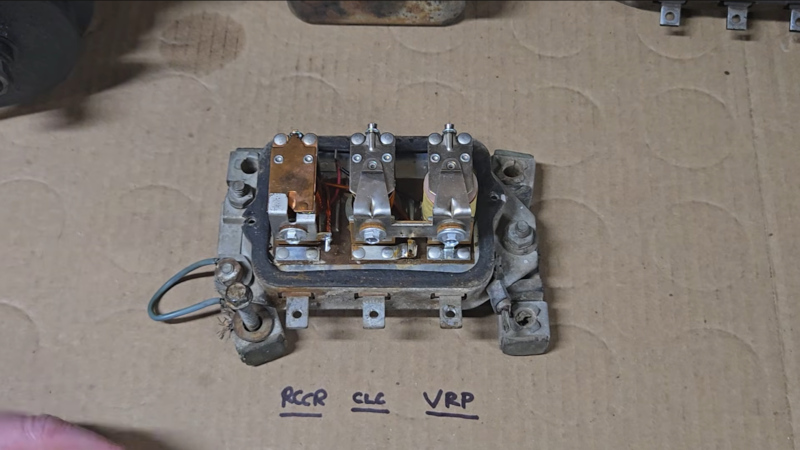
Did you ever wonder how the mechanical voltage regulator — that big black box wired up to the generator on a car from the ’60s or before — worked? [Jonelsonster] has some answers.
For most people in 2026 an old car perhaps means one from the 20th century, now that vehicles from the 1990s and 2000s have become the beloved jalopies of sallow youths with a liking for older cars and a low budget. But even a 1990s vehicle is modern in terms of its technology, because a computer controls the show. It has electronic fuel injection (EFI), anti-lock braking system (ABS), closed loop emissions control, and the like.
Go back in time to the 1970s, and you’ll find minimal electronics in the average car. The ABS is gone, and the closest thing you might find to EFI is an electronic ignition where the points in the distributor have been replaced with a simple transistor. Perhaps an electronic voltage regulator on the alternator. Much earlier than that and everything was mechanical, be that the ignition, or that regulator.
The video below the break has a pair of units, it seems from 1940s tractors. They would have had a DC generator, a spinning coil with a commutator and brushes, in a magnetic field provided by another coil. These things weren’t particularly powerful by today’s standards and sometimes their charging could be a little lackluster, but they did work. We get to see how, as he lifts the lid off to reveal what look like a set of relays.
We’re shown the functions of each of the three coils with the aid of a lab power supply; we have a reverse current relay that disconnects the generator if the battery tries to power it, an over-current relay that disconnects the field coil if the current is too high, and an over-voltage relay that does the same for voltage. The regulating comes down to the magnetic characteristics, and while it’s crude, it does the job.
We remember European devices with two coils and no field terminal, but the principle is the same. There is never a dull moment when you own an all mechanical car.












inb4 old farts come complaining about how modern cars all suck and fully analog 1970s station wagon with a 5L V8 engine developing 100 HP is the peak motoring because it has the ability to turn something that in a modern car would just be a minor incident into a major accident with injuries and possibly fatalities.
This comment is a linguistic treasure trove. You could write dissertations on the various things going on here. It reminds me of Japanese grammar in the way that half the clauses are just left off and the meaning is implied. Come in mid conversation and you have no idea what’s going on.
roffl
To which the 1970s Volvo says, oh did I make contact? Sorry, and drives on like nothing happened.
My farts are so old they smell of formaldehyde, but you’ll never catch me gazing lovingly through my rose-colored driving goggles at the automobile designs of (holy hell) more than half a century ago.
Do I think it’s unfortunate that modern cars are so complex and nigh-impossible to user-service and -maintain? Yes, in the same way I think it’s unfortunate that modern computing devices have lost nearly all of their modularity and reconfigurability.
But at the same time, in both instances, I also UNDERSTAND why those changes were made. (And, contrary to the prevailing conspiracy theories of the nostalgia-blinded set, it has nothing to do with intentionally making things harder on the enduser.)
Modern cars achieve power and efficiency levels never dreamed possible in Henry Ford’s day. The same way that, if your smartphone were a modular system with external removable battery, it wouldn’t be a 6-8 oz supercomputing platform with integrated HD display and all-day battery life — plus, if it’s less than 5-6 years old, all housed in a SHOCKINGLY* water-resistant package. (At least until you, the user, break the factory seals by opening it up.)
— (I’m taking “survive a drop in the bathtub with no repercussions whatsoever” levels of water resistance. And to think we used to keep bags of rice around as emergency dessicant!)
It´s not because something got more complex (and performant) that it reaches beyond your comprehension capabilities that everybody else is stuck. If you don´t upgrade your knowledge, you´ll end up stuck.
Rice is a very poor dessicant.
it was told when placing the wet phone in a bowl of rice in the evening some small chinese guys would come and fix it overnight
“But at the same time, in both instances, I also UNDERSTAND why those changes were made. (And, contrary to the prevailing conspiracy theories of the nostalgia-blinded set, it has nothing to do with intentionally making things harder on the enduser.)”
And yet, we catch cell manufacturers utilizing software “updates” to retard phone performance, or glue in batteries that, by definition are “consumable” items, so as to force people who are otherwise happy with an older phone into perpetual subscription slavery.
You mention cars… bought my last pickup new. I ran it for 25 years until the transmission went out. I could have fixed it, but all the plastic stuff was dry-rotting and even things like connector shells were starting to disintegrate, so I decided I’d earned something new.
The new truck has some nice “modern” features, BUT… it cost twice as much, it will NEVER last as long or be as repairable as the old truck (because of the electronics and plastic) and how nice its tech gizmos are, it doesn’t do anything the last truck couldn’t do.
Is it newer? Yes. Is it better? Not sure.
Have a D250 and a D350 both with first-generation Cummins. The tranny on the D350 gave out and I’m planning on replacing it if I ever get any money. The Cummins engine is good for a million miles. We’re now at maybe half a million on the D250.
One fine day at W-mart a fellow saw the D250 and said, “I had one of those and like an idiot I sold it. Wanna sell me that one?” I answered, “Do I look like an idiot?”
I’ve been saying this for years. I love old cars for their looks and home repair ability. But new cars are better in safety[1] (yes I said it) and performance and efficiency and reliability[2] (yes I said it) and features and price[3] (yes I said it) and noise and comfort and on and on.
I sure do love that old style tho.
[1] IIHS crash-tested a heavy 1959 Chevy against a lighter 2009 Chevy. The dummy in the new car suffered a leg injury, the dummy in the old car was nearly decapitated.
[2] Old cars were clapped out at 100k miles. But I often start my search of new cars at 100k, for maximum value.
[3] Adjusted for inflation, old cars cost more than new ones.
On [2], people forget there was a time not so long ago when odometers only had 5 digits because even the manufacturers didn’t believe the car would last past 99,999 miles.
“And to think we used to keep bags of rice around as emergency dessicant!)”
Look at that for a while and tell me with a straight face that it doesn’t sound silly. “I keep shards of wood around the house in case I need an emergency splint!” I understand rice is the least manly of all the foods but actually eating it doesn’t make you a sissy. Instant mashed potatoes, talcum powder, actually purpose-made dessicants, those make you a sissy.
Just put the phone in a sous-vide vacuum sealer perhaps?
Both things can be true. Do you really think there are technical reasons to lock diagnostics and changes behind tools that manufacturers charge $50,000 for? Dismissing everything you don’t agree with as irrational is just as bad as ignoring the rational.
There are also tradeoffs that someone can simply disagree with. Does every lightbulb need to be connected to CANBUS, making replacements cost 50x what they would without it?
Phones are a bad example, too. If they were bigger people would probably have a healthier relationship with them. I don’t care how thin my surveillance rectangle is.
Hackaday will never, ever, fix their quote system.
Volumetric efficiency is never talked about but it is WILD what they can do now.
I remember my old fart coworker was checking out my new FRS and I told him it wasn’t really that fast, just a lot of fun. Then I told him it had 200HP, he was kind of surprised, especially when I told him it was a 2.0 four banger.
He then went on a story about his old air cooled cars he used to race, and how you’d need a big engine and some serious work and probably race gas to get 200HP out of those things and nowhere near 100HP/L volumetric efficiency, while getting anything close to reasonable gas consumption.
Really made me appreciate all the efficiency work that’s been done.
Except his old car will easily last from 1960 to 2060 and beyond while your 200 HP lawnmower will burn itself out after 150kkm. I own a BMW so it doesn’t apply to me as much but my friends with KIAs and Hyundays now feel the pain as those cars are just not made to last but rather built like a moving garbage container.
The first electronics in cars were radios. Lee de Forest demonstrated a car radio in 1904. Chevrolet offered a factory-installed Westinghouse radio in 1922, a Philco radio in 1927. Motorola started producing the first widely popular U.S. radio in 1930. In the 1920s there were also developments in England and Australia.
Not counting the ignition spark system, of course.
Do points count as “electronics”?
My ’53 Willys Jeep had a voltage regulator like the one featured here, and not a single semiconductor in the whole vehicle. Not so much as a diode. The ignition was the usual points, coil and distributor. I would have said that vehicle had no electronics.
The ammeter was especially funny: it had just the high current batter cable running through the body of the ammeter. No shunt, no connections, just the cable passing through the meter: Essentially a clamp-on meter. The needle was moved by the magnetic field of the wire directly.
That truck lasted until ’77, but I wouldn’t say it was long-lived. It was held together by baling wire and Bondo near the end. It should have seen the junkyard a decade prior, but it still ran and it could still haul wood and trash and still plow snow, so had its use.
And that relay-based voltage regulator lasted until the very end.
I remember having to hit the voltage regulator with a stick every so often when it would stick from the relays welding themselves closed.
I had a couple of Mercedes diesels that the only electric things were the starter , lights , glow plugs and chartering system. It would run just fine with none of that once it was started. Had one decrepit 190d that was just had a battery, starter, and glow plugs that we used on the farm to drive around with a trunk full of tools and would recharge occasionally.
DeForest’s 1904 radio was a technology demonstration. At that time Fessenden had just recently transmitted speech by modulating a spark gap transmitter. It wasn’t exactly a mass market device. The DeForest Audion radio detector vacuum tube did not arrive until 1907.
The first really successful car radio was made by Galvin (Motorola) in 1930.
Previously reported on: https://hackaday.com/2024/04/08/1950s-switching-power-supply-does-it-mechanically/
And again, this time automotive: https://hackaday.com/2016/07/04/retrotechtacular-dc-to-dc-conversion-by-vibrator/
Oh don’t be such a cumshot in a tub of yoghurt. At least new writers have it easier by just re-posting articles from a previous decade.
It would take a just a glance at what was posted to recognize it’s not remotely the same thing.
If you find this post interesting, may I suggest you look into the carbon pile regulators found in vintage aircraft?
This design starts with a stack of carbon disks, pressed together with a spring. The electrical resistance across the stack varies with pressure. Wired in series with a generator’s exciter (field), the output of the generator therefore varies as a function of the pressure in the carbon stack.
Now you add a solenoid, mechanically linked to the stack in such a way that it tends to work against the action of the spring. This solenoid becomes the “sense” part of the regulator.
If the generator voltage is low, the solenoid is weak, the spring force dominates, the carbon pile is compressed, resistance goes down, and excitation to the generator increases. The generator voltage will creep up, as a result.
If line voltage is high, the solenoid is strong and its force dominates the spring. The pressure on the carbon pile is relaxed, the resistance rises, causing the excitation to the generator to fall. The generator output voltage falls.
This serves the same basic function as the mechanical automotive regulator described in the OP, except that while the car version is a bang-bang type regulator, the carbon pile is a proportional regulator with much more civilized output. In fact, it doesn’t require the presence of a battery to “smooth” things out, and so it can be applied to AC output generators, as well.
Engineers created astonishing and elegant machinery long before it became possible to put a microcontroller into everything, (whether it needed it or not.)
Very cool. I had not heard of those types of regulators, despite flying in a plane that probably used one (late ’50s Cessna 150). Thanks for sharing.
Pile regulators are nice for the avionics but, the most reliable and simplist ignition system in aircraft is the magneto. No battery to worry about once the engine is started.
magnetos. Plural.
Reliability and redundancy.
If I remember correctly, you run with just one magneto, then the other, before aiming up into the sky. If the RPMs for the two are different, you out to look for the problem while still on the ground.
Another related, outdated classic tech would be the regulators for AC. Mechanically and magnetically controlled automatic tap switchers/autotransformers, saturation regulating transformers, and the like.
I was literally just looking into this last week, asking Gemini about EMP-hardening automobiles. Cool topic.
An older 1980s or earlier Mercedes diesel is absolutely EMP proof.
If it has a manual transmission and it’s on a hill on a warm day you could start and drive it with no electrical system at all.
My first car, a 1959 Dodge, used this regulator. Expensive and crude, but easy to figure out. One could tweak the relay to adjust the current and voltage.
1990s? My old 84 Caprice Classic had a computer. I had to replace it once. Although I remember watching parents replace them I have never owned a car with a distributor cap and rotor. The only points and condensor I have had in an engine were in an old boat motor.
An even simpler unit from a 2CV was written about recently over at the Autopian, although it’s light on electronics details:
https://www.theautopian.com/2cv-update-it-now-runs-from-its-actual-fuel-tank/
Haha. I remember taking these apart as a kid to salvage the magnet wire from the voltage sensing coil. The other interesting magneto-mechanical device from those times was the vibrating interruptor used to make plate voltage for the vacuum tube radios. Ingenious, but very inefficient.
I just packed up a model T ignition coil that does basically the same thing. Really handy and primitive way of getting a high voltage with nothing other than magnet wire.
In the 70s some wag at Bendix devised a dual magneto adopted by Lycoming driven by a single gear and employed 2 coils, 2 contact sets and 2 capacitors surrounding a single coil in a single case. What could go wrong?
Because it weighed more than the normally used pair it tended to vibrate loose and fracture it’s attachment flange. Eventually abandoned as a concept but many legacy installations still fly today.
That should have read “single magnet” Doh! Roll on AI.