
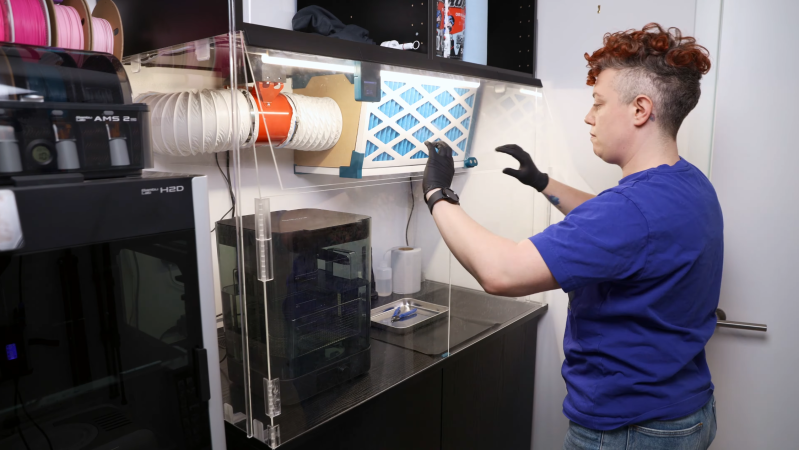
For a certain kind of intricate, highly-detailed manufacturing, there’s really no substitute for a resin 3D printer, and it’s therefore unfortunate that they require so many poisonous chemicals. The resin itself usually contains irritating acrylates and methacrylates, it can emit a wide spectrum of volatile organic compounds (VOCs) during printing, and even the isopropyl alcohol used in cleaning is moderately toxic. [Allie Katz] accordingly built this fume-control enclosure for resin printing and other ventilation-critical processes.
The biggest constraint was space: [Allie]’s workspace had a fairly limited volume available, and the enclosure needed to hold an SLA printer, an isopropyl alcohol washing station, a UV curing chamber, and miscellaneous supplies. Most of the enclosure was made out of IKEA cabinets, using some large cabinets at the base to hold the printer and curing station, a countertop over these to hold the washing station, and more cabinets above to hold supplies. An MDF backing panel and acrylic side panels enclose the workspace between the cabinets. There was no safe way to exhaust fumes, so the enclosure recycles its air: a fan pulls air in through an activated-carbon filter mounted above the work area and into the plenum behind the chamber, from which it passes through the printer’s cabinet back into the workspace enclosure. Panel filters surround the carbon filter to catch particulate matter.
The enclosure uses four ESP32-based boards for automation: one uses a touchscreen to display data, and three are paired with BME680 sensors, primarily to report VOC concentrations. One, which also has a particulate matter sensor, senses air quality in the main chamber and plenum, one monitors air quality in the rest of the shop, and the third detects clogging from within the filter enclosure. The first real test of the chamber was to 3D print and paint some handles for the cabinets. It worked as expected, detecting the increased VOCs and ramping up the fan to keep them in check.
We’ve seen a ventilated printer enclosure before, that time for an FDM printer. Although their hazards are less blatant, they too can produce dangerous fumes, which could possibly be carcinogenic.
Thanks to [Keith Olson] for the tip!












Wow, tons of sensors, but missing the mark on actual usability. Having the printer down below so you won’t be in a comfortable position transferring the prints to the wash station is such a major design oversight that I’m unsure if they researched resin printing processes upfront. Getting the print from the printer to the wash station is the messiest part, and printer maintenance, resin refilling is messy as well, so you’ll want to have your printer placed somewhere where, you know, these things are easy, as on a countertop. The recirculating air is a nice idea, but they do have a window, so just close the door to the room while printing and post-processing, put on adequate PPE, and then open the window afterwards? Missing from all of it would also be some UV light source to cure the odd resin spills. You can’t really avoid getting some resin drops on your work surface (why they don’t use one that can be cleaned easily is beyond me), but just hitting everything with UV after you’re done will polymerize them, making them harmless waste.
They did mention that they’ve been wanting to add resin printing to their workshop for a while, so I suppose they haven’t had the experience to know a lot of this
They did say space was the major constraint. The three priorities are probably price, space, and ergonomics. If you’re going for safety that won’t break the bank then ergonomics loses out. At the end of the day they don’t deserve flak for just going ahead and doing something that’s not perfect. They’ll learn if it doesn’t work. They don’t have to be seasoned experts to try something either.
A window is one approach that probably gets particulate matter in every crevice and on every surface. Walls, ceiling, floor, the tops and sides of everything really. Even if you add positive air pressure so the air leaves the room.
In a small space you very rarely have enough space to really set things up with real ergonomics in mind. For instance I just rebuilt my lathe and its stand which let me raise it up a bit for more comfort for me as I am very tall, but it can’t get up to the height the manuals all say a lathe should be for ergonomic use, still at least 4 inch too low. As it is I flew a little too close to the sun and will have to modify the bracket for the shelf above it so the belt cover can actually reach its locked open state, and I can’t lose that shelf as storage is so essential in the small space too!
When I set up the resin printer I want to add to my tool kit it will probably be even more awkward than this setup looks, as the only spot right now the thing can sit will be under a desk on the floor, so lots of sitting of the floor working on it I expect. But having such a useful and hard to replicate the functions of tool is worth it if you can.
Oh boy can’t wait for people to come in and talk about how they hang out beside their printer every day and even sleep in the same room as it w/no ventilation and how they’re “fine”.
The only component pending is a differential pressure sensor to determine the direction of VOC flow (inlet or outlet).
I bet you could route somthing externally. I have a resin printer as well and it sites there because of the fumes. I did recently but a lazer cutter and did ventilate that outside. Maybe along the ceiling where it meets the wall?