
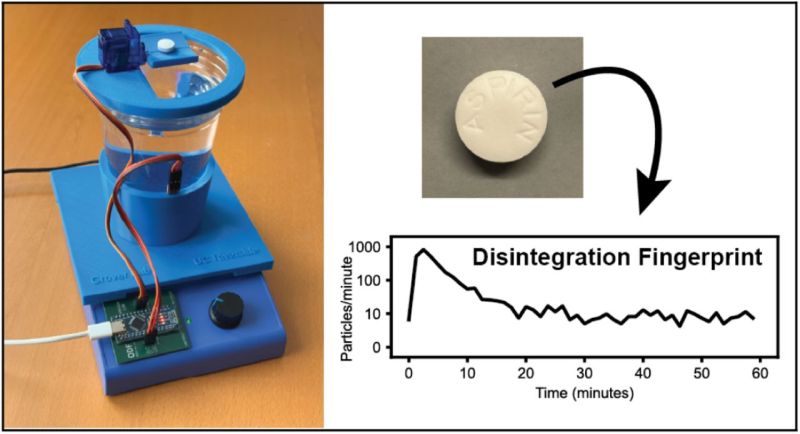
Odds are, you’ve taken pills before; it’s a statistical certainty that some of you reading this took several this morning. Whenever you do, you’re at the mercy of the manufacturer: you’re trusting that they’ve put in the specific active ingredients in the dosage listed on the package. Alas, given the world we live in, that doesn’t always happen. Double-checking actual concentrations requires expensive lab equipment like gas chromatography. It turns out checking for counterfeit pills is easier than you’d think, thanks to a technique called Disintegration Fingerprinting.
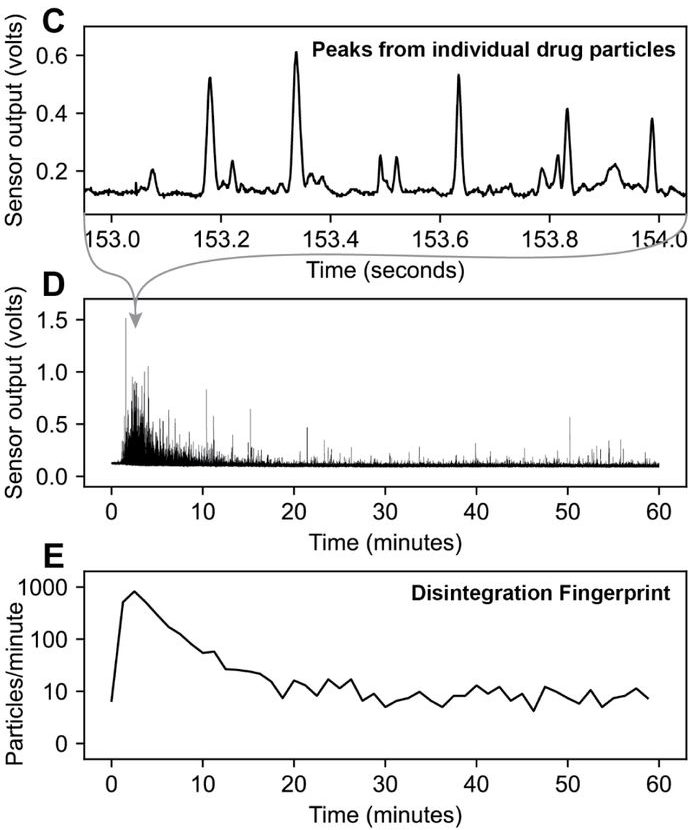
It’s delightfully simple: all you need is a clear plastic cup, a stir plate, and a handful of electronic components — namely, a microcontroller, a servo, and an IR line-following sensor. You’ve probably played with just such a sensor: the cheap ones that are a matched pair of LED and photodetector. It works like this: the plastic cup, filled with water, sits upon the stir plate. To start the device, you turn on the stir plate and actuate the servo to drop the pill in the water. The microcontroller then begins recording the signal from the photo-diode. As the pill breaks up and/or dissolves in the water, the swirling bits are going to reflect light from the IR LED. That reflectance signal over time is the Disintegration Fingerprint (DF), and it’s surprisingly effective at catching fakes according to the authors of the paper linked above. Out of 32 different drug products, the technique worked on 90% of them, and was even able to distinguish between generic and brand-name versions of the same drug.
Of course, you do need a known-good sample to generate a trustworthy fingerprint, and there’s that pesky 10% of products the technique doesn’t work on, but this seems like a great way to add some last-mile QA/QC to the drug distribution chain, particularly in low and middle-income countries where counterfeit drugs are a big problem.
We’ve featured pill-identifiers before, but machine vision is going to be much more easily fooled by counterfeits than this method. If your problem isn’t worrying that your pills are fake, but forgetting to take them, we’ve had projects to help with that, too.
Thanks to [Zorch] for the tip!












There are a few instruments like these. All low tech but capable of finding counterfeit medications. The nice thing about this one is, you don’t lose a dose provided the medicine isn’t time release or specially coated. You could just drink the sample.
I will throw out a warning about this. Once this becomes known counterfeiters will thwart it without much effort unless the manufacturers get creative.
There are more practical ways to make medicine tractable. But let’s save that for another post. Counterfeit medicine and food is a major widespread problem, and it won’t be getting better anytime soon.
The primary problem is that the pharma industry does next to nothing to prevent counterfeiting. Here in Austria it is a lot easier to fake meds than cigarettes. Packs of cigarettes are sealed and carry a barcode with a registered serial number while packs of tablets are neither sealed nor individually marked.
The same is true for much of the world. Even still though, who would be willing to scan every pill they received? Very few people would.
I received a counterfeit product a few years ago, well maybe it was tampered with instead, I guess I will never know. It came in a blister pack. The package had a qr code, which I scanned and it came back valid. The product was niche, not exactly a high volume market. Some of these people are incredibly motivated, even for what seems to be small financial gains. Nothing I could do about it except buy more of the item from elsewhere.
The nice thing about the anti counterfeit measures, even if they don’t help the victim immediately is they create a trail of evidence at least. In my case it didn’t matter, but maybe it does for others.
could you explain how you found out they were counterfeit? You list the “tests” it passed, but not how you learned about them otherwise. And, I’m not suggesting this was true in your case, but both placebo effects and nocebo effects are infamously common, even effecting the researchers who are highly aware of the effects. I’m surprised this isn’t in the article.
Sorry I should have been more clear. The product I bought that was counterfeit was not a medicine. It was a disposable good though. I was able to determine it was counterfeit because the materials were not the same chemically. Different plastics were used and the build quality was not the same.
Best way would be to ensure that people who need the drugs have access to them through official channels.
High quality, non-counterfeit pills make me hard.
That happens to a lot of older guys, but you really don’t need to tell everyone.
Why do they need the servo? Just to throw in the pill at a precise time?
Couldn’t you just drop it in by hand and the timer starts once the photosensor detects a short drop of light?
Yes you could. It’s just easier to analyze the data this way.
It may be convenient to do it this way if the pill is ground to a powder first.
Could be to avoid the potential risk of skin oil and to be 100% repeatable. A human wearing gloves dropping a pill is not a perfectly repeatable process
Maybe someone will upload the disintegration fingerprints of common drugs to the net?
All of the pieces would need to be standardized and calibrated.
How does this behave when a pill has a colored shell designed to dissolve easily? (I’m thinking of my multivitamin, which has an intensely red outer coating that dissolves almost immediately. Messy if your hand is wet.)
If the dye absorbs at the same wavelength as the photodiode you may have to do some corrections or admit defeat depending on how dark the solution is and how bright the source is. The problem would be getting insufficient reflected light due to absorption. Then again maybe tracking the absorption would be meaningful.
I should be more clear. If the dye doesn’t absorb at the same wavelength it would have no effect at all. Meaning this could work fine.
IMHO returning proper competition back and making sure monopolies cannot self-emerge would be a better step in the right direction. Competition would drive the pries down and keep checks on what’s made and sold.
Presently won’t happen any time soon.
That won’t happen until someone comes up with a universally better reason to fight for customers than farm them.
Many pills have more than just the active ingredient: fillers and binders, etc.. Those are going to be different for different manufacturers, and they will affect disintegration characteristics.
This.
It’s measuring the binders, fillers, density, humidity, coating, and drug. Of course it will be different between different manufacturers, but I bet a manufacturer could put out a batch of pills with no active ingredient and this thing would think they were identical.
They’re getting results, but they’re not measuring what they think they’re measuring.
“It’s measuring the binders, fillers, density, humidity, coating, and drug.” “I bet a manufacturer could put out a batch of pills with no active ingredient”
If they are measuring the drug in their control sample, then they would see there was no drug in these hypothetical pills. This method is interesting and valid.
We use a cyclograph (centrifugal chromatography) to perform similar tests. The cyclograph works by dissolving the sample in a solvent, introducing it to a spinning disc then chasing it with more solvent causing the individual compounds to separate according to their molecular mass. After a bit of spin time each component becomes an easily identified visual band in the cyclograph. The color of the band under normal light, IR, and UV allows us to identify and separate the various components. We divide the components, collecting the transition between bands and running them through a second, sometimes third, or forth pass when purifying substances. Some cyclographs are setup with optical sensors and software to log/measure compound components but ours is strictly manual.
An even simpler setup uses paper strips to determine the purity and potency of certain drug samples by taking a known weight of the substance, dissolving it in solvent, and placing a measured amount on a filter paper then allowing more solvent to wick from one end of the paper until the compounds have separated into distinct bands. Measuring those bands allows and doing a bit of maths allows you to determine the total concentration of the active as well as any adulterants.
You use paper TLC for drug identification? That seems unusual, why not do normal TLC? Same goes for the cyclograph? 2D TLC is really easy to do and can be quantitative. Cyclographs seem kind of rough.
They don’t think they’re measuring what you think they think they’re measuring. The researchers know exactly what they’re up to, and at no point does this article or the paper claim they can measure drug content– it claims the combination of binders, fillers and coating provides a fingerprint that can be used to ID pills.
You’re right that if Bayer put out Aspirin pills with no acetylsalicylic acid this might well not catch it, but Bayer is watched closely enough by various regulators around the world that that is not a concern. Bayer isn’t going to pull that scam. The concern is counterfeit pills masquerading as having been made by Bayer with god knows what in them.
Since Bayer’s exact process to press the pills– the binders, the fillers, etc, is all propeitary, you can ID by that. That’s why it can detect generics. If this technique became universal, you could imagine scammers trying to fool it, but that doesn’t mean it wouldn’t be useful now.
I don’t think it’s actually very hard to tell when it’s pressed, it’s not like the fakers try extra hard, their customers usually know the deal
Just buy generics. They’re already dirt cheap, no counterfeiter has a chance of making any decent amount of money
I think it’s a fake paper. This measures (if it does, which I doubt too) the size of particles that are mainly the filler used for the drug itself. Since the filler is quite common from many different drug, I don’t see why it would differ between pills. Also if you crush the pill to powder, you’re changing the particle size (and you’re unlikely to crush the pill the same each time). So, I’ll just wait for a scientific confirmation of the process before trusting anything this study is claiming.
As it reads this is not meant for crushed pills but rather whole pills. They are creating a chart of the rate particles break away from the tablet, and using differences in the particles reflective properties to identify how long those particles take to dissolve, if they dissolve. Even if every pill they test has identical binders and excipients the rate at which they dissintegrate and dissolve will vary with their differing percentages, and the active ingredients will further vary the result of their data collection. There are certainly far more accurate methods but there is no reason to discount this as a fake paper. The concept itself is sound. It clearly states that this paper has not been subject to peer review so jury is out as to whether this method will be proven effective.
I don’t think it’s fake, it’s probably not as useful as it might seem like it is. It turns out different manufacturers use different fillers or binders, with different machines set to different pressures. Those are more or less trade secrets. Many medicines are also a substantial percentage of active ingredient. Many manufacturers will have different particle sizes of the active ingredient. All of these will change how a tablet dissolves.
I dont use paper TLC professionally for drug identification but am aware that there are kits available for testing potency and purity of a number of common recreational drugs that do. See protestkit.eu for examples.
As for the cyclograph, we primarily use it for small batch separation and purification. The cyclograph is quite effective but its operation is a bit of an art. It was a very cheap second hand acquisition that has served us well. We recently purchased a used CPC for larger volume s&P but we wont be retiring the cyclograph anytime soon.
Interesting thanks for sharing. I’m always trying to learn new things in this type of area.
This is interesting, but checkout drug track and trace laws. They’re on the books in the US, EU, Canada, ROK, and probably other places since I stopped working at a company that sold an implementation. The short version is that every time a drug changes hands, the seller must provide documentation of the chain of custody back to production. Exposing track and trace data would allow customers to scan a barcode and get every step of the package contents.
open.groverlab.org https://share.google/ht9XB7jIgwKJMZCQI. Is where the files reside.
Ok, I was viewing counterfeit as a generic that may or may not contain the active ingredient as opposed to mimicing a different brand. In that case, this would indeed be valid.
The presence of drug tracing in (most of) the OCED is probably why the authors of the paper call out drug counterfeiting as a bigger problem in ‘low and medium income countries’.
I know Canada’s having a rough decade, but we’re not there yet.