
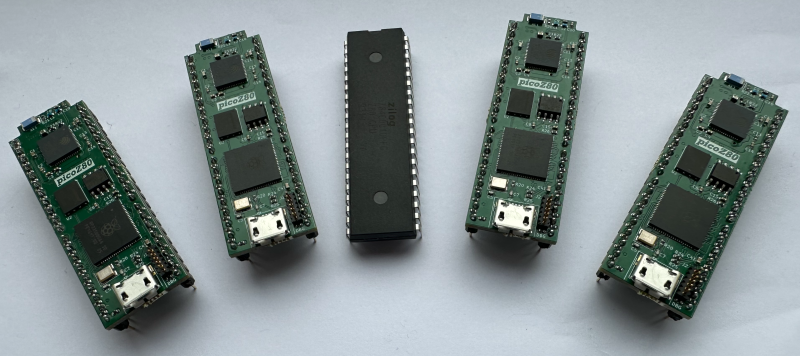
The Z80 has been gone a couple of years now, but it’s very much not forgotten. Still, the day when new-old-stock and salvaged DIP-40 packaged Z80s will be hard to come by is slowly approaching, and [eaw] is going to be ready with the picoZ80 project.
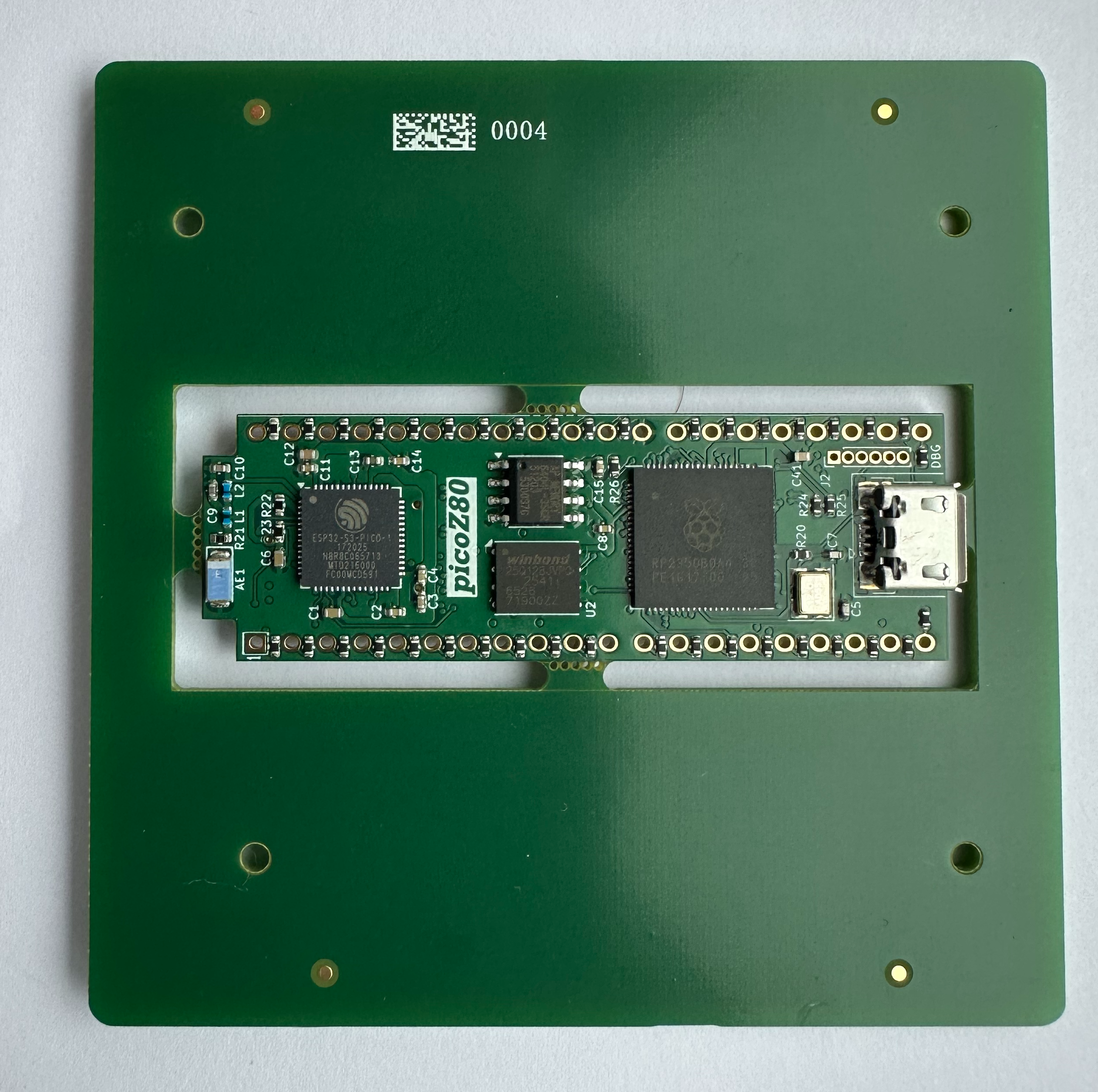
You can probably guess where this is going: an RP2350B on a DIP-40 sized PCB can easily sit on the bus and emulate a Z80. It can do so with only one core, without breaking a sweat. That left [eaw] a second core to play with, allowing the picoZ80 to act as a heck of an accelerator, memory expander, USB host, disk emulator– you name it. He even tossed in an ESP32 co-processor to act as a WiFi, Bluetooth, and SD-card controller to use as a virtual, wirelessly accessible disk drive.
The onboard ram that comes with an RP2350B would be generous by 1980s standards, but [eaw] bumped that up with an 8 MB SPRAM chip–accessed in 64 pages of 64 kB each, naturally. If more RAM than a very pricey hard drive wasn’t luxury enough, there’s also 16 MB of flash memory available. That’s configured to store ROM images that are transferred to the RAM at boot– the virtual Z80 isn’t grabbing from the flash at runtime in [eaw]’s architecture, because apparently there are limits to how much he wants to boost his retro machines.
If somehow you missed it, the venerable Z80 only hit EOL in 2024, so supplies won’t be drying up any time soon. This hack is really more about the quality-of-life addons this allows. Come back in a decade, and we’ll see if the RP2350 lasts longer than the stack of NOS Z80s.












I like it. 🩶
About the EOL of the Z80..
I’d like to add that this is about the classic throughole Z80 made by Zilog.
The Zilog eZ80 and Z80 clones by other manufacturers are a different thing.
Chips such as Z80, 8088 and 68000 were produced by many manufacturers, some were clones, some second-sourced.
So there’s a real possibility that the Z80 might be produced once again by another manufacturer, once there’s a market (again).
The Z80, 8085 and 6502 are now pretty much generic parts like 74000 series ICs (7805 stabi, 741 op-amp, 386 amp etc).
idk about being Z80s being produced again. Good news, is that there are projects like UnIC (https://www.modularcircuits.com/blog/2024/07/29/unic-the-modern-way-to-z80-and-more/) which can imitate just about ANY 40 pin DIP chip. The thing about RP2350B used in the article’s subject, is how cheap they are now, and I question can Z80 clones ever be mass reproduced at less(or even roughly equal!) cost. As long as emulating on cheap ARM chips is more cost effective, and for vintage hobbyists, FPGA solutions are relatively inexpensive, and eZ80 and the like exist, what market is left? It’s cheaper to emulate(or simulate) than to clone, with increases in speed, etc. We can dream, but I just don’t see them manufactured, except in post-apocalypse scenario where none of these other options are available. ;-)
The only scenario I can imagine is that there could be some industrial or military application that relies on a chip to exist decades longer than you’d expect. Like some nuclear power plant or long range bomber depends on it. That operator has to subsidize the production of the chip or rewrite some incredibly dangerous code from scratch.
What I like about using “native” electronics is that you can walk on the paths of the ancestors, so to speak.
Writing code or doing new development is more fun if you have access to something “real” that runs it.
If you program for a the architrcture of relays computer, for example, it’s nice to know there’s still a real relays computer it can be run on.
It’s much more rewarding that way.
On other hand, I also like emulators as development tools.
If you have a special purpose that needs to run an old firmware within emulation, for example.
Such as a Z80-based TAPR TNC-2 compatible firmware of an 80s era Packet-Radio TNC.
Here, it maybe makes sense to use a modern microcontroller and use Z80 emulation instead of “wasting” a real Z80.
Because the TNC is innthe role of an appliance here and it’s about running a specialized firmware in first place rather than about using a Z80 single-board computer.
If the environment is rather rough, such as in a moist cellar or in a hot/humid box bellow the roof, a cheap modern microcontroller might be easier to “sacrifice” than vintage parts that need care (old ROMs, SRAM, DRAMs, rare serial port chips etc).
Or in other words, modern microcontrollers can be throwaway parts.
They don’t need to be as much preserved as the vintage parts,
also because their development code uses high-level language code.
Ie, code written for the Pico or ESP32 ofzen is open source and can usually be modified to run on other, later microcontrollers.
With Z80 and assembler based source code, it’s a bit more complicated. Things are timing sensitive (MHz, amount of cycles some instructions take).
Hi! There’s a FOSS Z80 project, too, I think.
There are thousands of Z80’s available right now in the supply chain. New ones. The reason nobody produces them is because we have all we need. They are not scarce.
i probably have a good six or seven of them in my IC hoard and it’s unlikely i will ever use them Modern microcontrollers are so much easier to work with with their SPI and I2C buses. But if someone made a Z80 with 64k of RAM, an i2c and an spi bus, that might be fun.
Hi, my point was that not only Zilog has what it takes to make an Z80.
The blue prints are available, in short. It’s not going to be lost anytime soon.
A (fairly good) Z80 clone, U880, was made in East Germany in mid-80s, for example.
https://en.wikipedia.org/wiki/U880
https://www.cpu-collection.de/?tn=0&l0=cl&l1=Z80
Whenever someone mentions the Z80, I think of “Byte” magazine in the 80s.
Steve Ciarcia used a (64 pin) Hitachi 64180, on a setup that sat in a metal lunch box.
Huge by today’s SBC standards, but extremely compact at that time.
i remember that article! i loved everything Steve Ciarcia came up with. he also had a home automation system that ran on something like an 8051 or something. his hardware was always cooler than his software; he famously said his famous programming language was solder, something related to back then when the only code i could write was in BASIC and ran soooo sloooooow
I second that – some circuits simply don’t need code. Things that can be done with quad op amp ICs and few discreet components and just plain work.
Byte Magazine covers by Robert Tinney:
https://tinney.net/product-category/limited-edition-robert-tinney-byte-cover-illustration-prints
When I get my Rubber Beer Mat 48k Zx Spectrum running again, gonna shove one of these inside.
No idea why, but with modern AI tools, bet some software shennanigans can be achieved!. Can it run Doom?
It turns out the ZX Spectrum can run Doom!
https://youtu.be/3v7cFGneuaw
Huh, would have expected an FPGA implementation with something like an ice40.
They used mecha hitler to do some of the code? Well that’s a big nope from me
The article claims we will soon run out of new and salvaged DIP 40 Z80’s. Someone wrote that on a technical website.
The Z80 is one of the most ubiquitous processors of all time. As of this morning an electronics specialist friend of mine tells me he could lay his hands on a couple of hundred from his suppliers no problem. There won’t be any shortage soon.
Let alone salvaged units from old machines. Amstrad alone purchased over TEN MILLION Z80’s for their machines and none of those machines are rare of hard to get hold of in a broken state (barring the CPC 664 of course).
Barring the SID chip from the C64, vintage chips are pretty easy and cheap to get hold of. I needed a NEC V30 recently. Turned one up no problem from a supplier who seemed to have several in stock.
It’s great someone has made this board and it will have its uses. But the author didn’t even bother to do a simple Google and use their brain to think “hmm, would a chip produced in the order of hundreds of millions become scarce?”.
He never said that. He said “Still, the day when new-old-stock and salvaged DIP-40 packaged Z80s will be hard to come by is slowly approaching”
Yes, many hundreds of millions of Z80s were made but the vast majority are not the easy to diy use dip40.
A similar board would need to be made to diy a qfp z80 for instance and wouldn’t be able to do the other cool stuff this thing can.
There are actually a lot of vintage chips that are becoming scarce – 6510, vic, vicii, via and cia, c64 pla, and you mentioned sid. Pokey, and gtia from atari and numerous others. Got a genuine pla for a zx81 for me?
Honestly, I’d say most are in use, questionable functionality, or scarce.
Avoiding counterfeit chips can be difficult if you need a specific one, its enough of a problem that there are testers to help with identifying what chip you actually have… That said I could see this being a great development tool, it would make for a convenient in-circuit debugger.
Cool! I’ve had a rp2040 z80 replacement on the shelf mostly completed for a few years now but never got around to finishing it.
I’m extremely interested in seeing how they managed the PIO – my solution was so large it doesn’t fit into the PIO memory and so I stream programs into it via DMA. Not sure I’ve seen anyone attempt something similar!
I have a vintage Nascom 2 SBC from the 1980s – interesting to see how fairs on this.
Unfortunately it seems to be closed source, once again. It seems the be common those days..
8 MB of RAM?
I guess we had better start planning that big heist so we can afford it.
It’s a nice project but I was not able to find any downloads for KiCad PCB design nor firmware. The author’s website explicitly states that you can download those from the repository but there is no such repository available.
That’s in the works, according to [eaw] Perhaps we posted too soon after we got the tip and he hasn’t had time.
KiCad files are under /hardware/pcb/verified/ for nearly all the different pcbs. Certainly all the fire and ice, just missing a couple of the early revision STM32F4 boards (d,e and f). It appears that you build the firmware yourself using docker. I’ll have to try as I’ve just ordered a ready built board.