
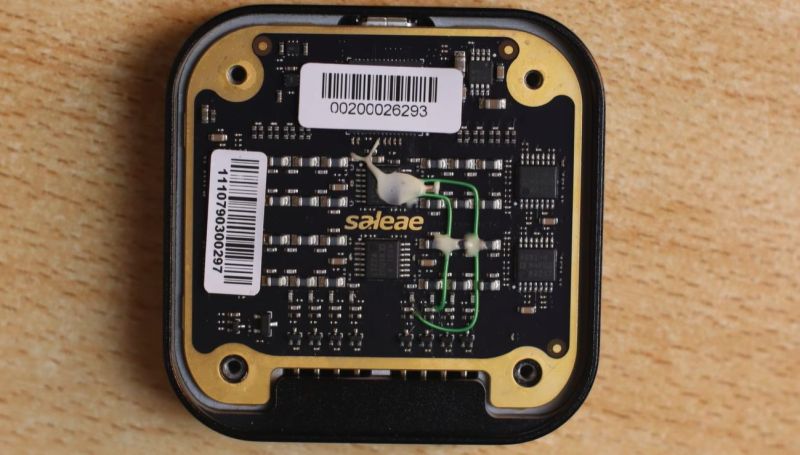
For those of us old enough to remember the harrowing days of the early 2020s, alongside another major kerfuffle there was a complete breakdown in global supply chains that led to the 2020-2023 global chip shortage. Unsurprisingly, this pushed many hardware manufacturers into less orthodox approaches, massive BOM changes, and hurried redesigns. One of the results of this era found its way into the hands of the bloke over at the [Playduino] YouTube channel, who was mystified to find two bodge wires in his fancy Saleae logic analyzer.
The reason for popping open the LA was crosstalk between two channels, which was bad enough that it made the unit quite unusable for the intended task. After seeing the cut traces and bodge wires he initially assumed that since he bought it used that the previous owner had modified it, but said person denied having opened it since purchasing it from an official retailer.
This was when he emailed Saleae support to see whether they knew anything. Initially they denied knowing anything about such a modification, but then the CTO emailed back with a long and very detailed confession. As explained in the video, during the aforementioned chip crisis Saleae was forced to rapidly redesign their LAs to use whatever FPGAs and other parts they could still get their hands on.
An initial prototype unit passed their internal tests, so they had a first batch manufactured using PCBs from a different supplier. Despite sending the same Gerber files, the resulting PCBs had ground fill issues that necessitated the observed rework, but due to insufficient testing for crosstalk a total of 406 units made it into the wild.
Sadly he had to return the defective unit for a replacement, making it somewhat hard to let go of such a piece of history. That said, if you want to know whether you’re also one of the lucky remaining 405 LA owners, the CTO provided the affected serial number range: 00200026245 to 00200026675 are affected.












As a regular user of saleae analyzers, I have always felt like they did a pretty good job, and this seems like a fairly classy move on their part for someone at the top to say yeah we messed up, here’s a replacement.
Was thinking the same thing. Publicly acknowledging it raises trustworthiness, at least in my book.
It’s entirely possible that the noted issue was completely unrelated to the rework. Bathtub failure curves have a spike right at the start of lifetime for a reason.
Honouring warranties (even for resold devices) is a mark of a good company. That they also provided a deep dive into why the rework was there is because they know their target market is actively interested in such things. It’s classy, but there’s also basically no risk in doing it.
” For those of us old enough to remember the harrowing days of the early 2020 ”
HUH? I doubt you have any 6 year old’s viewing your channel.
I bet there is 1 or 2.
” For those of us old enough to remember the harrowing days of the early 2020 ”
HUH? I doubt you have any 6 year old’s viewing your channel.
not every broken thing is historical.
The cancel reply button is right there
Why buy a $1200 Saleae when the same thing is available for $7 at Gotronik. Just like Apple they are a scummy company selling brand logo to clueless “makers”.
That’s not entirely fair. They made the first Cypress-chip-based logic analyser — as far as I know that was their invention. They also spent dev time writing the software for it, which I’ve heard works pretty well.
They are asking an incredible markup for the device, to be sure. But I don’t think they’re targeting “makers” anymore, rather corporates with money to burn on lab equipment, and for which the extra expense is justified by having a known and trusted company behind them.
But yeah. Either way, they’re not forcing you to buy their product. Take it easy.
I don’t think the markup is that unreasonable. Its not a Cypress chip anymore, its a full on FPGA running both ADC and Logic captures, A well made case, and the best software i’ve used for trace decoding.
I say this fully aware I was bought in from the cheap device, that DOES glitch out at higher speeds.
It’s just sad that they priced out themselves from the maker market.
I would have no issues to spend 100 for a good logic analyser but 500 for an 8 channel one – no way.
I can buy a mixed signal oscilloscope with 16 channels and a signal generator for the same price.
It makes no sense to sell it at 100 when the largest part of your customers are willing to pay 500.
There are plenty of cheap solutions for the hobby market, and it is too costly for them to try to compete with those.
Support and warranty claims don’t come for free, and those are things that are not covered by the cheap units
I’m not so sure whether saleae was the “first / “inventor” of that product. The USBee was for example nearly the same hardware:
https://sigrok.org/wiki/CWAV_USBee_SX
And back in the old days there were a few very similar products. But as far as I know, saleae is the only one of those companies who survived, and even they stopped selling the CY7C68013 variant.
Their current products are much different from the old Cypress based Logic Analyser, with an FPGA, and analog inputs on all channels. Their prices have been going upwards to very high levels. These things now cost (I think) more then my Siglent SDS 1104X-E scope.
Not even close. CWAV USBee ZX in 2003 https://www.edn.com/digital-test-in-a-pod/
Same question: Why buying a 100000$ Porsche when I can get a cheap horse wagon which has also 4 wheels?
Tell me you don’t know what you are talking about without telling me you don’t know what you are talking about…
I too use the clones, they work really well. All the magic is truly in the software. Sigrok has done a fantastic. However I don’t think Saleae targets makers at all, rather proper companies, who have enough money to buy equipment, after all its not hard to justify lab equipment as tax write off at all.
The large margin is partly from wanting to make a larger profit, but also because of a phenomena globally that is happening. When you have engineers living in 1st world countries (or just expensive countries in general), your engineering costs go really up because of their salaries. This reflects in the final unit price of the product. The manufacturing is likely still happening in China (let us not kid ourselves, no one other than China manufactures any electronics, at this point, at least economically or as fast)
From a purely finance point of view, a company is incentivised to make sure their engineering happens in the cheapest possible countries, with the lowest costs of living, while their products are sold in countries with higher income countries, at higher costs.
For Saleae this seems to be false, their engineering seems to be happening in a first world country, hence first world salaries and first world costs. Just my guess.
Still, all the HW in manufactured in China, PCB, Xilinx, other ICs, resistors, USB connector etc
The only difference that it’s assembled in USA.
This is a not how I would label either of those companies. Sure, they both do some things I don’t always like, but scummy usually means dirty or morally objectionable. Both Saleae and Apple make a really clean product that works well, and they also both provide nice software and good support.
So yeah, they charge more than I usually want to spend, but when my office foot the bill I was happy to buy a quality Saleae that came with support. And when I wanted a phone that came with support and a consistent interface I bought an iPhone. There are pros and cons with each, but when you label either one as “scummy” I think you are out of touch with the reality of the companies.
After using a RP2040 as a logic analyzer, combined with the captures it’s capable of, I’d say the only thing keeping it (or the newer RP2350) from being the go-to hobbyist tool for logic analyzers is that they don’t have USB 2.0.
If they had USB 2.0, then they could do full speed capture streaming to PC. Otherwise you are limited to the amount of memory they have on board.
Even still they can capture more channels and at higher sample rates than those cheap analyzers.
If anyone from Raspberry Pi is reading this, make the next one USB 2.0!
The clones are the slowest USB 2.0 streaming ones, unusable for medium speeds, full of jitter.
What you really need is one with FPGA in it e.g. DSLogic Series USB-based Logic Analyzer
which has a lot better performance/price ratio than saeleae.
There is no “Better” or “worse”. Just pick the tool that is suitable for the job. The EUR 10 LA’s are perfectly capable to capture nearly all digital signals generated by “entry level” microcontrollers. And they surely also have the best “performance to cost” ratio. When I first used the EUR 10 clone with sigrok, it was a truly amazing experience. These things should be part of every “arduino starters kit”.
So they shipped junk which is known to have manufacturing defects and is known to not pass QC for 1000$ ? What a scum company. Instead of re-manufacturing that 500 units and salvaging the hard to obtain components they send out bad units.
And I don’t understand why did they discontinue their hobbyist level products. I would pay (paid actually..) 99$/129$ for logic8, but 1000$ for something which sits idle on my desk for months? Especially when the 3$ clone is perfectly fine? Nope. 24Mhz sampling rate is fine for 99.9999% of the jobs. Even 4Mhz is fine for 99.9%.
At least their software still supports the older units.
If you read the article it sounds like it did pass QC after the rework was completed, but quality control failed to sufficiently test for crosstalk until they realized they were facing another issue.
Do you realize how big of a deal that is in today’s market that their software still supports the older units? I purchased my first Saleae logic device in 2011, and 15 years later they are still releasing software improvements for the device. How many companies are doing that in today’s hardware world? Most of them are sending me emails letting me know that they stopped supporting my 3-5 year old devices, and those are big companies like Amazon, Google, Apple, ect.
It should not be that big of a deal though. There is nothing really they need to do to support them, as long as they don’t disable the products intentionally.
What kind of improvements have they released for that particular device? Or do you mean they improved the application software, which improved all the supported devices? Genuinely asking.
I agree that it shouldn’t be that big of a deal, and yet it seems like most other manufacturer’s are constantly bricking perfectly capable devices.
As far as improvements go I was referring to the software, I should have been more clear about that. So they aren’t actually changing my old device, but they are adding value to it. The biggest improvement for me was when they added the ability to generate custom protocol analyzers. It is useful to be able to build my own analyzer for SPI, I2C, or CAN that handles custom packets and devices that don’t follow convention.
They replaced the unit.
It reads like they thought the pandemic era rework was correct and then found out it it wasn’t and owned up to it. Sounds like one of the better companies to deal with.
“And I don’t understand why…”
There appears to be much you do not understand about percision lab hardware. Having managed a university EE lab to support research and prototype creation, we used certified (ISO 17025) electronic instruments with much of the hardware donated by government labs as they routinely budget equipment replacements.
Research for publication or patent submission must have a solid test basis and repeatable results. One does not buy hobby electronics for such purposes; therefore, while understandable that a semi-professional or hobby need may be met by inexpensive imports, no one in percision industry or academia wants to use such and possibly get caught with questionable data.
I own a Saleae in my personal lab and have never regretted the purchase. The storage o’scope I purchased to replace an aging Tek from the late ’70’s was of off-shore origin but I paid extra to have it run through certified testing and delivered with the test results. Even my digital thermometer was purchased with a NIST traceable certification.
If you want cheep, those instruments are available. If you want guaranteed accurate and repeatable results, you must spend to get the premium product. In the end, the decision is based upon the user’s needs.
Balderdash. No such animal. To quote yourself, “There appears to be much you do not understand about percision lab hardware.” ISO17025 is a standard for accreditation of a facility. The requirements are similar to , although more well-defined and rigorous, ISO9001 scam. By itself, 17025 accreditation is useless; qv, the normative references and scope clause. ISO17025 has nothing to do with the issue of a ‘certificate’ (whatever that is) for an instrument. In a nutshell, 17025 is about process control and formal documentation.
The ‘high road’, the most expensive route, is where a test report is issued by an accredited facility, where the test data is collected in accordance with the mfr’s cal procedure. The report data can be useful where the lab must report measurement uncertainty.
You do not need 17043 and 17025 accreditation to demonstrate instrument tracebility and process control. I did it for years, and routinely crammed my test data down the throats of the bureaucratic minions of NRTLs and governmental agency auditors, saving my employer almost 100k USD per annum.
I framed a response from a manager of a well-known NRTL, acknowleding that my (then) employer’s data was legit, and that their 17025-accredited facililty had produced bogus data. Long after I retired, that report remains on display in the same engineering lab.
This Saleae comparison is a very unfair one.
The cheap clones use an old design that is stripped down to the bare minimum, skipping all buffering and ESD protection. The 1000$ one mentioned is the Logic Pro 8 that is able to sample up to 500 MS/s with much more accurate timing. There is also a cheaper 500$ version (Logic 8) with max. 100 MS/s. Both are also able to measure analog signals (not too fast or precise but often good enough).
Don’t forget that the clones often use the original Saleae code which you do not pay for.
Yes, Sigrok is a great alternative but then I suggest to build or buy the El Dr Guzman logic analyzer with a Pico2: 24 channels, or up to 120 if you daisy chain a few of them. The software is compatible with the Sigrok protocol decoders.
I went through quite a few of those cheap clones before biting the bullet and buying a Logic Pro 8 and the only regret I have is not getting one earlier …
I also have a logic analyzer pod for my Siglent scope but the Saleae one is still my preferred choice.
Pico2 based https://github.com/gusmanb/logicanalyzer#good-news is hitting 400 Ms/s for ~$15
Only for short bursts though. the saleae one can capture as much as it can fit into the capture buffer on the PC side (depends on your available RAM and what you configured as the soft limit in the software) after run-length-compressing the data. capture buffer is treated as a ring buffer by dropping oldest data when the buffer is full, i often keep mine running when debugging stuff so i know that i got a capture when something trolls me for sure
We should really develop some chip manufacturing capabilities that are not exclusively limited to that one island off the coast of China. There’s just no good reason we can’t have chips made elsewhere. Heck they get all their lithography equipment from Europe anyway
You know, these electronics are in fact often NOT produced in Taiwan.
There are many many many fabs spitting out very modern high performance chips – for embedded or industrial designs.
You’re right about most high performance mobile CPUS.
If you wanted to, there is still Intel with fabs in the USA
I would like to emphasize that the crosstalk isn’t very high. It was only visible using the analyzer in analog mode and zoomed in a lot it was not unusable for me. Just wanted to make that clear. Thx for covering my video!