
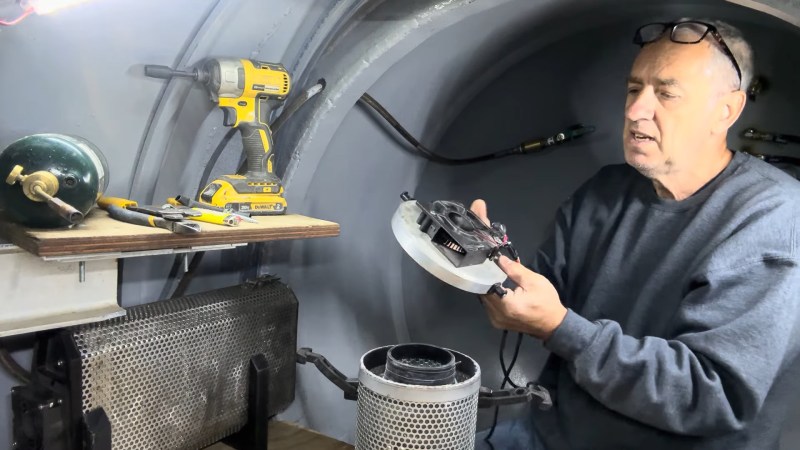
If you look around your environment, you can probably pick off quite a few things that you’ve made, at least if you’ve been at this a while. You probably aren’t reading this from the bottom of a body of water though, which means you lack the incredible confidence of submarine builder [Hank Pronk]. Not only is he building himself a capable-looking diesel-electric submarine over on YouTube, he’s even DIYing CO2 scrubbers for it! Yeah, that’s a man who believes in himself.
Luckily [Hank] is not anywhere near the Caribbean, so needn’t worry about being misidentified as a narco-sub, but he still has to be concerned about his oxygen supply when tooling around beneath the local lakes. Perhaps more important than the oxygen supply in a sub is the build up of CO2. It doesn’t matter how many oxygen tanks you bring down with you if you can’t scrub CO2 out of the air to make room for it. Just like the Apollo missions, he’s using a chemical adsorbent to take carbon dioxide out of the air — and just like Apollo 13, he’s switching from square to round.
Or, rather, from a rather rectangular commercial model to a DIY little round unit. That’s because he doesn’t need the big scrubber in this sub: being diesel-powered, he expects to spend a lot of time at snorkel depth, where both the pilot and the engines can get clean air through the tube. Dives are expected to be short, and in that use case, too big of a CO2 scrubber is really a waste. If for some reason he gets stuck on the bottom, well, the lake isn’t that deep. He can swim to surface, and has a detailed bailout plan. If he wants to stay under overnight to avoid bailing at night, he’s carrying enough extra adsorbent for that.
There’s a reason almost every submarine we’ve featured on this site over the years is an ROV. It’s not that a homemade submarine is automatically a death trap, but you sure do have to be confident in your design.












So I watched a couple of videos. I one of them he says “you know, a submarine doesn’t care how deep it is. As long as it’s been pressure treated it doesn’t matter if it’s 10 feet or 100 feet.”
Is that right? I don’t want to jump on him because I’m not a submersible engineer but I thought there was a whole thing about hull pressure and all …
I mean 10-100ft maybe but I bet it does care if it’s 10,000ft. 10ft is approximately 19psi and 100ft is 39psi (both rounded) which in small scale context is a lot but in practice here I don’t think it’s that much.
I’m also not getting in a homemade submarine anytime soon so there’s that.
Where do you get 19 psi and 39 psi from? If you go 10x deeper, you would expect 10x the pressure, no?
It’s 1 atm/10m.
10ft: 4.34psi
100ft: 43.35psi
10ft depth is 4.34psig (≈19psi absolute)
100ft depth is 43.35psig (≈58psi absolute)
Wait what? What is psig and how is “absolute psi” not linear with depth?
In reality the pressure is not linear with depth, because a) water is compressible, b) water density changes with temperature which changes (nonlinearly) with depth c) the inside “1 bar” backpressure will drift over a dive without a reference to atmospheric pressure, d) atmospheric pressure above the water changes with weather, e) the submersible actually comresses ans such has less internal volume, but all five effects are neglegible. Generally, 10m of extra depth is 1 bar of extra pressure (100000 pascal = 100000N/m² ~ 1 atm)
IIVQ, psig is psi gauge and psi absolute is compared to an absolute vacuum. Water is effectively incompressible. It takes something like 2200psi to reduce the volume by even 1%. That’s about 5,000 ft depth. Even at the bottom of the Mariana Trench, water is only compressed by about 5%.
i think he is ‘murican. they do things different over there. why use decimal like in currency if you can use a completely obvious non coherelt system of units?
//s
Canadian.
Macsimki, there’s a good chance you would also be using a unit with decimals because metric atmospheric pressure is 101.325 kPa and 1.01 bar.
Ummm. 10ft is a bit under one third of a bar– maybe 4.5PSI– in freshwater. 100ft (30m) is about 3bar (maybe 45PSI) It is linear. A tad higher for oceanwater due to the higher density from the dissolved salt
One bar has a length of 33 9/20 feet, which is about half a chain (66/2 feet), or incidentally exactly one half French chain. The bar as a unit of measurement was introduced by Thomas Jefferson in 1778 and arose out of his practial needs after importing a number of barrels of French chain links. Sadly, the master standard of the bar, the countertop of a tavern in Charlottesville, was lost to a fire in 1832. As you mentioned, 30 feet is three bits short of one bar, which puts the bit at 1 3/20 feet. The cubed bit was briefly used as a volumetric unit for the measurement of barley, equals to roughly 4,28 liters and is quite close to a gallon. I am quite fond of those lovely old units of measurement.
It doesn’t matter how deep as long as it’s been pressure tested to that depth (+safety margin)
i would guess that he’s just saying the internal atmospheric pressure doesn’t change much no matter how deep you go, up until your pressure hull fails
Ah, I watched the video. To me he says “as long as it’s been pressure tested” which makes sense.
Meaning if you’ve pressure tested the submarine for operation at 100feet, it doesn’t behave any differently at any depth in it’s operational range.
Honestly, the scrubber is probably pretty low on the list of things to worry about DIY-ing on a homemade sub. Pretty low tech, hard to screw up, and well-trod territory: everything from tourist submarines, personal rebreather SCUBA gear, and all the way up to the Dragon Crew capsule use it.
You really need to be able to measure the CO2 and O2 levels though, so you can tell when the sorbent is working well/exhausted, or when you need to add O2. The sorbents with colour-change indicator help with the former.
You need to add oxygen to maintain a constant pressure, as removing the CO2 lowers the air pressure. Measuring is a good way to make sure everything is working correctly, but not necessary to control the oxygen. The gas meters we use at work before entering a confined space measure oxygen concentration and there are lots of CO2 meters out there, so it can’t be too hard.
It’s a bad idea to rely just on ambient pressure to estimate oxygen content. There’s only a 10% difference in pressure between “normal” and “unconscious”.
Rebreather oxygen sensors for exactly this purpose are commonly available and only around $100.
On the other hand, even in a small sub of a few cubic meters volume, there’s enough usable oxygen (a few percent of the volume, so say 100 litres) to last you over an hour even without any replenishment: You only use a liter or so (1-2 grams) per minute.
The problem is, you might not notice yourself going hypoxic. You’ll be giggling at the funny blueish color of your fingernails just before you pass out.
There is an amazing recording of a hypoxic pilot contacting Air Traffic Control. His copilot had already passed out. He sounds as if he is having a great time: “Unable to control…airspeed! Unable to control…heading! Unable to control…altitude! Apart from that…everything A-OK!” ATC managed to talk him through getting the aircraft to a lower attitude and you can HEAR him returning to the usual serious individual you expect a pilot to be.
Not only that, but if you are monitoring the CO2 , the consequences of screwing this part up are pretty trivial in the grand scheme. “Oh no, my CO2 is rising too much! I’m doomed to…. Surface from my entirely voluntary leisure dive now.”
Even in the case of a failure where he is stuck underwater, it sounds like the worst result is bailing out of the sub and swimming. Which definitely sucks, but, again, if the CO2 level is monitored appropriately, no failure modes lead to loss of life, limb or eyesight.
In theory, your theory is correct.
In practice things can be very different, even for professionals:
https://en.wikipedia.org/wiki/Johnson_Sea_Link_accident
Entanglement can also mean not being able to bail. Ideally we want 72 hours of reliable life support to give the topside crew time to mount a rescue attempt. When that runs out, you think about bailing.
Bailing is like a data backup, but you have never done a data recovery test. You only depend on it when all else is lost.
Many subs use an altimeter (or other sensitive pressure measurement device). If pressure drops, you need to add more O2, if pressure is increasing, you are either adding too much O2, or your CO2 absorbent has stopped working.
Exhaled CO2 occupies exactly the same volume as the O2 inhaled and used to make it: A pressure gauge won’t increase when the CO2 absorbent stops working. (in actuality, the pressure will decrease somewhat because some of that inhaled oxygen got burned to make water too, which will tend to condense out on the walls).
In a sealed chamber, even a temperature change can cause a pressure change of the same magnitude as the difference between an atmosphere that you can be alert in, and one so oxygen deficient that it makes you incapable of thinking straight, or simply unconscious.
A pressure gauge alone is a cheap but imprecise and really dumb way to estimate your breathing air’s oxygen content.
“A pressure gauge won’t increase when the CO2 absorbent stops working.”
You are still adding O2 (usually fixed at around 1.5L to 2L per minute, per person, under normal conditions), so the pressure will go up once the scrubber stops removing CO2. (You are measure the exhaled CO2 + added O2).
“temperature change can cause a pressure change”
Usually you zero the altimeter right at or after the start of the dive so the sub pretty much at temperature. You could compensate for pressure vessel temperature as well.
“A pressure gauge alone is a cheap but imprecise and really dumb way to estimate your breathing air’s oxygen content.”
Not really dumb, not particularly imprecise. Also it is commonly used, often in conjunction with CO2 and O2 sensors, but sometimes not. Also, calling it “really dump” leads me to believe you don’t have any experience with manned submersibles.
Also worth calling out that humans have pretty good built in CO2 sensors. You know when CO2 is getting high long before you get into the danger zone. Some subs don’t have life support and just do SAR (Surface And Replenish). Basically just surface and open the hatch when things feel stuffy.
I would like to retracted the “leads me to believe you don’t have any experience with manned submersibles”, it doesn’t add anything. Your other post demonstrated an above average knowledge of small submersibles.
I’m not sure that it’s actually the case that the inhaled volume of O2 is the same as the exhaled volume of CO2. A while ago I was working on functionally the same problem as OP, except for a space/environment suit. The problem with the volume question is that there doesn’t seem to be a lot of consensus, and the only paper I could find was in the “Indoor Air – The International Journal of Indoor Environment and Health”. You can find it here: https://pmc.ncbi.nlm.nih.gov/articles/PMC5666301/
The paper has a lot of formulas for estimating metabolic functions, but the really interesting thing is that O2/CO2 volume (called the Respiratory Quotient) is determined by your diet
In theory, volume aside, considering mass, you breathe out more than you breathe in.
That carbon has to come from somewhere. Your body burning sugar for example. It takes up a lot more room as a gas.
It begs the question about long term pressure relief on subs that stay under for years at a time with hundreds of people onboard.
@CRJEEA
The CO2 (and carbon) is removed from the atmosphere in the pressure vessel. So there is no pressure build up. The effective O2 and CO2 levels stay constant, with additional O2 being added and excess CO2 being removed at the rates of consumption and expulsion.
@Tobias
Yes, metabolic functions and diet affect affects the radio of CO2 produced. Ranging from 0.7 to 1.0 liters of CO2 for 1 liter of O2.
Note, if you run a sub without any life support system (no CO2 scrubber, no O2 added), the sub have a slight negative pressure. This could make the hatch difficult to open when back on the surface, and one of the reasons subs need a pressure relieve valve.
The whole reason I didn’t join the Navy!
I see no reason why home made would equal deathtrap. If engineer can build it in a factory an engineer could build it at home. Knowledge is not bound to geography. Would I step in one. Hell no. Not even a “real” one if I can prevent it. But I do believe that if the man has done the calculations there is little reason his cannot be just as safe as the “real” deal.
Provided the engineer uses well tested techniques, proper quality control etc., you’re right.
We had a guy building his own sub, which worked down to about 30 m. I knew the guy (built rockets with him), and I would never set foot inside anything, he built.
(He ended up disassembling a Swedish journalist)
Are you saying he became a murderer?
https://en.wikipedia.org/wiki/Murder_of_Kim_Wall
Oh my!!