
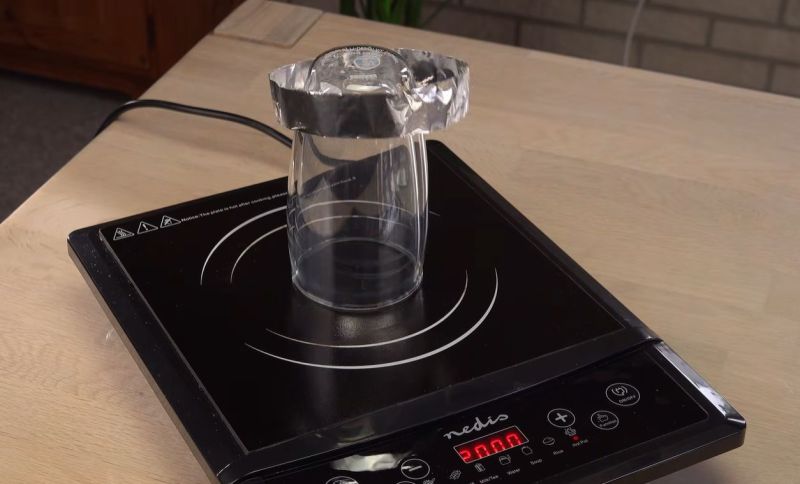
Adding another item on the list of things you probably shouldn’t be trying at home, we got [Brainiac75] giving magnetic levitation a shot using an unmodified induction cooktop and aluminium foil. Although not ferromagnetic, it turns out that aluminium can be made to do interesting things in the magnetic field created by the powerful electromagnet that underlies the induction principle.
Interestingly, although there’s a detection circuit in these units that should detect the presence of an appropriate (ferromagnetic) object, it appears that even a thin sheet of aluminium foil can completely deceive it. The effect is that of a force pushing the foil away from the cooktop’s surface, with foil areas that remain close enough to the ferrite bars on the electromagnet even heating up enough to begin melting the aluminium.
After a bit of fun with various shapes and types of aluminium objects, the video moves on to a scientific explanation of what’s going on. The surface resistivity of the foil is similar enough to ferromagnetic cookware that it fools the sensor, after which the skin effect of aluminium induces a current. This then does the typical Lorentz force things.











In the 1970s there was a machine at the Smithsonian, you put a quarter (25 cent piece) in the slot and it would crush an aluminum can with a magnetic field.
The key question is: does the induction hob remain unmodified, or does this risk a permanent and destructive modification?
Because ever since we got one I’ve wondered if it could be coaxed into serving other duties, such as an induction forge…
But I’m definitely not trying for risk of breaking it!
I am 99% sure its an unmodified induction stove. I too have noticed it happen when I tried to heat food by wrapping it in aluminium foil and putting it on the stove. It works fine, but also tends to make aluminium foil float away
I’d like to hear more about the 25 cent machine at the Smithsonian. I was saddened to find out that that is an offensive topic.
I use mine to heat baked beans etc in the tin and if I need a bowl of hot water I just dump a metre of galv chain in the bowl and off we go to wash the car.
Foil works on our cook top no problem. Found out by mistake when I turned on the wrong dial while a gingerbread house was sat atop a ring on a foiled cake board. Thankfully I caught it fast (within a couple of seconds) but that was enough to cause smoke and burn marks on the foil.
Cool fact: at the operating frequency of a typical cooktop, “heavy duty” aluminum foil looks roughly like an iron sheet, as far as the reflected impedance at the coil is concerned. It doesn’t have the low resistance of bulk metal, it’s less than a skin depth; in this regime, foil thickness and bulk resistivity can be approximated as an infinitesimal sheet of some “resistance per square”.
The same is true of 0.5-2oz copper foil for PCBs, at same or somewhat lower frequency (10-30kHz) — handy if you ever have the need to heat a board (substantially solid i.e. large ground planes, or blank copper clad) somewhat evenly through.
Which, for the impedance, and power levels required (10s W), is one of the easier induction demos to breadboard. It can have some practical value, say if you need to tin a bunch of copper-clad for prototypes; just whip together an oscillator, driver and MOSFETs. Q is low, and the range of load condition is pretty modest, making fixed-frequency control not much of a problem. Coil can be a modest size E-core, open faced, one or two dozen turns being good enough for a 9-24V operating range (give or take desired power level, and what turns exactly you put on there).
My induction stove is not fooled by aluminum foil