
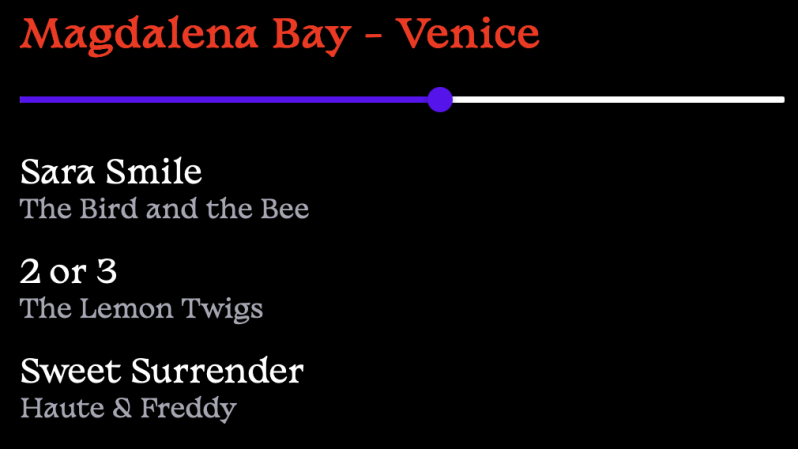
Mixtapes used to be a way that we cultivated a personal selection of music for our own enjoyment, or to give as gifts to those we wanted to impress with a personal touch. These days, we’d typically try that with a playlist, but it’s less romantic despite also being more ephemeral. Songs fall off streaming services all the time, and few of us have the exact same subscriptions as those we’re trying to flirt with. Thus, [Hunter Irving] whipped up a more lasting solution for this modern age.
The concept is simple—it’s a collection of songs that are packaged together in a easily portable format that won’t disappear because of corporate bureaucratic nonsense. [Hunter] has termed their project Mixapps—because it’s a method of sharing music based around Progressive Web Apps (PWA). To create a custom mix, you start by running a Python script, which will then let you add tracks and reorder them as you desire. From there, you run a second script that builds the web app for you.
You can then upload the prepared app directory to a web host to share it with anyone you like. They can then save the PWA to the home screen of their mobile device, where it will live happily ever after. There’s no need to keep hosting the app online or for the user to remain connected to the Internet; everything is self contained on their device. If you’re curious, there’s a demo you can check out online.
It’s worth noting that there are intellectual property concerns to be had as with any form of music sharing, but what else is new? We’ve explored the magic of mixtapes in the past, anyway, to be sure. If you’re finding new ways to trade music and playlists, romantically or platonically, don’t hesitate to let us know.












My brother in law is a pro musician struggling on the meager income he gets from Spotify etc. I’ve sure he would be thrilled to read this article (NOT).
Maybe the problem is Spotify not paying artists properly.
70% of the revenue is going to the artists. Considering Spotify has a ton of employees, datacenters etc, that’s actually impressive. I expect it to be 40% or less but I just looked it up and it’s 70%.
So Spotify is paying the artists properly.
My brother in law says Spotify has been really good for him.
Who cares?
Hang on… I’m confused.
How is this any better than just sharing an MP3 file?
Have we lost the ability to play a local file or something?
Unlike a folder of MP3 files, this approach:
– preserves your track ordering
– bundles with a player, so your recipient doesn’t have to do any file management (which is often inconvenient on mobile – how do i unzip files on iOS?)
You could include some metadata in your folder of MP3s, but then you’re counting on your recipient’s audio player of choice understanding and respecting that metadata.
The PWA approach also unlocks personalization opportunities with a line or two of CSS.
Nonsense:
– track ordering stays in a .m3u (or .pls) file, as usual (and with metadata: EXTINF tags)
– don’t have to zip mp3 files : they are already compressed
The zip file is just a convenient container that most if not all file managers already understand.
media container formats exist. sticking a bunch of files in a zip file seems antiquated even by mp3 standards. mp3 can also contain arbitrary user defined tags so you can concatenate a bunch of files and put in a cue sheet. i think thats what audiobooks do.
Yet we do it every day, like downloading a folder off of Teams – comes in a zip container. Nothing wrong about it.
The problem is iOS, not mobile. Moving photos/videos on,/off the iOS camera roll or into folders, is just as cryptic. File management is just as easy on Android as it is in Windows etc.
Well, with the right tools. Stock file viewer is a poor manager.
File management on Android is a mess of permissions that has changed every time I go to do something theoretically simple like run SCUMM. I have to Google to find what folder is allowed to be accessed and what new name the permission has that lets the app see the folder or storage at all.
out of the box? cleaaaarly nope, these 3 platforms suck at it and volontary, to sell their cloud storage BS.
iOS is the most offensive platform about filemanagement, though.
You can simply name your files starting with 1, 2, 3 ….
Or 1, 11, 12, 13 . . . 19, 2, 20, 21, 22, 23 . . . (Yes, this is how some file managers list numerically ordered files.)
Which actually makes sense, since a file name isn’t a number and the file manager doesn’t know what you mean by it.
So you use 00, 01, 02 …. 99 and that ought to work for all of them.
Do I really want to have embedded executable code in a media file sent by some random person, and actually run it on my device?
That’s the oldest scam on the internet. Just download this music.exe file to listen to the track.
To be fair, it’s not really an executable, but client-side HTML, CSS, and JavaScript, running in a web browser (with all the protections that affords). The code is simple and open-source if you’d like to audit it. And presumably you wouldn’t be installing these from strangers, but rather people you know and trust.
Grandma sent me an email saying “Hi, I hope you like this music list I made, [click here].” Then she called me and said her email was hacked.
I’m still concerned the phone call might be be an AI spoof.
Like downloading the actual malicious payload and then requesting you to run it, the same as you just did in good faith with the music player.
You just described an app, do you avoid all apps?
As much as possible. I hate it when I’m forced to install an app due to some stupid company’s shitty practices. (Like “Text boarding pass to phone”. But went you need to install the airline’s app to view the boarding pass, required for boarding…).
But, yes, avoid all apps as much as you can.
Like all parking getting switched to a phone app and removing the ticket machines or any means to pay normally. When you try to find parking you have to guess which one of the twenty different companies it is, download yet another app, and figure out how to use it on the spot. Next time you come to the same spot, it’ll be a different company and a different app.
@Dude
Re: Parking Apps
Also let’s not forget about the scammers posting QR codes around the parking lot leading to fake Parking Apps/websites…
The parking app situation has lead to a strange side effect: if you ask a company “Where are your guest parking spots?” – they don’t actually know because they’ve outsourced the management to a private company and the information is ONLY available through their parking app.
So you get to install yet another app on your phone….
“Tap the ZIP file or archive. A folder is created containing the files.”
– support.apple.com
The thing is, there is no universal standard for playlist sharing, but it would be simpler to merge the songs into a single mp3 file
Yes there is. You name your files in the order they’re intended to play, then sort by file name.
Merging the songs into a single file loses the names and individual metadata, and makes it difficult to play just one.
THIS.
Just merge the songs into one mp3 file.
Preserves order, etc…
Stop using extra technology where none is needed.
That is the true hack.
Plus ID3 tags can be used to put “chapter” markers in an MP3 file, so you can still skip between tracks in a single file.
Needed if one is doing trance mixes for example. A lot don’t however.
Sure is.
Instantly what I thought. It is dumb this even has to exist. Just use mixdrop or make an mp3 and put it up on dropbox or heaven forbid your Drive/iCloud. I will be over here adjusting the onion on my belt I guess. It is funny too I have literally used spotify twice. Once when it came out to compare against pandora, and again two years ago because our cable box had it for free. Anyway it does fine without me and I do fine without it so ships in the night and more for others to enjoy. It is one of the worst platforms though in terms of bot army and industry manipulation from the things I read.
I think this is just wonderful!
Thank for checking it out! It’s definitely a niche idea, but I’m glad it seems to be finding its audience :-)
unlike most people i still maintain a local mp3 collection. i still use winamp (even on linux). i guess this is for people who dont remember the good old days when you had control over your data (and which frankly never ended if you make good software choices).
I see it as something for both the people who don’t remember those good old days, and for those who do. This project was largely inspired by my nostalgia for making mix CDs (and the occasional mixtape) and sharing them with friends. I still have the hardware to play them, but none of my friends do, so I improvised, adapted, and overcame.
Since you need local audio files to make mixapps, I’ve switched almost entirely to locally-served music. It’s nice to not have to rely on streaming platforms, and artists get a much greater payout when you buy their stuff, so I see it as a win-win (for eveyone but Spotify and friends).
“ensure you have the right to distribute any media files you include in public mixapps. personal archival backups are for your own use. sharing them with others, even as a gift, is not covered by fair use or backup exceptions.”
You know full when that people will use this repo for illegal purposes. Shame on you. Doing it for your own curiosity and use is one thing, but to allow wholesale exploitation of musicians who worked hard to create their tracks is another. Please do the right thing and make this repo private.
The current IP model exploits the listeners by forcibly renting rather than selling the work of musicians.
The present copyright system enables the IP organizations, labels, media corporations, distribution platforms etc. to extract unlimited rent with only limited payments to the original authors.
This rent collection is unjustified and arbitrary, based only on the legal fiction that intellectual property is like real property with value and scarcity like real objects, while actually being entirely virtual and unlimited. Alternatively, it’s the argument that the subjective value derived by the listeners belongs to the owner of the intellectual property right, and therefore should be paid for. It’s like the argument that the blacksmith who made the hammer owns the house that the carpenter built with that hammer.
Copyright is based on obvious nonsense. The value of any creative labor that belongs to the author is in the making of the thing, not in the distribution or the consumption. “Piracy” is not exploiting the musicians. The musicians are being exploited on the point where they sign a contract with a music label and sign away their IP rights to get access to distribution channels like Spotify.
To put a finer point on it: while the popularity, quality and quantity of work, influences how much people are willling to pay an artist, the real value of their work is nevertheless undefined in these terms. Subjective value is created by the audience, not the artist, so the artist has no claim over how much anyone likes their work.
The artist can only claim value based on how much money they need to make that thing exist. Paying less means the thing won’t exist, while demanding more would be exploiting the audience. The artist may be able to hold their work at ransom, people can also choose to pay more by charity, but that’s a different negotiation between the artist and their audience.
In simple terms, how much people are willing to pay doesn’t truly determine the value of art. If it did, prices would not be grounded to anything. Some people take that backwards to argue that because you can ask for anything and get it, you’re justified in doing so – which is how we get to the point of the IP industry:
The Copyright industry and the intellectual property system is about demanding more than you are truly owed, many times over the actual value you’re providing, without ever having to negotiate for it. It works by splitting the payment into seemingly insignificant or invisible portions, mandatory royalties and license payments, over billions of people who are not aware of the total cost or the fact that they’re even paying it. The public can be made to pay thousands or millions of times over the real value of the work, under the premise that each person truly has a moral obligation to pay into this system without a reasonable argument that they actually do.
Because the industry doesn’t value the art itself, only the money it can make, they don’t pay the artists in proportion: they pay only enough to get the job done. Often less, by tricking you into debt. If you don’t sign the contract, they pick someone else and you’re left alone trying to defend your copyright with no money and no power. A handful of superstars get extra to keep up the illusion that you can become rich by selling your rights to the industry, though these superstars are deliberate projects constructed and propped up by the labels at the exclusion of others. This system has nothing to do with rights or morals, it’s about exploiting both sides of the deal. It’s a legalized parasite on the society.
At least they get paid something, even if it’s not very much. This Hunter Irving guy wont pay them anything so it’s complete theft. Make him no better than your average criminal.
Stockholm syndrome, like living under Feudalism as a slave to the land and owned by aristocracy, “At least the lords protect us from the marauders…”
The payment issue is solved otherwise, by other business models than claiming imaginary rights and collecting rent on the distribution. Creative labor and distribution are distinct enterprises that each deserve their rewards, but one should not mix up the two and pay for the wrong thing under false premises because that leads to unfair and unjustified compensation – both over and under of what is actually deserved.
Why would he? Is he the one doing the thieving, or somehow responsible for other people?
Remember, if buying cannot result in ownership, then copying cannot result in theft – because there’s actually nothing to buy and nothing to take.
Lol, wtf? Helping people make shareable mixtapes is a metaphysical DMCA violation now? Where does this insanity come from? It isn’t the creator’s business how people use it, and furthermore there’s absolutely nothing wrong with sharing music without Big Brother’s permission.
The music industry has seen this all before. Creating a mixtape yourself for a loved one was, and still is, a relatively innocent thing to do, but this guy is enabling wholesale theft through automation. Rest assured, he will attract the attention of the authorities at some stage and he will be fined for loss of musicians earnings.
Pure delusion. Do you understand this program doesn’t even download any music?
The way I understand it is that the user downloads or rips tracks from spotify / youtube music etc, bundles them up into a playlist, then uploads them onto a server with this software where anybody can then access it and play it / download it to their local PC or phone without paying anything to the artists. Mix tapes used to be cute because they were a nice one-to-one gift. Back in the day, criminals also created bootlegs / mix tapes and sold them in flea markets. Nothing cute about criminal gangs selling those tapes. There’s nothing cute about this software either – it’s enabling whole sale theft.
Uh, yeah, that’s why download em.
What, no AI in there? How are they going to avoid copyright laws without it?
My ex and I exchanged mixtapes similarly. She made one with ncurses and I made one with winamp in a windows VM. Not sure a python-based PWA is much less ephemeral, but it’s certainly more accessible.
Just concatenate the files into one.
It also resembles the linear format of a mixtape much better. No metadata, no jump marks, no shuffle.